Kerbal Space Program Goes To The Movies In Stowaway

Fans of the lusciously voiced space aficionado [Scott Manley] will know he often uses Kerbal Space Program (KSP) in his videos to knock together simple demonstrations of blindingly complex topics such as orbital mechanics. But as revealed in one of his recent videos, YouTube isn’t the only place where his KSP craft can be found these days. It turns out he used his virtual rocket building skills to help the creators of Netflix’s Stowaway develop a realistic portrayal of a crewed spacecraft in a Mars cycler orbit.

The Mars cycler concept was proposed in 1985 by Buzz Aldrin as a way to establish a long-term human presence on the Red Planet. Put simply, it describes an orbit that would allow a vehicle to travel continuously between Earth and Mars while needing only an occasional engine burn for course corrections. The spacecraft couldn’t actually stop at either planet, but while it made a close pass, smaller craft could rendezvous with it to hitch a ride. The concept can be thought of as a sort of interplanetary train: where passengers and cargo are picked up and dropped off at “stations” above Earth and Mars. It’s worth noting that a similar cycler orbit should be possible for Earth-Venus trips, but nobody really wants to go there.

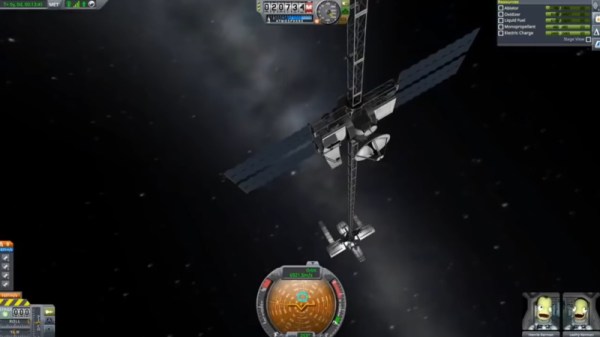
An early KSP proof of concept for Stowaway.

The writers of Stowaway wanted their film to take place on a Mars cycler, and to avoid having to create the illusion of weightlessness, they wanted their fictional craft to also have some kind of artificial gravity. The only problem was, they weren’t sure what that would actually look like. So they reached out to [Scott], who in turn used KSP to throw together a rough idea of how such a ship might work in the real-world.

As you can see in the video below, the CGI spacecraft shown in the film’s recently released trailer ended up bearing a strong resemblance to its KSP prototype. While naturally some artistic license was used, [Scott] is excited by what he’s seen so far. The spinning spacecraft, which uses a spent upper stage to counterbalance its crew module and features a stationery utility node at the center, certainly looks impressive; all the more so with the knowledge that it’s based on sound principles.

While Netflix has had a hand in some surprisingly realistic science fiction in the past, they’ve also greenlit some real groan-worthy productions (if you haven’t watched Away, don’t). So until we can see the whole thing for ourselves, we can only hope that [Scott]’s sage advice will allow the crew of Stowaway to fly safe.

Continue reading “Kerbal Space Program Goes To The Movies In Stowaway

Putting Perseverance Rover’s View Into Satellite View Context

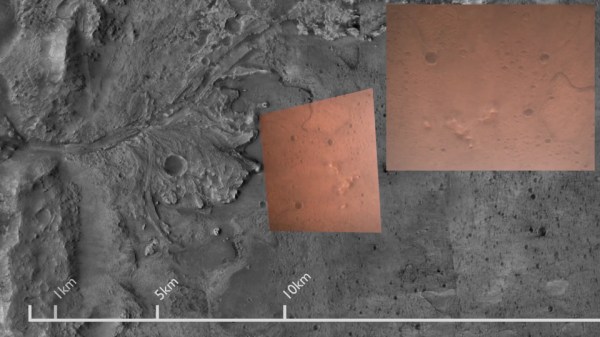
It’s always fun to look over aerial and satellite maps of places we know, seeing a perspective different from our usual ground level view. We lose that context when it’s a place we don’t know by heart. Such as, say, Mars. So [Matthew Earl] sought to give Perseverance rover’s landing video some context by projecting onto orbital imagery from ESA’s Mars Express. The resulting video (embedded below the break) is a fun watch alongside the technical writeup Reprojecting the Perseverance landing footage onto satellite imagery.

Some telemetry of rover position and orientation were transmitted live during the landing process, with the rest recorded and downloaded later. Surprisingly, none of that information was used for this project, which was based entirely on video pixels. This makes the results even more impressive and the techniques more widely applicable to other projects. The foundational piece is SIFT (Scale Invariant Feature Transform), which is one of many tools in the OpenCV toolbox. SIFT found correlations between Perseverance’s video frames and Mars Express orbital image, feeding into a processing pipeline written in Python for results rendered in Blender.

While many elements of this project sound enticing for applications in robot vision, there are a few challenges touched upon in the “Final Touches” section of the writeup. The falling heatshield interfered with automated tracking, implying this process will need help to properly understand dynamically changing environments. Furthermore, it does not seem to run fast enough for a robot’s real-time needs. But at first glance, these problems are not fundamental. They merely await some motivated people to tackle in the future.

This process bears some superficial similarities to projection mapping, which is a category of projects we’ve featured on these pages. Except everything is reversed (camera instead of video projector, etc.) making the math an entirely different can of worms. But if projection mapping sounds more to your interest, here is a starting point.

[via Dr. Tanya Harrison @TanyaOfMars]

Continue reading “Putting Perseverance Rover’s View Into Satellite View Context”

A Technical (But Not Too Technical) Explanation Of Landing Perseverance Rover On Mars

There was a lot of enthusiasm surrounding Mars arrival of Perseverance rover, our latest robotic interplanetary explorer. Eager to capitalize on this excitement, NASA JPL released a lot of information to satisfy curiosity of the general public. But making that material widely accessible also meant leaving out many technical details. People who crave just a little more can head over to How NASA’s Perseverance Landed On Mars: An Aerospace Engineer Breaks It Down In Fascinating Detail published by Jalopnik.

NASA JPL’s public materials mostly explained the mission in general terms. Even parts with scientific detail were largely constrained for a target audience of students K-12. Anyone craving more details can certainly find them online, but they would quickly find themselves mired in highly technical papers written by aerospace engineers and planetary geologists for their peers. There is a gap in between those extremes, and this write-up slots neatly in that gap. Author [Brian Kirby] is our helpful aerospace engineer who compiled many technical references into a single narrative of the landing, explained at a level roughly equivalent to undergraduate level math and science courses.

We get more details on why the target landing site is both geologically interesting and technically treacherous, requiring development of new landing smarts that will undoubtedly help future explorers both robotic and human. The complex multi-step transition from orbit to surface is explained in terms of managing kinetic energy. Condensing a wide range of problems to a list of numbers that helps us understand why, for example, a parachute was necessary yet not enough to take a rover all the way to the surface.

Much of this information is known to longtime enthusiasts, but we all had to get our start somewhere. This is a good on-ramp for a new generation of space fans, and together we look forward to Perseverance running down its long and exciting to-do list. Including flying a helicopter, packing up surface samples of Mars, and seeing if we can extract usable oxygen from Martian atmosphere.

Got Oxygen? Future Mars Missions Are Relying On The MOXIE Of Perseverance

The rule of thumb with planetary exploration so far has been, “What goes up, stays up.” With the exception of the Moon and a precious few sample return missions to asteroids and comets, once a spacecraft heads out, it’s never seen again, either permanently plying the void of interplanetary or interstellar space, or living out eternity on the surface of some planet, whether as a monument to the successful mission that got it there or the twisted wreckage of a good attempt.

At the risk of jinxing things, all signs point to us getting the trip to Mars reduced to practice, which makes a crewed mission to Mars something that can start turning from a dream to a plan. But despite what some hardcore Martian-wannabees say, pretty much everyone who goes to Mars is going to want to at least have the option of returning, and the logistical problems with that are legion. Chief among them will be the need for propellants to make the return trip. Lugging them from Earth would be difficult, to say the least, but if an instrument the size of a car battery that hitched a ride to Mars on Perseverance has anything to say about it, future astronauts might just be making their own propellants, literally pulling them out of thin air.

Continue reading “Got Oxygen? Future Mars Missions Are Relying On The MOXIE Of Perseverance”

Sea Level: How Do We Measure Global Ocean Levels And Do Rising Oceans Change That Benchmark?

Every summer you go down the shore, but lately you’ve begun to notice that the beach seems narrower each time you visit. Is that the sea level rising, or is the sand just being swept away? Speaking of sea levels, you keep hearing that they rise higher every year — but how exactly is that measured? After all, you can’t exactly use a ruler. As it turns out, there are a number of clever systems in place that can accurately measure the global sea level down to less than an inch and a half.

Not only are waves always rippling across the ocean’s surface, but tides periodically roll in and out, making any single instantaneous measurement of sea level hopelessly inaccurate. Even if you plan to take hundreds or thousands of measurements over the course of weeks or months, taking the individual measurements is still difficult. Pick a nice, stable rock in the surf, mark a line on it, and return every hour for two weeks to hold a tape measure up to it. At best you’ll get within six inches on each reading, no matter what you’ll get wet, and at worst the rock will move and you’ll get a damp notebook full of useless numbers. So let’s take a look at how the pros do it.

Continue reading “Sea Level: How Do We Measure Global Ocean Levels And Do Rising Oceans Change That Benchmark?”

NASA’s Perseverance Rover Makes Its First Martian Tracks

There’s a special kind of anxiety that comes from trying out a robotic project for the first time. No matter the size, complexity, or how much design and planning has gone into it, the first time a creation moves under its own power can put butterflies in anyone’s stomach. So we can imagine that many people at NASA are breathing a sigh of relief now that the Perseverance rover has completed its first successful test drive on Mars.

To be fair, Perseverance was tested here on Earth before launch. However, this is the first drive since the roving scientific platform was packed into a capsule, set on top of a rocket, and flung hundreds of millions of miles (or kilometers, take your pick) to the surface of another planet. As such, and true to NASA form, the operators are taking things slow.

This joyride certainly won’t be setting speed records. The atomic-powered vehicle traveled a total of just 21.3 feet (6.5 meters) in 33 minutes, including forward, reverse, and a 150 degree turn in-between. That’s enough for the mobility team to check out the drive systems and deem the vehicle worthy of excursions that could range 656 feet (200 meters) or more. Perseverance is packed with new technology, including an autonomous navigation system for avoiding hazards without waiting for round-trip communication with Earth, and everything must be tested before being put into full use.

A couple weeks have passed since the world was captivated by actual video of the rover’s entry, descent, and landing, and milestones like this mark the end of that flashy, rocket-powered skycrane period and the beginning of a more settled-in period, where the team works day-to-day in pursuit of the mission’s science goals. The robotic arm and several on-board sensors and experiments have already completed their initial checks. In the coming months, we can look forward to tons of data coming back from the red planet, along with breathtaking pictures of its alien surface and what will hopefully be the first aircraft flown on another world.

A Look At The “Risky” Tech In NASA’s Martian Helicopter

On February 18th, the Perseverance rover safely touched down on the Martian surface. In the coming days and weeks, the wide array of instruments and scientific payloads tucked aboard the robotic explorer will spring to life; allowing us to learn more about the Red Planet. With a little luck, it may even bring us closer to determining if Mars once harbored life as we know it.

Among all of the pieces of equipment aboard the rover, one of the most intriguing must certainly be Ingenuity. This small helicopter will become the first true aircraft to take off and fly on another planet, and in a recent interview with IEEE Spectrum, operations lead [Tim Canham] shared some fascinating details about the vehicle and some of the unorthodox decisions that went into its design.

Ingenuity’s downward facing sensors.

[Tim] explains that, as a technology demonstrator, the team was allowed to take far more risks in developing Ingenuity than they would have been able to otherwise. Rather than sticking with legacy hardware and software, they were free to explore newer and less proven technology.

That included off-the-shelf consumer components, such as a laser altimeter purchased from SparkFun. It also means that the computational power packed into Ingenuity far exceeds that of Perseverance itself, though how well the helicopter’s smartphone-class Snapdragon 801 processor will handle the harsh Martian environment is yet to be seen.

On the software side, we also learn that Ingenuity is making extensive use of open source code. Not only is the onboard computer running Linux, but the vehicle is being controlled by an Apache 2.0 licensed framework developed by NASA’s Jet Propulsion Laboratory for CubeSats and other small spacecraft. The project is available on GitHub for anyone who wants it, and according to the changelog, the fixes and improvements required for the “Mars Helicopter Project” were merged in a few releases ago.

The fact that code currently ticking away on the surface of Mars can be downloaded and implemented into your own DIY project is a revelation that’s not lost on [Tim]. “It’s kind of an open-source victory because we’re flying an open-source operating system and an open-source flight software framework and flying commercial parts that you can buy off the shelf if you wanted to do this yourself someday.”

Of course, it took a whole lot more than some Python libraries and a handful of sensors from SparkFun to design and build the first space-going helicopter. But the fact that even a small slice of the technology inside of a project like Ingenuity is now available to the average hacker and maker is a huge step towards democratizing scientific research here on Earth.

Continue reading “A Look At The “Risky” Tech In NASA’s Martian Helicopter”