Tractor Drives Itself, Thanks To ESP32 And Open Source

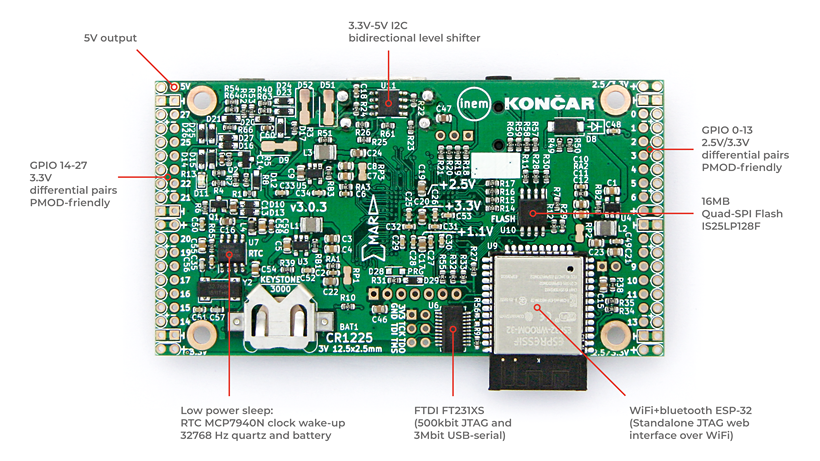
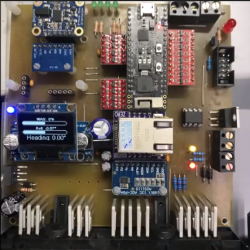
[Coffeetrac]’s ESP32-based Autosteer controller board, complete with OLD OLED display for debugging and easy status reference.
Modern agricultural equipment has come a long way, embracing all kinds of smart features and electronic controls. While some manufacturers would prefer to be the sole gatekeepers of the access to these advanced features, that hasn’t stopped curious and enterprising folks from working on DIY solutions. One such example is this self-steering tractor demo by [Coffeetrac], which demonstrates having a computer plot and guide a tractor through an optimal coverage pattern.

A few different pieces needed to come together to make this all work. At the heart of it all is [Coffeetrac]’s ESP32-based Autosteer controller, which is the hardware that interfaces to the tractor and allows for steering and reading sensors electronically. AgOpenGPS is the software that reads GPS data, interfaces to the Autosteer controller, and tells equipment what to do; it can be thought of as a mission planner.

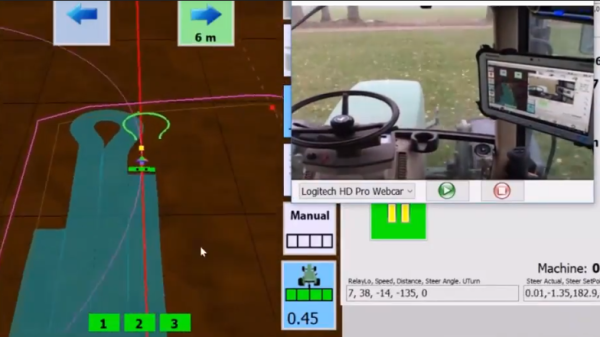
[Coffeetrac] put it all together with everything controlled by a tablet mounted in the tractor’s cab. The video is embedded below, complete with a “cockpit view” via webcam right alongside the plotted course and sensor data.

Continue reading “Tractor Drives Itself, Thanks To ESP32 And Open Source”

Dexter Robotic Arm Wins The 2018 Hackaday Prize

Dexter, an open-source, high-precision, trainable robotic arm has just been named the Grand Prize winner of the 2018 Hackaday Prize. The award for claiming the top place in this nine-month global engineering initiative is $50,000. Four other top winners were also named during this evening’s Hackaday Prize Ceremony, held during the Hackaday Superconference in Pasadena, California.

This year’s Hackaday Prize featured challenges with five different themes. Entrants were asked to show their greatest Open Hardware Design, to build a Robotics Module, to design a Power Harvesting Module, to envision a Human Computer Interface, or to invent a new Musical Instrument. Out of 100 finalists, the top five are covered below. Over $200,000 in cash prizes have been distributed as part of this year’s initiative where thousands of hardware hackers, makers and artists compete to build a better future.

Dexter: High Precision Robotic Arm

Dexter is the Grand Prize winner of the 2018 Hackaday Prize. This remarkable robotic arm design brings many aspects of high-end automation to an open source design which you can utilize and adapt for your own needs. In addition to impressive precision, the design is trainable — you can move the joints of the arm and record the motion for playback.

The image here shows position data from one arm being moved by a human, controlling another arm in real time. Each joint utilizes a clever encoder design made up of a wheel with openings for UV sensors. Sensing is more than merely “on/off”. It tracks the change in light intensity through each opening for even greater granularity. The parallel nature of an FPGA is used to process this positioning data in real time.

Hack a $35 Wearable to Build Mental Health Devices

Manufacturing custom electronics is a tricky, costly, and time-consuming process. What if you could sidestep most of that by starting with a powerful, proven consumer good that is modified to your specifications? This project takes existing fitness trackers and customizes the hardware and software to become sensor suites for mental health research. Dig into this one and see how they can help patients become aware of unconscious behaviors (like trichotillomania which is compulsive hair pulling) and change them over time.

Portal Point Generator

This project focuses on an alternative power source for times when traditional infrastructure is not functioning or simply not available. You may be familiar with generators made using DC motors. The Portal Point Generator replicates that simplicity, but goes beyond with instructions for building the generator itself for far greater efficiency. A winding jig is used to make the coils which are placed inside of the 3D printed generator parts along with permanent magnets to complete the build. Here you can see it in testing as a wind generator in Antarctica, but it is easily adapted to other applications like using water wheels.

EmotiGlass

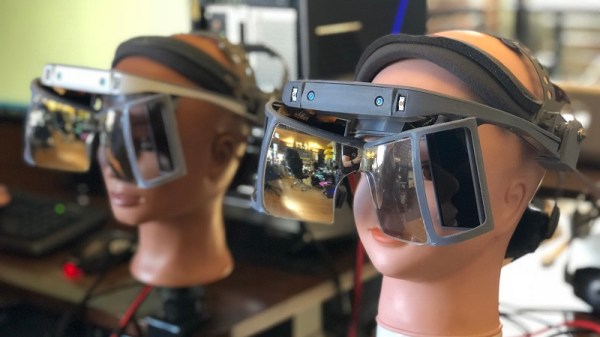
There is a body of research that suggest a link between cardiac cycle and anxiety-producing visuals; you may have a different emotional reaction to the things you see based on what part of a heartbeat is occurring when your brain process information from your eyes. This could have profound implications in areas like PTSD research. EmotiGlass uses LCD screens to selectively block the wearer’s vision. This can be synchronized with heat beat, avoiding the instant where a negative emotional response is most likely. Think of them as 3D shutter glasses for mental health research.

PR-Holonet: Disaster Area Emergency Comms

Recovering from natural disasters is an enormous challenge. The infrastructure that supports the community is no longer in place and traditional communications simply cease to exist. PR-Holonet was inspired by the recovery process after hurricanes in Puerto Rico. It leverages the availability of commercial electronics, solar power sources, and enclosures to build a communications system that can be deployed and operated without the need for specialized training. Once in place, local devices using WiFi can utilize text-based communications transferred via satellite.

Congratulations to all who entered the 2018 Hackaday Prize. Taking time to apply your skill and experience to making the world better is a noble pursuit. It doesn’t end with the awarding of a prize. We have the ability to change lives by supporting one another, improving on great ideas, and sharing the calling to Build Something that Matters.

FIDO2 Authentication In All The Colors

Here at Hackaday, we have a soft spot for security dongles. When a new two-factor-authentication dongle is open source, uses USB and NFC, and supports FIDO2, the newest 2FA standard, we take notice. That just happens to be exactly what [Conor Patrick] is funding on Kickstarter.

We’ve looked at [Conor]’s first generation hardware key, and the process of going from design to physical product.  With that track record, the Solo security key promises to be more than the vaporware that plagues crowdfunding services.

Another player, Yubikey, has also recently announced a new product that supports FIDO2 and NFC. While Yubikey has stepped away from their early open source policy, Solo is embracing the open source ethos. The Kickstarter promises the release of both the software and hardware design as fully open, using MIT and CC BY-SA licenses.

For more information, see the blog post detailing the project goals and initial design process.  As always, caveat emptor, but this seems to be a crowdfunding project worth taking a look at.

Can You “Take Back” Open Source Code?

It seems a simple enough concept for anyone who’s spent some time hacking on open source code: once you release something as open source, it’s open for good. Sure the developer might decide that future versions of the project close up the source, it’s been known to happen occasionally, but what’s already out there publicly can never be recalled. The Internet doesn’t have a “Delete” button, and once you’ve published your source code and let potentially millions of people download it, there’s no putting the Genie back in the bottle.

But what happens if there are extenuating circumstances? What if the project turns into something you no longer want to be a part of? Perhaps you submitted your code to a project with a specific understanding of how it was to be used, and then the rules changed. Or maybe you’ve been personally banned from a project, and yet the maintainers of said project have no problem letting your sizable code contributions stick around even after you’ve been kicked to the curb?

Due to what some perceive as a forced change in the Linux Code of Conduct, these are the questions being asked by some of the developers of the world’s preeminent open source project. It’s a situation which the open source community has rarely had to deal with, and certainly never on a project of this magnitude.

Is it truly possible to “take back” source code submitted to a project that’s released under a free and open source license such as the GPL? If so, what are the ramifications? What happens if it’s determined that the literally billions of devices running the Linux kernel are doing so in violation of a single developer’s copyright? These questions are of grave importance to the Internet and arguably our way of life. But the answers aren’t as easy to come by as you might think.

Continue reading “Can You “Take Back” Open Source Code?”

Wood Shines In This SCARA Robotic Arm Project

[igarrido] has shared a project that’s been in the works for a long time now; a wooden desktop robotic arm, named Virk I. The wood is Australian Blackwood and looks gorgeous. [igarrido] is clear that it is a side project, but has decided to try producing a small run of eight units to try to gauge interest in the design. He has been busy cutting the parts and assembling in his spare time.

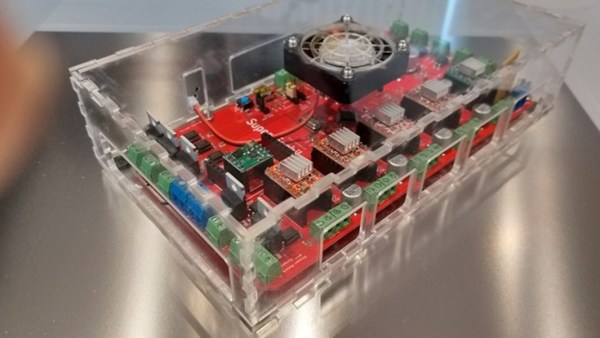
Besides the beautifully finished wood, some of the interesting elements include hollow rotary joints, which mean less cable clutter and a much tidier assembly. 3D printer drivers are a common go-to for CNC designs, and the Virk I is no different. The prototype is driven by a RAMPS 1.4 board, but [igarrido] explains that while this does the job for moving the joints, it’s not ideal. To be truly useful, a driver would need to have SCARA kinematic support, which he says that to his knowledge is something no open source 3D printer driver offers. Without such a driver, the software has no concept of how the joints physically relate to one another, which is needed to make unified and coherent movements. As a result, users must control motors and joints individually, instead of being able to direct the arm as a whole to move to specific coordinates. Still, Virk I might be what’s needed to get that development going. A video of some test movements is embedded below, showing how everything works so far.

Continue reading “Wood Shines In This SCARA Robotic Arm Project”

This Hackable Phone Makes WiFi Calls.

Over the years, we’ve seen dozens of projects that sell themselves as an ‘Open Source’ cellphone, a hackable cellphone, or some other confabulation of a microcontroller, screen, and a cellular module. The WiPhone is not one of these projects. That’s not to say it’s not an Open Source phone that’s intended to be hackable. No, this is a DIY phone that doesn’t make cellular calls, because this is a phone that only works with SIP and VoIP apps. It’s a WiPhone, and something a lot of us have been waiting for.

The hardware for this WiFi enabled phone is extremely minimal, but there are some interesting tricks up its sleeve. Instead of letting the main microcontroller handle capturing all the button presses, the team behind the WiPhone are using a SN7326 key-scan controller. This cheap part is able to scan 64 buttons, although there are only 25 buttons on the phone. The audio board is a  WM8750BL, a cheap codec with a stereo microphone interface and a 400 mW speaker driver. The display is a simple SPI TFT, and apart from the microcontroller, that’s about it.

But it’s the microcontroller that makes it, and for that we turn to the incredible ESP-32. This chip has enough power to play Doom, be a Game Boy, and in this case, make and receive calls from a VoIP provider, scan and connect to WiFi networks, and yes, it can even play snake.

While this is just about the simplest phone you can imagine, and it only works where there’s a WiFi network, a device like this could be invaluable. And really, these days how far are you from a WiFi network you’re already connected to anyway?

Retro-uC, Your Favorite Instruction Sets On Custom Silicon

A few months ago, we caught wind of an interesting project in Big-O Open silicon. It’s a chip, loaded up with the great CPU cores of yore. Now, it’s finally a project on Crowd Supply. The Retro-uC project is an Open Source microcontroller for the retro geek, with a Zilog Z80, MOS 6502, and Motorola 68000 buried in the epoxy of a single QFP package. Oh yes, custom silicon and retro goodness, what more could you want?

The Retro-uC project is part of the Chips4Makers project to develop an Open Source chip for the community. Of course, this has been done before with projects like the HiFive1 and other RISC-V implementations, but really — this is a Z80, 6502 and 68k on a single chip. Let’s not bury the lede here.

As far as the architecture and implementation of these cores go, the ‘active’ core is externally selected on reset, or can be changed through the JTAG interface. There are 72 GPIO pins that can handle 5V, with each pin mapped to the address space of the cores. So far, so good. We can make this work for some really cool stuff.

The JTAG interface is used for testing and programming, although programs can be stored on an external I2C Flash chip and booted from there. There is 4kB of on-chip RAM, and while the peripheral configuration is still being determined, there will at least be UART, I2C, and PWM peripherals. How many of each is anyone’s guess.

The Retro-uC is now a Crowd Supply project, with rewards/orders/whatever ranging from a bare Retro-uC chip for $42 USD to an Arduino Mega-ish development platform for $89, a breadboard version of the chip for $59, and a chip mounted to a Perf2+ prototyping board for $65.

While this chip hasn’t even gotten to tape-out, all the cores work on an FPGA, and there is precedent for doing Open Source, crowdfunded silicon. We’re looking at this one closely and are excited to see what everyone is going to make.

This project has been a long time in the making, with the project lead giving a talk at FOSDEM earlier this year. Now it’s finally time for the hard part of any silicon project — getting the money — and we’re looking forward to see what comes of it.