The Robots Of Fukushima: Going Where No Human Has Gone Before (And Lived)

The idea of sending robots into conditions that humans would not survive is a very old concept. Robots don’t heed oxygen, food, or any other myriad of human requirements. They can also be treated as disposable, and they can also be radiation hardened, and they can physically fit into small spaces. And if you just happen to be the owner of a nuclear power plant that’s had multiple meltdowns, you need robots. A lot of them. And [Asianometry] has provided an excellent synopsis of the Robots of Fukushima in the video below the break.

Starting with robots developed for the Three Mile Island incident and then Chernobyl, [Asianometry] goes into the technology and even the politics behind getting robots on the scene, and the crossover between robots destined for space and war, and those destined for cleaning up after a meltdown.

The video goes further into the challenges of putting a robot into a high radiation environment. Also interesting is the state of readiness, or rather the lack thereof, that prompted further domestic innovation.

Obviously, cleaning up a melted down reactor requires highly specialized robots. What’s more, robots that worked on one reactor didn’t work on others, creating the need for yet more custom built machines. The video discusses each, and even touches on future robots that will be needed to fully decommission the Fukushima facility.

For another look at some of the early robots put to work, check out the post “The Fukushima Robot Diaries” which we published over a decade ago.

Continue reading “The Robots Of Fukushima: Going Where No Human Has Gone Before (And Lived)”
Detecting Radiation For Fun And Profit

It used to be that every well-stocked doomsday bunker had a Geiger counter. These days, you don’t have to have a big tube-based meter. You can inexpensively get a compact digital instrument to handle your radiation detection needs. [DiodeGoneWild] reviews and tears down such a unit from FNIRSI. The case looks like several other similar instruments we’ve seen lately, so presumably, someone is mass-producing these handheld meter cases. You can see the video, below. The meter reads the absolute radioactivity and can also measure cumulative exposure.

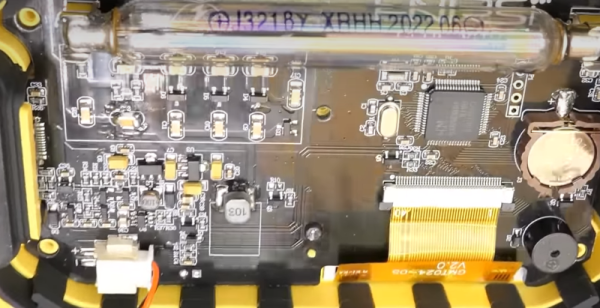
After measuring a few common radioactive items, we get to the teardown. Inside, of course, is an ordinary tube. A few screws reveal a typical rechargeable battery, a fairly simple PCB with a microcontroller and battery backup for the real-time clock. A lot of the board is involved in multiplying voltage up to the several hundred volts required for the Geiger tube.

The other side of the PCB has only buttons, a vibration motor, and, of course, the LCD. We don’t know how you might test the relative accuracy other than comparing it to a known-good meter. The bare tube was, of course, more sensitive without the plastic cover, but that could be calibrated out, too.

A Geiger counter doesn’t have to have a lot of parts. Either way, a surprising number of things will set them off.

Continue reading “Detecting Radiation For Fun And Profit”

Dosimetry: Measuring Radiation

Thanks to stints as an X-ray technician in my early 20s followed by work in various biology labs into my early 40s, I’ve been classified as an “occupationally exposed worker” with regard to ionizing radiation for a lot of my life. And while the jobs I’ve done under that umbrella have been vastly different, they’ve all had some common ground. One is the required annual radiation safety training classes. Since the physics never changed and the regulations rarely did, these sessions would inevitably bore everyone to tears, which was a pity because it always felt like something I should be paying very close attention to, like the safety briefings flight attendants give but everyone ignores.

The other thing in common was the need to keep track of how much radiation my colleagues and I were exposed to. Aside from the obvious health and safety implications for us personally, there were legal and regulatory considerations for the various institutions involved, which explained the ritual of finding your name on a printout and signing off on the dose measured by your dosimeter for the month.

Dosimetry has come a long way since I was actively considered occupationally exposed, and even further from the times when very little was known about the effects of radiation on living tissue. What the early pioneers of radiochemistry learned about the dangers of exposure was hard-won indeed, but gave us the insights needed to develop dosimetric methods and tools that make working with radiation far safer than it ever was.

Continue reading “Dosimetry: Measuring Radiation”

Probably The Simplest Radiation Detector You Already Own

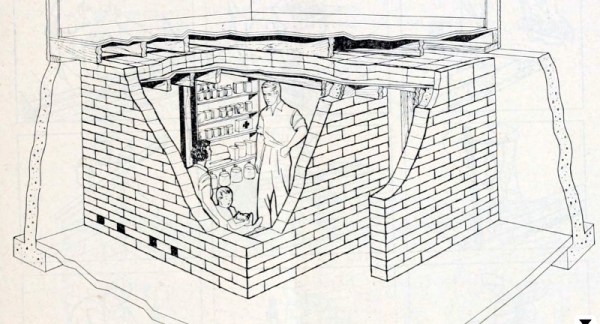
Over the years we’ve featured quite a few radiatioactivity detectors, which usually include a Geiger-Muller tube, or perhaps a large-area photodiode. But in the event of radiation exposure from a nuclear attack, how does the man in the street gauge the exposure without owning a dedicated instrument? This was a question of note at the height of the Cold War, and it’s one that [Dr. Marshall Brucer] answered in a 1962 paper entitled “When Do You Leave A Fallout Shelter“. The full paper is behind a paywall but the part we’re interested in is on the freely available first page.

Dr. Brucer‘s detector is simplicity itself, and it relies on the erosion of a static electric charge by radiation. Should you rub a plastic comb in your hair it will accumulate enough charge to pick up a small piece of paper, and under normal background radiation the charge will ebb away such that it will drop the piece of paper after about 15 seconds. His calculation is that once the field reaches around 10 roentgens per hour it will be enough to erase the charge and drop the paper immediately. There’s a comtemporary newspaper report (Page 7, just to the left of the large advertisment) which tells the reader that since the exposure limit is 100 roentgens (one sievert), this test failing indicates that they have nine hours to create a better shelter. For obvious reasons we can’t test this at the Hackaday bench, but those of us who remember the days when such topics were a real concern will be searching for a handy comb anyway.

Thanks [Victor Matthew] for the tip.

Fixing A Hot Shop, With Science

We know that pretty much everybody in the Northern hemisphere has had a hellish summer, and there’s little room for sympathy when someone busts out with, “Oh yeah? You think THAT’s hot? Well, lemme tell you…” But you’ve got to pity someone who lives in north Texas and has a steel Quonset hut for a shop. That’s got to be just stupidly hot.

But stupid hot can be solved — or at least mitigated — with a little smarts, which is what [Wesley Treat] brought to bear with this cleverly designed shop door heat shield. When it pushes past 42°C — sorry, that sounds nowhere near as apocalyptic as 108°F — the south-facing roll-up door of his shop becomes a giant frying pan, radiating heat into his shop that the air conditioner has trouble handling. His idea was to block that radiant heat with a folding barrier, but to make sure it would be worth the effort, he mocked up a few potential designs and took measurements of the performance of each. His experiments showed him that a layer of extruded polystyrene (XPS) foam insulation covered with reflective Mylar did better than just the foam or Mylar alone.

The finished heat shield is an enormous tri-fold plywood beast that snugs up against the door when things get toasty in the shop. There’s a huge difference in temperature between the metal door and the inside surface of the shield, which will hopefully keep the shop more comfortable. We imagine that the air between the door and the shield will still heat up, and convection could still distribute all that hot air into the shop. But at least he’s giving the AC a fighting chance.

In addition to great shop tips like this and his custom storage bins, [Wesley] is a talented signmaker. He’s pretty funny too — or maybe that’s just the heat talking.

Continue reading “Fixing A Hot Shop, With Science”

Hackaday Prize 2022: Soviet Geiger Counter Gets WiFi

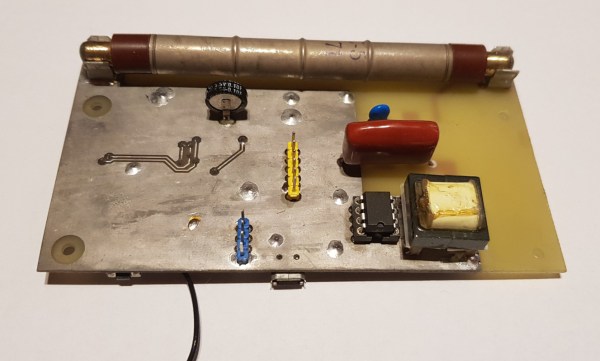
[Marek] has an impressive collection of old Soviet-style Geiger counters. These are handy tools to have in some specific situations, but for most of us they would be curiosities. Even so, they need some help from the modern world to work well, and [Marek] has come up with some pretty creative ways of bringing them into the 21st century. This version, for example, adds WiFi capabilities.

This build is based on the STS-5 Geiger tube but the real heavy lifting is handled by an ESP8266 which also provides a wireless network connection. There are some limitations to using an ESP8266 to control a time-sensitive device like a Geiger tube, especially the lack of local storage, but [Marek] solves this problem by including a real-time clock and locally caching data until a network connection is re-established. Future plans for the device include adding temperature and atmospheric temperature sensors.

Eventually this Geiger counter will be installed in a watertight enclosure outside so [Marek] can keep an eye on the background radiation of his neighborhood. Previously he was doing this with another build, but that one only had access to the network over an Ethernet cable, so this one is quite an upgrade.

Forget Radio! Transmitting With Neutrons

Throughout history, people have devised ways to send information across long distances. For centuries we relied on smoke signals, semaphores, and similar physical devices. Electricity changed everything. First the telegraph and then radio transformed communications. Now researchers at the University of Lancaster have demonstrated another way to send wireless data without using electromagnetic radiation. They’ve harnessed fast neutrons from californium-252 and modulated them with information with 100% success.

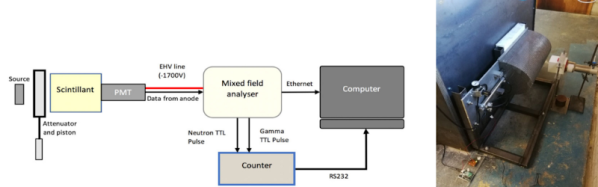
The setup was interesting. The radioactive material was encased in a cubic meter steel tank filled with water. A pneumatic system can move the material to one edge of the tank which allows fast neutrons to escape. A scintillating detector can pick up the increased neutron activity. It seems like it is akin to using what hams call CW and college professors call OOK (on off keying). You can do that with just about anything you can detect. A flashlight, knocking on wood, or — we suppose — neutrons.

We wondered what the practical application of this might be. The paper suggests that the technique could send data through metal containment structures like those of a nuclear reactor or, perhaps, a spacecraft where you don’t want anything unnecessarily breaching the containment. After all, neutrons cut through things that would stop a conventional radio wave cold.

It seems like you only have to prove you can detect something to make this work — it really doesn’t matter what it is you are detecting. It seems like it would be much harder to do more advanced types of modulation using neutrons. Maybe this is why we don’t hear aliens. They are all Morse code operators with neutron-based telegraphs.