Entombed Secrets Partially Unearthed As Researchers Dissect Clever Maze-Generating Algorithm

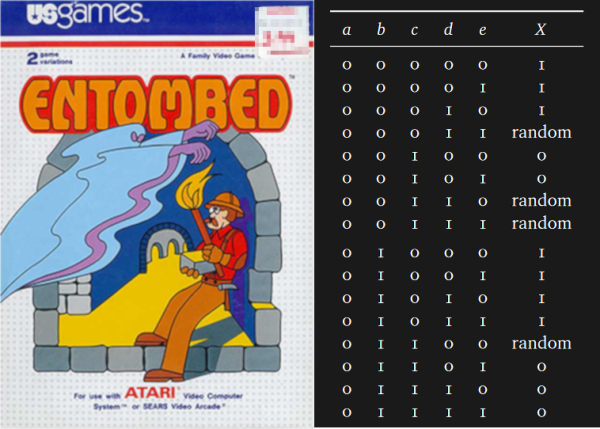
If you look at enough of another developer’s code, you will eventually say, “What were you thinking, you gosh-darn lunatic?” Now, this exchange can precede the moment where you quit a company and check into a padded room, or it can be akin to calling someone a mad genius and offering them a beer. In the case of [Steven Sidley]’s 1982 game Entombed, [John Aycock] and [Tara Copplestone] found a mysterious table for generating pseudo-random mazes and wrote a whitepaper on how it all works (PDF). The table only generates solvable mazes, but if any bits are changed, the puzzles become inescapable.

The software archaeologists are currently in a labyrinth of their own, in which the exit is an explanation of the table, but the path is overgrown with decade-old vines. The programmer did not make the table himself, and its creator’s name is buried somewhere in the maze. Game cart storage was desperately limited so mazes had to be generated on-the-fly rather than crafted and stored. Entombed‘s ad-hoc method worked by assessing the previous row and generating the next based on particular criteria, with some PRNG in places to keep it fresh. To save more space, the screen was mirrored down the center which doubles the workload of the table. Someday this mysterious table’s origins may be explained but for now, it is a work of art in its own right.

Aside from a table pulled directly from the aether, this maze game leaned on pseudo-random numbers but there is room for improvement in that regard too.

Via BBC Future.

Odd-Sized Military Headphone Connectors, Tamed!

Military headphones, at least the older ones, are like few other sound reproducers. They are an expression of function over form, with an emphasis on robustness over operator comfort. Electrically they most often have high-impedance drivers and annoyingly proprietary connectors for whichever obscure radio system they were a part of.

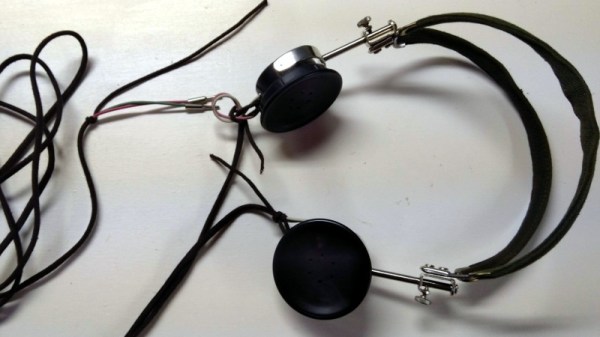
[John Floren] has a HS-16A headset, the type used by the US military during the Vietnam war. It’s an antiquated design with a dual spring steel headband and on-the-ear ‘phones with no muff for comfort, and a quick bit of research finds that they can be had brand new in their 1960s packaging for somewhere around $20. Their connector is a pair of odd metal pins, and rather than doing what most of us would do and snipping the wire to fit something more useful, he hunted high and low for a TE Connectivity receptacle that would fit them. A short extension and a jack plug allowed him to use these slightly unusual cans.

This isn’t a special hack, but it’s still an interesting read because it sheds a bit of light upon these old-style headphones and reveals that they’re still available for anyone who wants their radio operating to have a retro feel. If you buy a set, you’ll probably still have them decades after more modern pairs have bitten the dust.

Modern Linux Runs On Ancient Toshiba

While Microsoft no longer supports those of its operating systems that were in heavy use into the early 2000s, support for old hardware is not typically something that you will have to worry about if you run Linux on your machines. Sure, there will be driver issues from time to time, and you might have to do some things by hand, but if you’re using legacy hardware you’ll want a Linux distribution of some sort. Especially if you’re running it on one of the first laptops to ever feature a Pentium processor of any kind.

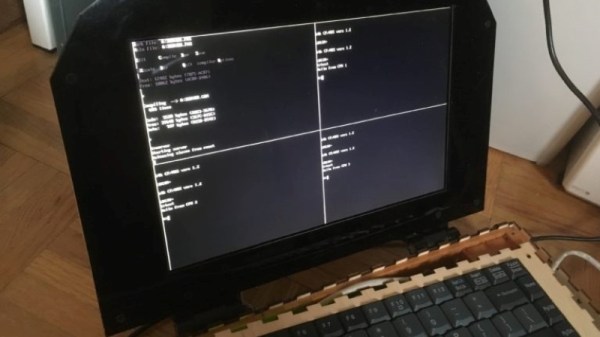
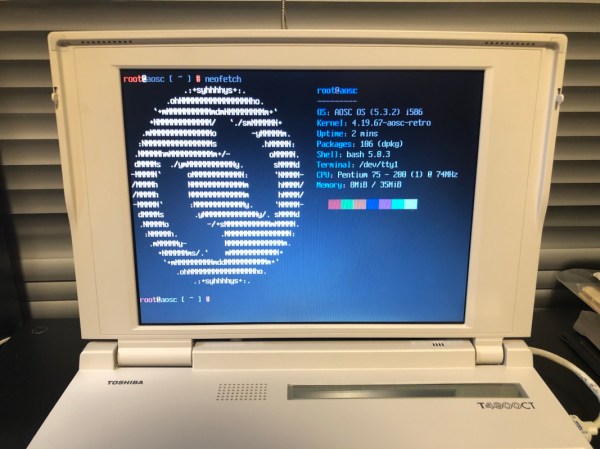
This is a Toshiba T4900CT which [MingcongBai] has been able to spruce up by installing a simplified version of the AOSC OS Linux distribution. The distribution is known for its simplified user interface, and this particular one runs a “Retro” command-line-only version. Upon startup (which takes over two minutes), the user can view the hardware and software specs: Linux kernel 4.19.67 (released within the past year) on a 75 MHz Intel processor.

Getting old equipment to work, even if the software is available, is a challenge and this one stands out for the historical noteworthiness of the laptop. We didn’t see it connect to the Internet, but if it ever does we still keep Retro Hackaday up specifically for situations like this.

You Need A Cyberdeck, This Board Will Help

In 1984, William Gibson’s novel Neuromancer helped kick off the cyberpunk genre that many hackers have been delighting in ever since. Years before Tim Berners-Lee created the World Wide Web, Gibson was imagining worldwide computer networks and omnipresent artificial intelligence. One of his most famous fictional creations is the cyberdeck, a powerful mobile computer that allowed its users to navigate the global net; though today we might just call them smartphones.

While we might have the functional equivalent in our pockets, hackers like [Tillo] have been working on building cyberdecks that look a bit more in line with what fans of Neuromancer imagined the hardware would be like. His project is hardly the first, but what’s particularly notable here is that he’s trying to make it easier for others to follow in his footsteps.

There’s a trend to base DIY cyberdecks on 1980s vintage computer hardware, with the logic being that it would be closer to what Gibson had in mind at the time. Equally important, the brutalist angular designs of some of those early computers not only look a lot cooler than anything we’ve got today, but offer cavernous internal volume ripe for a modern hardware transfusion. Often powered by the Raspberry Pi, featuring a relatively small LCD, and packed full of rechargeable batteries, these cyberdecks make mobile what was once anchored to a desk and television.

[Tillo] based his cyberdeck on what’s left of a Commodore C64c, reusing the original keyboard for that vintage feel. That meant he needed to adapt the keyboard to something the Raspberry Pi could understand, for which some commercially available options existed already. But why not take the idea farther for those looking to create their own C64c cyberdecks?

He’s currently working on a new PCB specifically designed for retrofitting one of these classic machines with a Raspberry Pi. The board includes niceties like a USB hub, and should fill out some of those gaping holes left in the case once you remove the original electronics. [Tillo] has already sent the first version of his open source board out for fabrication, so hopefully we’ll get an update soon.

In the meantime, you might want to check out some of the other fantastic cyberdeck builds we’ve covered over the last couple of years.

Giving The Amstrad CPC A Voice And A Drum Kit

Back in the ’80s, home computers weren’t capable of much in terms of audio or multimedia as a whole. Arguably, it wasn’t until the advent of 16-bit computers such as the Amiga that musicians could make soundtrack-quality music without having to plug actual studio gear up to their machines. [Michael Wessel] is trying to bring some of that and many more features to the Amstrad CPC with his ambitious LambdaSpeak 3 project, an expansion card built completely up from scratch and jam-packed with features.

First, and likely giving it its name, is the speech synthesizer. [Michael] has made an emulation mode where his card can act just like the original SSA-1 expansion, being able to be controlled by the same software as back then. By default, the card offers this mode with an Epson S1V30120 daughterboard (which is based on DECTalk synthesis), however for further authenticity you also have the option of fitting it with an SP0256-AL2 chip, the same one used in the original Amstrad hardware in 1985.

As for the more musical part of the project, the board supports 4-channel PCM playback, much like the Amiga’s sound offering. This can be used for a drum machine sequencer program, and it has an Amdrum mode, emulating another expansion from the original Amstrad days. Sample playback can also be used alongside the speech synthesis as shown here, with random allophone beats that wouldn’t sound out of place in a Kraftwerk recording. Finally, by using the UART interface included on the LambdaSpeak, you can also turn the CPC itself into a synth by giving it MIDI in/out and interfacing a controller in real time with the computer’s AY-3-8912 sound chip.

If you like modern expansions giving old computers new life, did you know that you can get just about any retro computer online, perhaps a TRS-80, an Amiga and even a Psion Organizer? And if you’re interested in just using old systems’ sound chips with modern USB MIDI controllers, it’s easy to make a microcontroller do all the heavy lifting.

Continue reading “Giving The Amstrad CPC A Voice And A Drum Kit”

Creative Limitation And The Super Nintendo Sound Chips

The Super Nintendo recently experienced a surge in popularity, either from a combination of nostalgic 30-somethings recreating their childhoods, or because Nintendo released a “classic” version of this nearly-perfect video game system. Or a combination of both. But what made the system worthy of being remembered at all? With only 16 bits and graphics that look ancient by modern standards, gameplay is similarly limited. This video from [Nerdwriter1] goes into depth on a single part of the console – the sound chips – and uses them to illustrate a small part of what makes this console still worth playing even now.

The SNES processed sound with two chips, a processing core and a DSP. They only had a capacity of 64 kb, meaning that all of a game’s sounds and music had to fit in this tiny space. This might seem impossible if you’ve ever played enduring classics like Donkey Kong Country, a game known for its impressive musical score. This is where the concept of creative limitation comes in. The theory says that creativity can flourish if given a set of boundaries. In this case it was a small amount of memory, and within that tiny space the composer at Rare who made this game a work of art was able to develop a musical masterpiece within strict limitations.

Even though this video only discusses the sound abilities of the SNES, which are still being put to good use, it’s a good illustration of what made this system so much fun. Even though it was limited, game developers (and composers) were able to work within its limitations to create some amazingly fun games that seem to have withstood the test of time fairly well. Not all of the games were winners, but the ones that were still get some playtime from us even now.

Continue reading “Creative Limitation And The Super Nintendo Sound Chips”

Run Your Own Phone To Bring The Dreamcast Back Online

Playing a video game online is almost second nature now. So much so that almost all multiplayer video games have ditched their split-screen multiplayer modes because they assume you’d rather just be alone at your house than hanging out with your friends. This wasn’t always the case though. In the early days of online multiplayer, systems had to rely on dial-up internet before broadband was readily available (and still had split screen if you didn’t even have that). Almost no one uses dial up anymore though, so if you still like playing your old Dreamcast you’re going to have to do some work to get it online again.

Luckily for all of us there’s a Raspberry Pi image to do almost anything now. This project from [Kazade] uses one to mimic a dial-up connection for a Dreamcast so you can connect with other people still playing Quake 20 years later. It’s essentially a network bridge, but you will need some extra hardware because phone lines use a high voltage line that you’ll have to make (or buy) a solution for. Once all the hardware is set up and working, you’ll need to make a few software configuration changes, but it’s a very straightforward project.

Granted, there have been ways of playing Dreamcast games online before, but this new method really streamlines the process and makes it as simple as possible. The Dreamcast was a great system, and there’s an argument to be made that the only reason it wasn’t more popular was that it was just slightly too far ahead of its time.

Thanks to [Rusty] for the tip!