Skeletal Robot Skips The Chassis

With the high availability of low-cost modular electronic components, building your own little robot buddy is easier and more affordable than ever. But while the electronics might be dirt cheap thanks to the economies of scale, modular robot chassis can be surprisingly expensive. If you’ve got a 3D printer you can always make a chassis that way, but what if you’re looking for something a bit more artisanal?

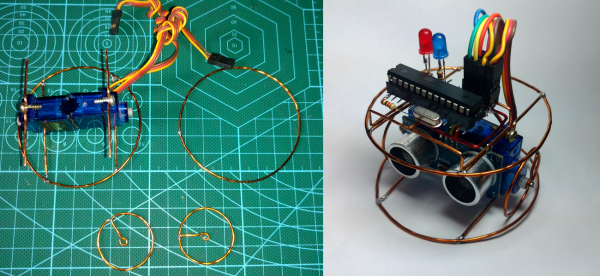
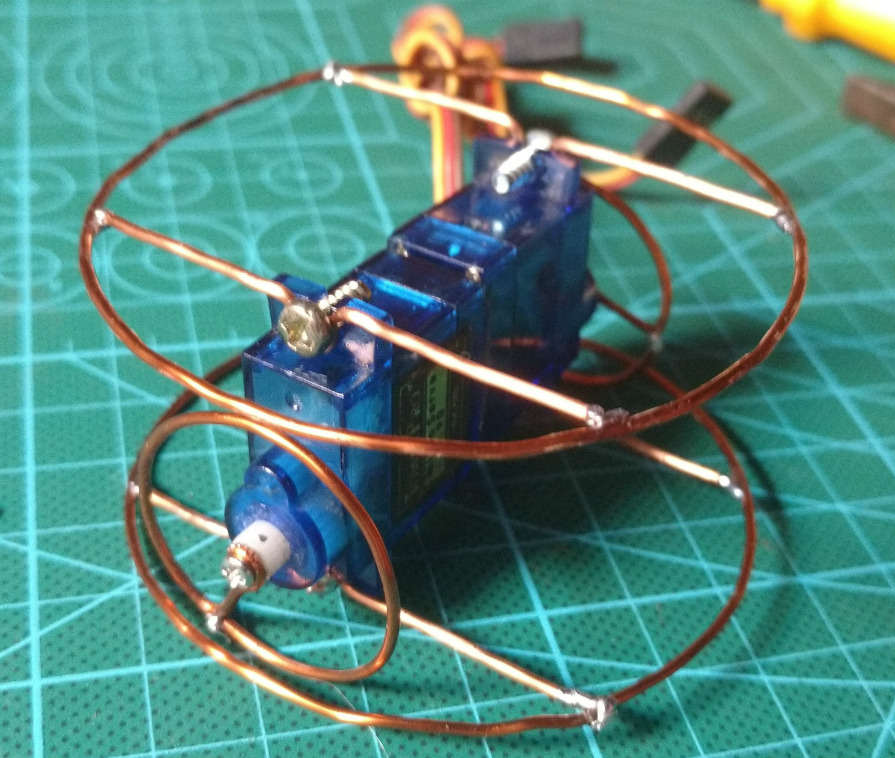
For his entry into the Circuit Sculpture Contest, [Robson Couto] has built a simple robot which dumps the traditional chassis for a frame made out of bent and soldered copper wire. Not only does this happen to look really cool in a Steampunk kind of way, it’s also a very cheap way of knocking together a basic bot with just the parts you have on hand. Not exactly a heavy-duty chassis, to be sure, but certainly robust enough to rove around your workbench.

The dual servos constrained within the wire frame have been modified for continuous rotation, which combined with the narrow track should make for a fairly maneuverable little bot. [Robson] equipped his servos with copper wheels built in the same style of the frame, which likely isn’t great for traction but really does help sell the overall look. If you aren’t planning on entering your creation into a contest that focuses on unique construction, we’d suggest some more traditional wheels for best results.

The brains of this bot are provided by an ATmega8 with external 16MHz crystal tacked onto the pins. There’s also a ultrasonic sensor board mounted to the servos which eventually will give this little fellow the ability to avoid obstacles. Of course, it doesn’t take a robotics expert to realize there’s currently no onboard power supply in the design. We’d love to say that he’s planning on using the copper loops of the frame to power the thing via induction, but we imagine [Robson] is still fiddling around with the best way to get juice into his wireframe creation before the Contest deadline.

Speaking of which, there’s still plenty of time to get your own Circuit Sculpture creation submitted. If it’s a functional device that isn’t scared to show off the goods, we’re interested in seeing it. Just document the project on Hackaday.io and submit it to the contest before the January 8th, 2019 deadline.

Welding Robot Takes On A Hot, Dirty, Dangerous Job

They used to say that robots would take over the jobs too dirty or dangerous for humans. That is exactly what [Joel Sullivan] had in mind when he created this welding robot. [Joel] designed the robot for the OSB industry. No, that’s not a new operating system, it’s short for Oriented Strand Board. An engineered lumber, OSB is made of strands (or chips) of wood. It’s similar to plywood but doesn’t require large thin sheets of lumber. To make a panel of OSB, a 5-inch thick matt of wood chips is mixed with glue and compressed down to 5/16″ at 7500 PSI and 400° F.

The presses used to make OSB are a massively parallel operation. 20 or more boards can be pressed at once. Thy press is also a prime area for damage. A nut or bolt hidden in the wood will dig into the press, causing a dent which will show up on every sheet which passes through that section. The only way to fix the press is to shut it down, partially dismantle it, and fill the void in with a welder. [Joel’s] robot eliminates most of the downtime by performing the welding on a still hot, still assembled press.

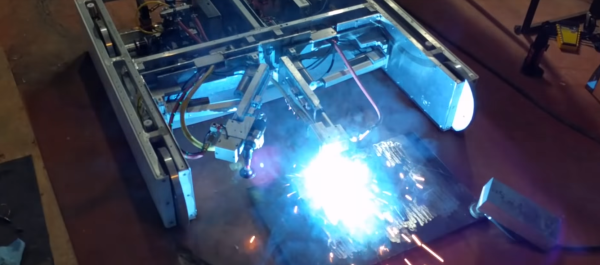
The robot looks like it was inspired by BattleBots, which is fitting as the environment it works in is more like a battleground. It’s a low, wide machine. In the front are two articulated arms, one with a welder, and one with a die grinder. The welder fills any voids in the press platen, and the die grinder grinds the fresh welds flat.  An intel NUC controls things, with plenty of motor drives, power supplies, and relays on board.

[Joel’s] bot is tethered, with umbilicals for argon, electricity and compressed air. Air travels through channels throughout the chassis and keeps the robot cool on the hot press. Everything is designed for high temperatures, even the wheels. [Joel] tried several types of rubber, but eventually settled on solid aluminum wheels. The ‘bot doesn’t move very fast, so there is plenty of traction. Some tiny stepper motors drive the wheels. When it’s time to weld, pneumatic outriggers lock the robot in place inside the narrow press.

Cameras with digital crosshairs allow the operator to control everything through a web interface. Once all the parameters are set up, the operator clicks go and sparks fly as the robot begins welding.

If you’re into seriously strong robots, check out trackbot, or this remote-controlled snow blower!

Continue reading “Welding Robot Takes On A Hot, Dirty, Dangerous Job”

SMORES Robot Finds Its Own Way To The Campfire

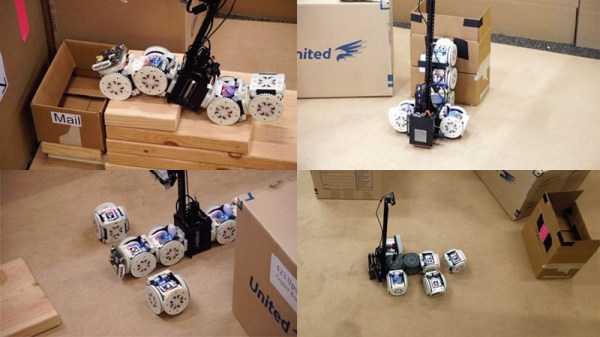
Robots that can dynamically reconfigure themselves to adapt to their environments offer a promising advantage over their less dynamic cousins. Researchers have been working through all the challenges of realizing that potential: hardware, software, and all the interactions in between. On the software end of the spectrum, a team at University of Pennsylvania’s ModLab has been working on a robot that can autonomously choose a configuration to best fit its task at hand.

We’ve recently done an overview of modular robots, and we noted that coordination and control are persistent challenges in this area. The robot in this particular demonstration is a hybrid: a fixed core module serving as central command, plus six of the lab’s dynamic SMORES-EP modules. The core module has a RGB+Depth camera for awareness of its environment. A separate downwards-looking camera watches SMORES modules for awareness of itself.

Combining that data using a mix of open robot research software and new machine specific code, this team’s creation autonomously navigates an unfamiliar test environment. While it can adapt to specific terrain challenges like a wood staircase, there are still limitations on situations it can handle. Kudos to the researchers for honestly showing and explaining how the robot can get stuck on a ground seam, instead of editing that gaffe out to cover it up.

While this robot isn’t the completely decentralized modular robot system some are aiming for, it would be a mistake to dismiss based on that criticism alone. At the very least, it is an instructive step on the journey offering a tradeoff that’s useful on its own merits. And perhaps this hybrid approach will find application with a modular robot close to our hearts: Dtto, the winner of our 2016 Hackaday Prize.

[via Science News]

Continue reading “SMORES Robot Finds Its Own Way To The Campfire”

Laser Cut Cardboard Robot Construction Kit Eases Learning And Play

It has never been easier to put a microcontroller and other electronics into a simple project, and that has tremendous learning potential. But when it comes to mechanical build elements like enclosures, frames, and connectors, things haven’t quite kept the same pace. It’s easier to source economical servos, motors, and microcontroller boards than it is to arrange for other robot parts that allow for cheap and accessible customization and experimentation.

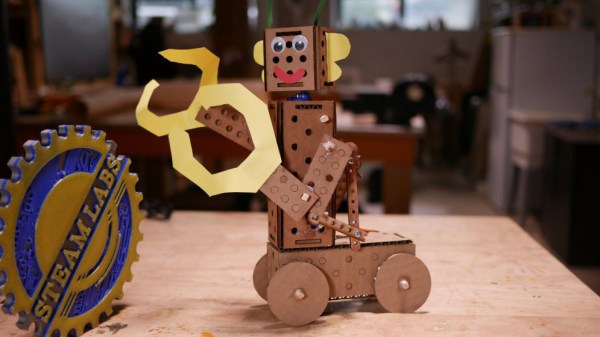
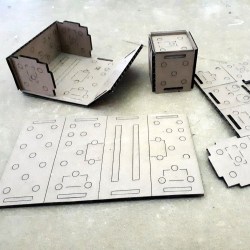
That’s where [Andy Forest] comes in with the Laser Cut Cardboard Robot Construction Kit, which started at STEAMLabs, a non-profit community makerspace in Toronto. The design makes modular frames, enclosures, and basic hardware out of laser-cut corrugated cardboard. It’s an economical and effective method of creating the mechanical elements needed for creating robots and animatronics while still allowing easy customizing. The sheets have punch-out sections for plastic straws, chopstick axles, SG90 servo motors, and of course, anything that’s missing can be easily added with hot glue or cut out with a knife. In addition to the designs being open sourced, there is also an activity guide for educators that gives visual examples of different ways to use everything.

Cardboard makes a great prototyping material, but what makes the whole project sing is the way the designs allow for easy modification and play while being easy to source and produce.

One-Legged Jumping Robot Shows That Control Is Everything

Robots that can jump have been seen before, but a robot that jumps all the time is a little different. Salto-1P is a one-legged jumping robot at UC Berkeley, and back in 2017 it demonstrated the ability to hop continuously with enough control to keep itself balanced. Since then it has been taught some new tricks; having moved beyond basic stability it can now jump around and upon things with an impressive degree of control.

Key to doing this is the ability to plant its single foot exactly where it wants, which allows for more complex behaviors such as hopping onto and across different objects. [Justin Yim] shows this off in the video embedded below, which demonstrates the Salto-1P bouncing around in a remarkably controlled fashion, even on non-ideal things like canted surfaces. Two small propellers allow the robot to twist in midair, but all the motive force comes from the single leg.

Continue reading “One-Legged Jumping Robot Shows That Control Is Everything”

Gesture Control Without Fancy Sensors, Just Pots And Weights

[Dennis] aims to make robotic control a more intuitive affair by ditching joysticks and buttons, and using wireless gesture controls in their place. What’s curious is that there isn’t an accelerometer or gyro anywhere to be seen in his Palm Power! project.

The gesture sensing consists not of a fancy IMU, but of two potentiometers (one for each axis) with offset weights attached to the shafts. When the hand tilts, the weights turn the shafts of the pots, and the resulting readings are turned into motion commands and sent over Bluetooth. The design certainly has a what-you-see-is-what-you-get aspect to it, and as a whole it works much like an inverted, weighted joystick hanging from one’s palm.

It’s an economical way to play with the idea of motion sensing, and when it comes to prototyping, being able to test a concept while keeping costs to a minimum is a good skill to have.

Turn Your Teddy Bear Into A Robot With Yale’s “Robotic Skin”

Despite what we may have seen in the new Winnie the Pooh movie, our cherished plush toys don’t usually come to life. But if that’s the goal, we have ways of making it happen. Like these “robotic skins” from Yale University.

Each module is a collection of sensors and actuators mounted on a flexible substrate, which is then installed onto a flexible object serving as structure. In a simple implementation, the mechanical bits are sewn onto a piece of fabric and tied with zippers onto a piece of foam. The demonstration video (embedded below the break) runs through several more variations of the theme. From making a foam tube (“pool noodle”) crawl like a snake to making a horse toy’s legs move.

There’s a serious motivation behind these entertaining prototypes. NASA is always looking to reduce weight that must be launched into space, and this was born from the idea of modular robotics. Instead of actuators and sensors embedded in a single robot performing a specific function, these robotic skins can be moved around to different robot bodies to perform a variety of tasks. Such flexibility can open up more capabilities while occupying less weight on the rocket.

This idea is still early in development and the current level prototypes look like something most of us can replicate and improve upon for use in our projects. We’ve even got a controller for those pneumatics. With some more development, it may yet place among the ranks of esoteric actuators.

Continue reading “Turn Your Teddy Bear Into A Robot With Yale’s “Robotic Skin””