Dog-Operated Treat Dispenser

Every good dog is deserving of a treat. [Eliasbakken]’s dog [Moby] is a certified good boy,  so he designed a dispenser with a touchscreen that his dog can boop to treat himself when he isn’t barking up a ruckus.

Adding a touchscreen to a treat dispenser when a button would suffice is a little overkill, but we’re not here to judge. [Eliasbakken] is using a BeagleBone Black — a Linux-based development platform — as this dispenser’s brains, and a Manga touchscreen that is likely to see a lot of use.  A wood-like material called Vachromat was laser cut for the frame and glued together, while an RC servo with a 3D-printed jointed pushing arm to dispenses the treats. The dispenser’s hopper only holds fifteen, so we expect it will need to be refilled every fifteen seconds or so.
Continue reading “Dog-Operated Treat Dispenser”

Three Thumbs, Way, Way Up!

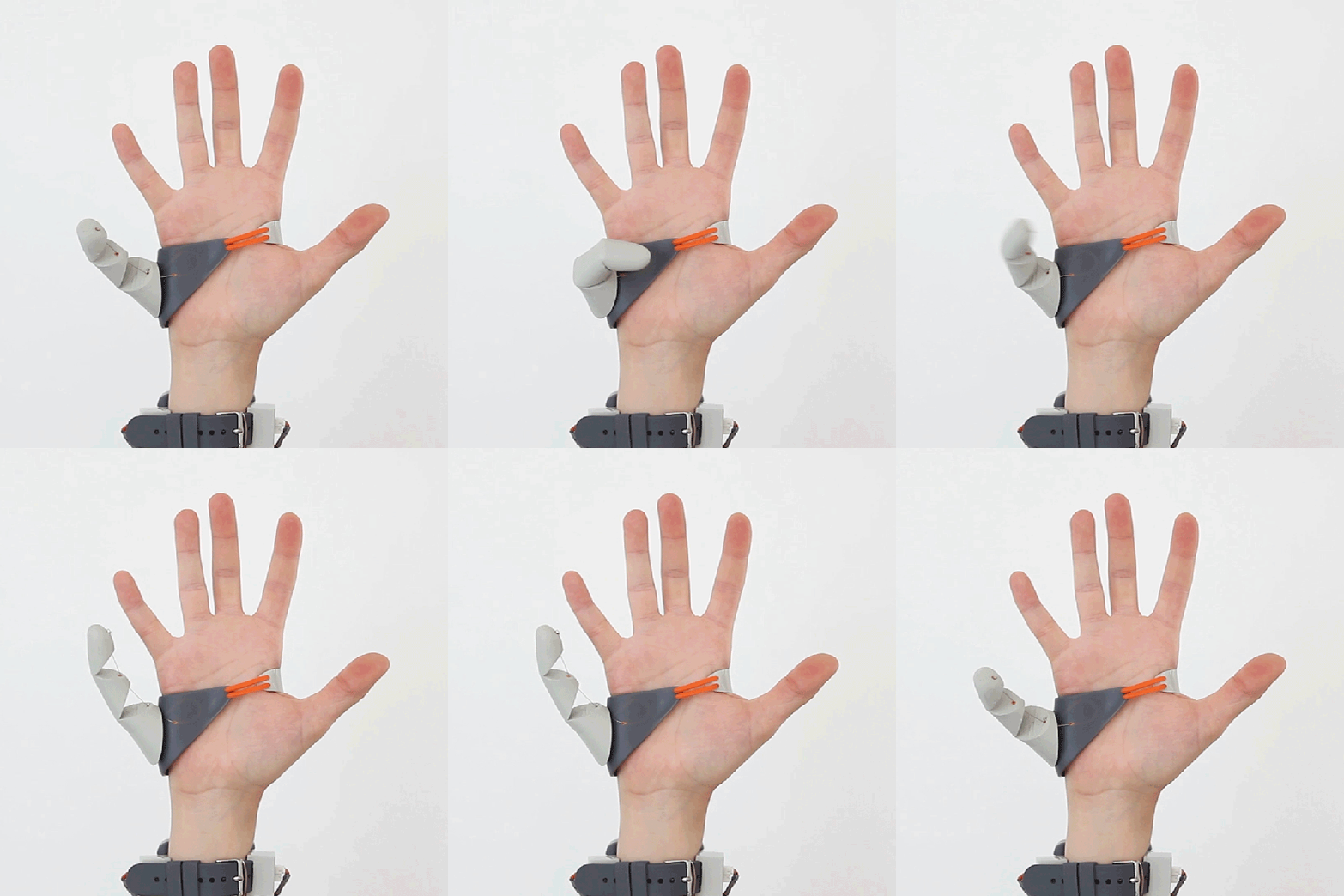
At least one in their lives — or several times a day — everyone has wished they had a third hand to help them with a given task. Adding a mechanical extra arm to one’s outfit is a big step, so it might make sense to smart small, and first add an extra thumb to your hand.

This is not a prosthetic in the traditional sense, but a wearable human augmentation envisioned by [Dani Clode], a master’s student at London’s Royal College of Art. The thumb is 3D-printed out of Ninjaflex and mounted to a printed brace which slides over the hand. One servo rotates the thumb, and a second pulls it closed using a bowden cable system — not unlike that of a bicycle brake. Control of the thumb is achieved by pressure sensors in the wearer’s shoes, linked via Bluetooth to a wristband hosting the servos and the electronics. We already use our hands and feet in conjunction, so why not capitalize on this intuitive link?

Continue reading “Three Thumbs, Way, Way Up!”

Hackaday Prize Entry: Very, Very Powerful Servos

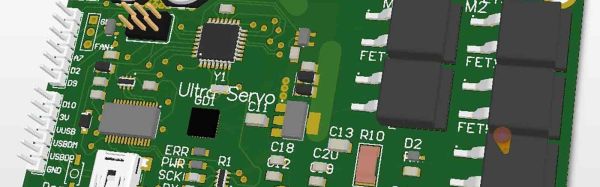
A few years ago, [patchartrand] decided to build a robot arm. The specs were simple: he needed a drive system that would be at least as strong as a human arm. After looking at motors, couldn’t find a solution for under $3,000. This led to the creation of the Ultra Servo, an embiggened version of the standard hobby servo that provides more than ten thousand oz-in of torque.

Your typical hobby servo has three main components. The electronics board reads some sort of signal to control a motor. This motor is strapped into a gear train of some sort, and a potentiometer reads the absolute position of a shaft. This is basically what the Ultra Servo is doing, although everything is much, much bigger.

The motor used in the Ultra Servo is a very large brushed DC motor. This is attached to a 160:1 planetary gearbox and the electronics are built around four reasonably large MOSFETs. The electronics are built around the ATmega168 microcontroller, and the specs for the completed servo include 12 V or 24 V operation, TTL, SPI, and standard RC communication, 60 RPM no load speed, and 60 ft-lbs of torque.

This is not your standard servo. This is a massive chunk of metal to move stuff. If you’ve ever wanted a remote-controlled Cessna, here you go. That said, servos of this size and power will always be pricey, and is looking at a cost of $750 per unit. Still, that’s much less than the thousands of a comparable unit, and a great entry to the Hackaday Prize.

Use The Force To Turn On This Lamp

Holocrons are holographic data storage devices used in the Star Wars universe by both Jedi and Sith as teaching devices or for storing valuable information. After the fall of the Jedi, they became rare and closely guarded artifacts. [DaveClarke] built one to light the room.

[DaveClarke] built the lamp around a Particle Photon – a STM32 ARM-M0 based microcontroller with a Cypress wifi chip. All [Dave] needed for the workings were an IR proximity sensor, a servo and a bunch of super-bright white LEDs. When the sensor detects something, it starts up the system. The servo rotates a gear which raises the lamp and fades in the LEDs. The next time the sensor detects something, the servo lowers the lamp and the lights begin to fade out. And since the Photon is connected to the cloud, the system can be accessed with a web interface as well.

Okay, so it’s just an IR sensor detecting reflected infrared light and not the Force that’s used to turn it on, but it’s still pretty cool. There are plenty of pictures and videos at [DaveClarke]’s site, along with a schematic, 3D printer designs, and the source code. The whole thing was designed using Autodesk Fusion 360 and 3D printed in about 30 hours and press-fits together. A very simple yet clever design. There have been some other great lamps on the site, like this blossoming flower lamp or this laser cut lamp with which also has a unique switch.

Continue reading “Use The Force To Turn On This Lamp”

Folding Mass Effect Pistol!

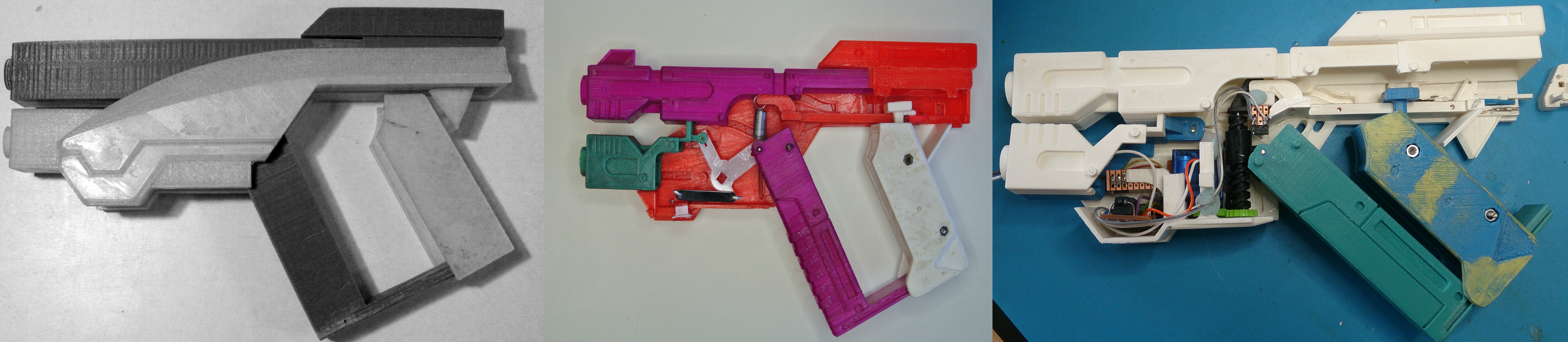
Video game props require a dedicated maker with a repertoire of skills to create. When those props are pulled from the Mass-Effect universe, a little more technological mastery is needed. Bringing those talents to bear,  [Optimistic Geometry] has built a motorized, folding M-3 Predator Pistol!

The gun was modeled in Fusion 360 and 3D printed on an Ultimaker 2 at the  MAKLab Glasgow. [Optimistic Geometry] felt constrained by the laws of our reality, so opted for the smaller firearm thinking it would be an appropriate entry-level challenge. I’m sure you can guess how that went.

There wound up being three main build phases as well as a spring-loaded version to testing purposes. Throughout, [Optimistic Geometry] struggled with getting the parts to latch fully open or closed, as well as working with the small form factor. However, overhauling the motor design — and including some limiters lest it deconstruct itself — a custom latching circuit, and — obviously — a few LEDs for effect, produced a magnificent prop.

Continue reading “Folding Mass Effect Pistol!”

Upgraded Roboceratops Still Not Extinct

We first heard about [Robert Stephenson]’s robotic baby dinosaur a few years ago, and recently he made some upgrades.

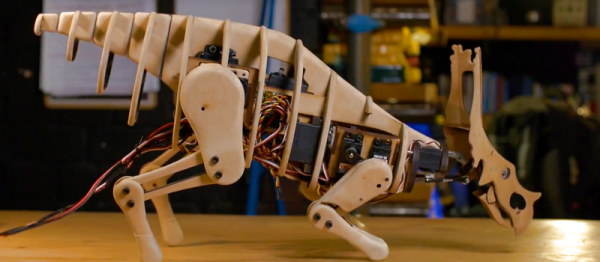
Roboceratops V2 uses 10 servos in the jaw, neck, tail, and front and back legs with 16 degrees of freedom—the two front legs each got an additional degree of freedom in the upgrade. [Robert] is currently in the process of swapping out the Hitec HS645 MGs for higher-torque New Power XLDs.

The older version had aluminum legs covered with upholstery foam, but [Robert] has refined the design. The head, body, and legs are made from laser-cut MDF sanded to give a more natural, bone-like rounding. Finally, to better make use of the new servos [Robert] rewrote the gait engine, giving Robosaurus a more natural motion as it adjusts its center of gravity with each step.

So, for the next version are we all on board for simulated skin?

Continue reading “Upgraded Roboceratops Still Not Extinct”

Vintage Plotter Handles Chaos With Ease

No lab in almost any discipline was complete in the 70s and 80s without an X-Y plotter. The height of data acquisition chic, these simple devices were connected to almost anything that produced an analog output worth saving. Digital data acquisition pushed these devices to the curb, but they’re easily found, cheap, and it’s worth a look under the hood to see what made these things tick.

The HP-7044A that [Kerry Wong] scored off eBay is in remarkably good shape four decades after leaving the factory. While the accessory pack that came with it shows its age with dried up pens and disintegrating foam, the plotter betrays itself only by the yellowish cast to its original beige case. Inside, the plotter looks pristine. Completely analog with the only chips being some op-amps in TO-5 cans, everything is in great shape, even the high-voltage power supply used to electrostatically hold the paper to the plotter’s bed. Anyone hoping for at least a re-capping will be disappointed; H-P built things to last back in the day.

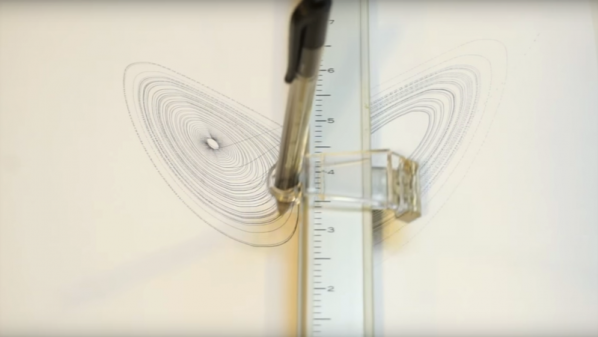
[Kerry] puts the plotter through its paces by programming an Arduino to generate a Lorenz attractor, a set of differential equations with chaotic solutions that’s perfect for an X-Y plotter. The video below shows the mesmerizing butterfly taking shape. Given the plotter’s similarity to an oscilloscope, we wonder if some SDR-based Lissajous patterns might be a fun test as well, or how it would handle musical mushrooms.

Continue reading “Vintage Plotter Handles Chaos With Ease”