

Even when you bear a passing resemblance to the paranoid Auror of the Harry Potter universe, you still really need that wonky and wandering prosthetic eye to really sell that Mad-Eye Moody cosplay, and this one is pretty impressive.
Of course, there’s more to the [daronjay]’s prosthetic peeper than an eBay doll’s eye. There’s the micro-servo that swivels the orb, as well as a Trinket to send the PWM signal and a pocket full of batteries. The fit and finish really tie it together, though, especially considering that it’s made from, well, garbage — a metal food jar lid, a yogurt cup, and the tube of a roll-on antiperspirant. Some brass screws and a leather strap evoke the necessary Potter-verse look, and coupled with what we assume are prosthetic scars, [daronjay] really brings the character to life. We think it would be cool to have the servo eye somehow slaved to the movements of the real eye, with a little randomness thrown in to make it look good.
Marauder’s maps, wand duels, Weasley clocks — the wizarding world is ripe for creative hacking and prop making. What’s next — a Nimbus 2000 quadcopter? Please?
Continue reading “Servo-Controlled Eyeball Makes A Muggle Moody”

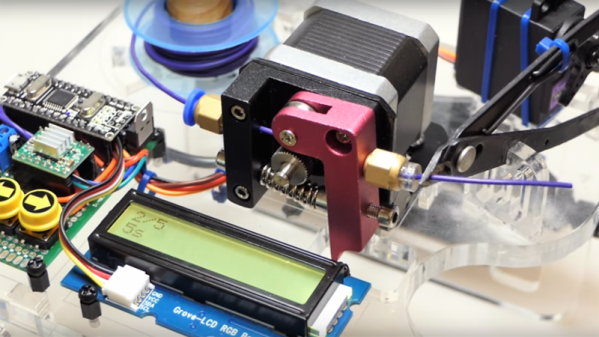
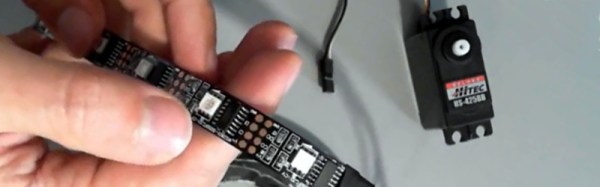
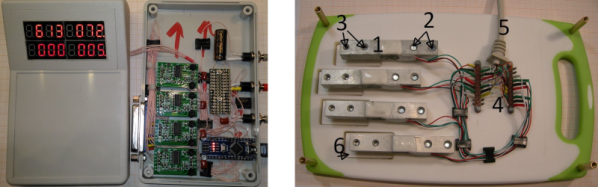
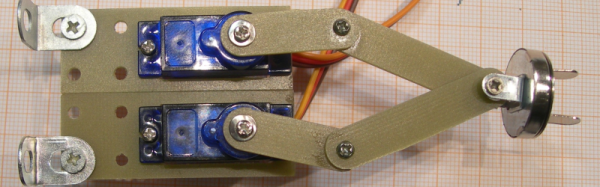
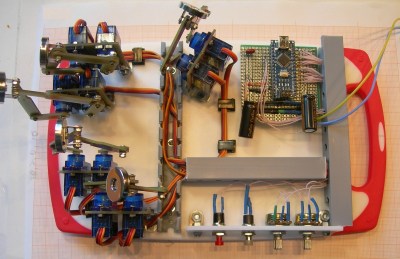 He’s using ten hobby micro servos connected to an Arduino Nano, all mounted on a kitchen chopping board, with a few other bits thrown in to round out the build. There’s one pair of servos for each finger. A five bar linkage converts the servo rotations to two-dimensional motion. The end of the linkage has a swiveling metallic disk. Patient fingers are attached to these discs via magnetic metal pads that are attached to the end of the fingers using adhesive plaster tape. Two push buttons cycle through a large number of exercise modes and two potentiometer’s help adjust the speed and smoothness (the number of points calculated for the desired motion). Two 7-segment LED display modules connected to the Arduino provides a visual interface showing program modes, speed, number of cycles and other relevant information. Replicating the project ought to be very straightforward since the device uses off-the-shelf parts which are easy to put together using the detailed build instructions, photos and code posted on [Sergei]’s project page. Check out the videos below to see the rehab helper in action.







