Retrotechtacular: The Saturn Propulsion System

“We choose to go to the Moon in this decade and do the other things, not because they are easy, but because they are hard; because that goal will serve to organize and measure the best of our energies and skills, because that challenge is one that we are willing to accept, one we are unwilling to postpone, and one we intend to win, and the others, too”

When President Kennedy gave his famous speech in September 1962, the art of creating liquid-fueled rocket engines of any significant size was still in its relative infancy. All the rocketry and power plants of the Saturn series of rockets that would power the astronauts to the Moon were breaking entirely new ground, and such an ambitious target required significant plans to be laid. What is easy to forget from a platform of five decades of elapsed time is the scale of the task set for the NASA engineers of the early 1960s.

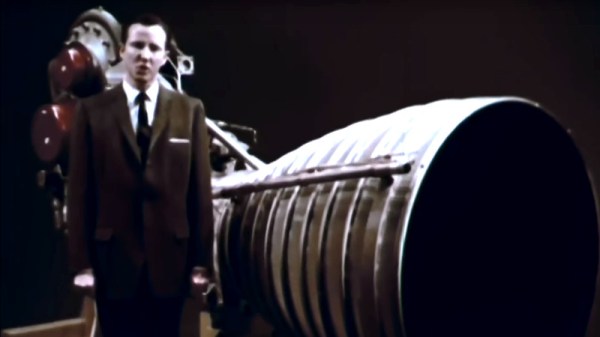
The video below the break is from 1962, concurrent with Kennedy’s speech, and it sets out the proposed development of the succession of rocket motors that would power the various parts of the Saturn family. We arrive at the famous F-1 engine that would carry the mighty Saturn 5 and start its passengers on their trip to the Moon at a very early stage in its development, after an introduction to liquid rocket engines from the most basic of first principles. We see rockets undergoing testing on the stand at NASA’s Huntsville, Alabama facility, along with rather superlative descriptions of their power and capabilities.

The whole production is very much in the spirit of the times, though unexpectedly it makes no mention whatsoever of the Space Race with the Soviet Union, whose own rocket program had put the first satellite and the first man into space, and which was also secretly aiming for the moon. It’s somewhat jarring to understand that the people in this video had little idea that such an ambitious program would be as successful as it became, or even that in the wake of Kennedy’s assassination the following year there would be such an effort to fulfill the aim set out in his speech to reach the moon within the decade.

The moon landings, and the events and technology that made them possible, are a subject of considerable fascination for our community. We must have covered innumerable stories about artifacts from the Apollo era in these pages, and no doubt more will continue to come our way in the future. Films like this one do not tell us quite the same story as does a real artifact, but their values lies in capturing the optimism of the time. Anything seemed possible in 1962, and those who lived through the decade were lucky enough to see this proven.

Fifty years from now, what burgeoning engineering efforts will we look back on?

Continue reading “Retrotechtacular: The Saturn Propulsion System”

Get Your Name On The Hottest List In The Solar System

How often does NASA name a spacecraft after a living person? How often do you get to launch your name into a star? How often does NASA send probes to explore the sun? If your answer to all these questions is NEVER, then you win the honor of adding your name to an SD card bound for the center of our solar system. We’re already on the list with [William Shatner] so we’ll see you there. Submissions for the hot list aboard the Parker Solar Probe close on April 27th, 2018 and it launches in May.

The Parker Solar probe honors living astrophysicist [Eugene Parker] who theorized a great deal about how the sun, and other stars, emit energy. His work has rightly earned him the honor of seeing his name on a sun-bound probe. We even owe the term, “solar wind” to [Parker].

To draw more attention, you can have a few bits aboard this probe dedicated to you or someone you care about by adding your name to their list. Or you can send the name of your greatest enemy into the hottest furnace for millions of miles. Your call.

Even though our sun is the most prominent heavenly body, NASA hasn’t sent a probe to explore it before. They are good about sharing their models and they really know how to write standards for workmanship.

Continue reading “Get Your Name On The Hottest List In The Solar System”

Space Garbage Truck Takes Out The Trash

On April 2nd, 2018 a Falcon 9 rocketed skywards towards the International Space Station. The launch itself went off without a hitch, and the Dragon spacecraft delivered its payload of supplies and spare parts. But alongside the usual deliveries, CRS-14 brought a particularly interesting experiment to the International Space Station.

Developed by the University of Surrey, RemoveDEBRIS is a demonstration mission that aims to test a number of techniques for tackling the increasingly serious problem of “space junk”. Earth orbit is filled with old spacecraft and bits of various man-made hardware that have turned some areas of space into a literal minefield. While there have been plenty of ideas floated as to how to handle this growing issue, RemoveDEBRIS will be testing some of these methods under real-world conditions.

The RemoveDEBRIS spacecraft will do this by launching two CubeSats as test targets, which it will then (hopefully) eliminate in a practical demonstration of what’s known as Active Debris Removal (ADR) technology. If successful, these techniques could eventually become standard operating procedure on future missions.

Continue reading “Space Garbage Truck Takes Out The Trash”

It’s Raining Chinese Space Stations: Tiangong-1

China’s first space station, Tiangong-1, is expected to do an uncontrolled re-entry on April 1st, +/- 4 days, though the error bars vary depending on the source. And no, it’s not the grandest of all April fools jokes. Tiangong means “heavenly palace”, and this portion of the palace is just one step of a larger, permanent installation.

But before detailing just who’ll have to duck when the time comes, as well as how to find it in the night sky while you still can, let’s catch up on China’s space station program and Tiangong-1 in particular.

Continue reading “It’s Raining Chinese Space Stations: Tiangong-1”

Carrots In Space

For this year’s Hackaday Prize, [will.stevens] is growing his own produce and now looks for a way to shield his endeavors from the perils of the British winter. To achieve this, he decided to grow vegetables in sealed containers. Inspired by prior art and backed up by research, his approach is a wild mix of applied laziness on one hand and reckless over-engineering on the other. The sealed containers in this project are PET bottles, chosen for their availability and the produce are carrots, mainly because they can be harvested through the bottle’s mouth. Carrots also feature a high energy density and can provide fibers for plant-based construction materials so [will] deems them ideal space colonist food.

The project is currently in its fourth attempt and somewhere along the road from carrot seeds, dirt and some water in a soda bottle to the current state, the setup sprouted artificial lighting and a CO2 sensor. Fully aware that sealed greenhouses are a proven concept, [will.stevens] provides links to literature one should read before attempting something like this, alongside regular updates on his progress.

With a sensor and LEDs already in place, it is just a matter of time until a raspi will be added. Or we might see the demise of the soil in favor of a hydroponic setup.

Lockheed Shares Satellite Connectivity Options

In an unusual turn of events, Lockheed Martin has released technical “payload accommodation information” for three of their satellite busses. In layperson’s terms, if you wanted to build a satellite and weren’t sure what guidelines to follow these documents may help you learn if Lockheed Martin has a platform to help you build it.

An opportunity to check out once-confidential information about satellites sounds like a perfect excuse to dig through some juicy documentation, though unfortunately this may not be the bonanza of technical tidbits the Hackaday reader is looking for. Past the slick diagrams of typical satellites in rocket fairings, the three documents in question primarily provide broad guidance. There are notes about maximum power ratings, mass and volume guidelines, available orbits, and the like. Communication bus options are varied; there aren’t 1000BASE-T Ethernet drops but multiply redundant MIL-STD-1553B might come standard, plus telemetry options for analog, serial, and other data sources up to 100 Mbps. Somewhat more usual (compared to your average PIC32 datasheet) are specifications for radiation shielding and it’s effectiveness.

In the press release EVP [Rick Ambrose] says “we’re sharing details about the kinds of payloads we can fly…” and that’s exactly what these documents give us. Physical ballpark and general guidelines about what general types of thing Lockheed has capability to build launch. Hopefully the spirit of openness will lead to the hoped-for increase in space utilization.

If you take Lockheed up on their offer of satellite development, don’t forget to drop us a tip!

[Via the Washington Post]

Photographing Starman From A Million Miles Away

Love it or loathe it, launching a sports car into space is a hell of a spectacle, and did a great job at focusing the spotlight on the Falcon Heavy spacecraft. This led [Rogelio] to wonder – would it be possible to snap a photo of Starman from Earth?

[Rogelio] isn’t new to the astrophotography game, possessing a capable twin-telescope rig with star tracking capabilities and chilled CCDs for reducing noise in low-light conditions. Identifying the location of the Tesla Roadster was made easier thanks to NASA JPL tracking the object and providing ephemeris data.

Imaging the Roadster took some commitment – from [Rogelio]’s chosen shooting location, it would only be visible between 3AM and 5:30AM. Initial attempts were unsuccessful, but after staying up all night, giving up wasn’t an option. A return visit days later was similarly hopeless, and scuppered by cloud cover.

It was only after significant analysis that the problem became clear – when calculating the ephemeris of the object on NASA’s website, [Rogelio] had used the standard coordinates instead of the actual imaging location. This created enough error and meant they were looking at the wrong spot. Thanks to the wide field of view of the telescopes, however, after further analysis – Starman was captured, not just in still, but in video!

[Rogelio]’s work is a great example of practical astronomy, and if you’re keen to get involved, why not consider building your own star tracking rig? Video after the break.

[Thanks to arnonymous for the tip! If that’s a nickname and not just a request to be anonymous but misspelled.]

Continue reading “Photographing Starman From A Million Miles Away”