A Better Way To Measure Your Impact On The World

Close your eyes and think of an electric wheelchair. What do you see? Is it sleek, futuristic, and elegant… worthy of the moniker: iChair? No, no it is not. It’s a boxy tank-like thing with grey knobbed wheels that is powered with lead-acid batteries. Why is that?

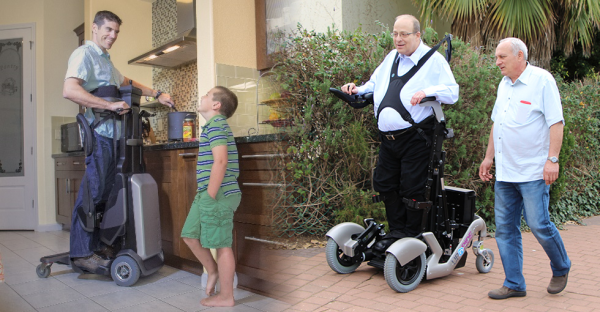
Obviously there are alternatives. Just yesterday I came across UPnRIDE (that name is sore on the eyes but speak it aloud and you’ll get it). It’s an electric wheelchair that converts into a standing position. And it looks comparatively sleek and modern. And it’s not the first time I’ve seen the idea before. One of my favorite articles over the years is still our coverage of Tek RMD, a similar standing robotic wheelchair design. So why is it I don’t see these in the wild? Why is it I only remember seeing the concept twice in four years?

Continue reading “A Better Way To Measure Your Impact On The World”

RC Car Piloting With The Blast Shield Down

Many of us have had a radio controlled car at some time in our youth, though it’s probable that none all of us entirely mastered it. There are memories of spectacular crashes, and if we were really unlucky, further boosts to Mr. Tamiya’s bank balance as fresh parts had to be fitted.

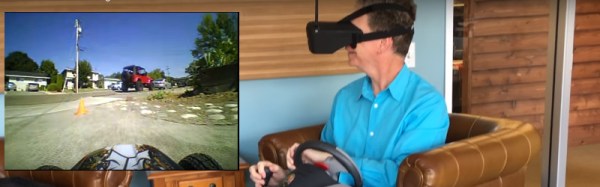
[Paul Yan] was watching his young son with a radio controlled toy, and was struck by how the two-joystick control layout is not necessarily as intuitive as it could be. By contrast when faced with a console game with first-person view and a steering wheel the boy had no problem dropping straight into play. This observation led him to investigate bringing a console steering wheel to an RC car, and the result is a rather impressive FPV immersive driving experience.

Paul's FPV car, explained.
Paul’s FPV car, explained.

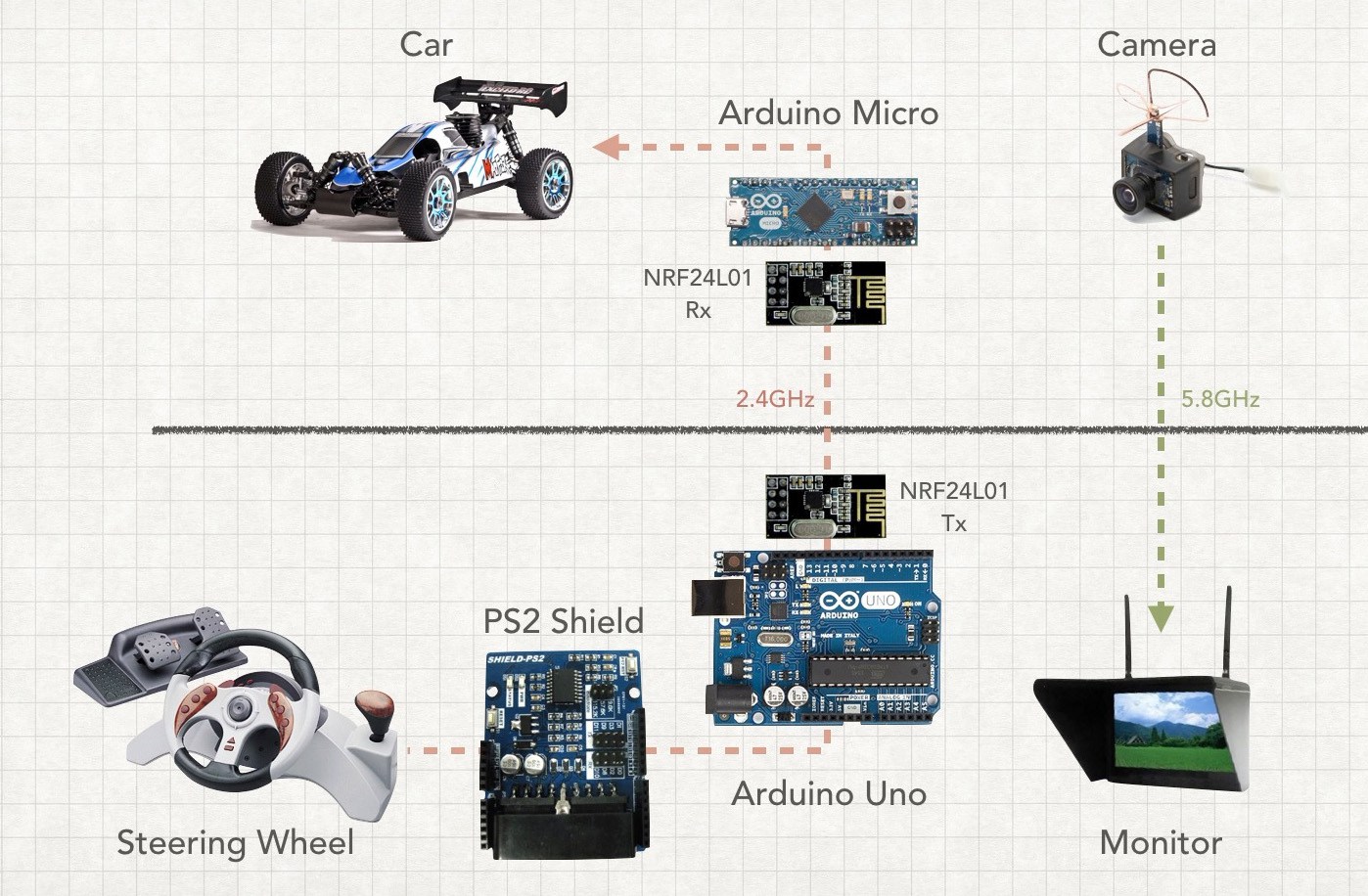
His build took a PS2 steering wheel peripheral with pedals and mated it to an Arduino Uno via a PS2 shield. The Uno talks to a Nordic NRF24L01 RF module, which communicates with another NRF24L01 on the car. This in turn talks to a car-mounted Arduino Micro, which controls the car servos and speed controller.

FPV video is provided by a miniature camera and transmitter from the world of multirotor flying which is mounted on the car and transmits its pictures over 5GHz to a set of monitor goggles. Sadly he does not appear to have posted any of the software involved, though we doubt there is anything too challenging should you wish to try it for yourselves.

The video below shows the car in action, complete with an over-enthusiastic acceleration and crash from his young son. He tells us it’s a similar experience to playing a racing kart game in the real world, and having seen the video we wish we could have a go.

Continue reading “RC Car Piloting With The Blast Shield Down”

Resistance In Motion: What You Should Know About Variable Resistors

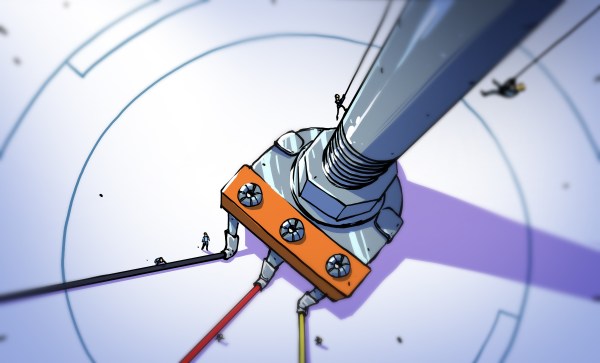
Adjusting the volume dial on a sound system, sensing your finger position on a touch screen, and knowing when someone’s in the car are just a few examples of where you encounter variable resistors in everyday life. The ability to change resistance means the ability to interact, and that’s why variable resistance devices are found in so many things.

The principles are the same, but there are so many ways to split a volt. Let’s take a look at what goes into rotary pots, rheostats, membrane potentiometers, resistive touchscreens, force sensitive resistors, as well as flex and stretch sensors.

Continue reading “Resistance In Motion: What You Should Know About Variable Resistors”

Grand Theft Auto V Used To Teach Self-Driving AI

For all the complexity involved in driving, it becomes second nature to respond to pedestrians, environmental conditions, even the basic rules of the road. When it comes to AI, teaching machine learning algorithms how to drive in a virtual world makes sense when the real one is packed full of squishy humans and other potential catastrophes. So, why not use the wildly successful virtual world of Grand Theft Auto V to teach machine learning programs to operate a vehicle?

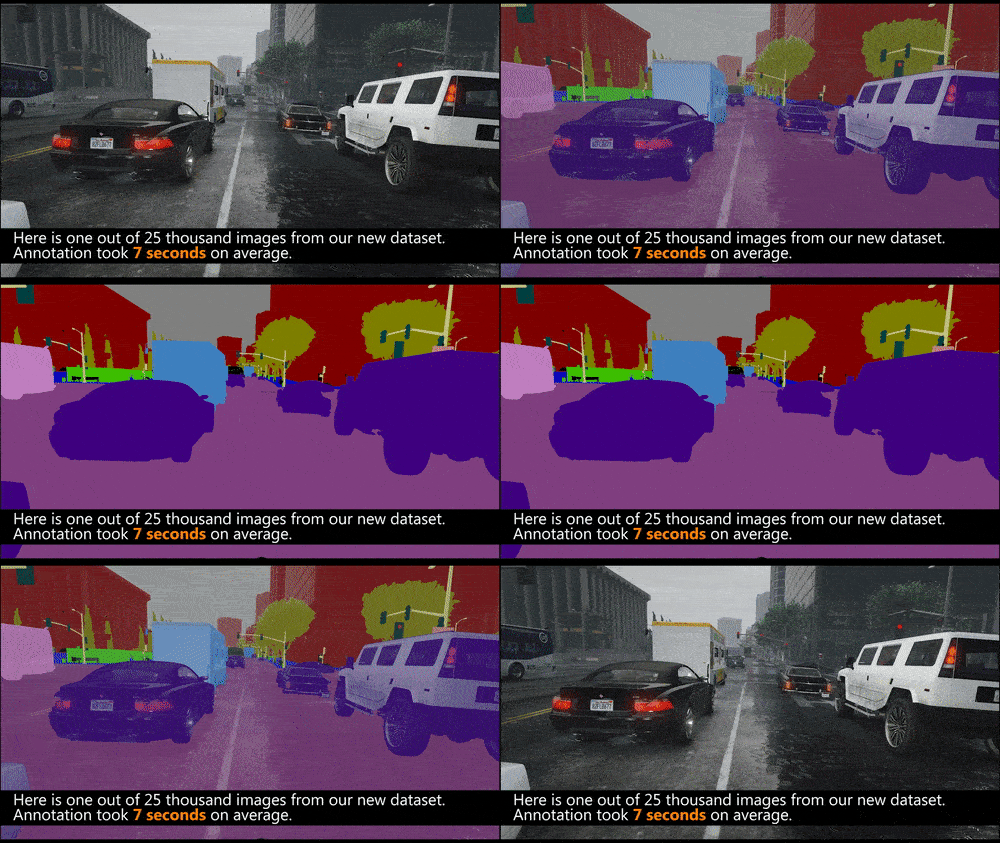
Half and Half GTAV Annotation ThumbThe hard problem with this approach is getting a large enough sample for the machine learning to be viable. The idea is this: the virtual world provides a far more efficient solution to supplying enough data to these programs compared to the time-consuming task of annotating object data from real-world images. In addition to scaling up the amount of data, researchers can manipulate weather, traffic, pedestrians and more to create complex conditions with which to train AI.

It’s pretty easy to teach the “rules of the road” — we do with 16-year-olds all the time. But those earliest drivers have already spent a lifetime observing the real world and watching parents drive. The virtual world inside GTA V is fantastically realistic. Humans are great pattern recognizers and fickle gamers would cry foul at anything that doesn’t analog real life. What we’re left with is a near-perfect source of test cases for machine learning to be applied to the hard part of self-drive: understanding the vastly variable world every vehicle encounters.

A team of researchers from Intel Labs and Darmstadt University in Germany created a program that automatically indexes the virtual world (as seen above), creating useful data for a machine learning program to consume. This isn’t a complete substitute for real-world experience mind you, but the freedom to make a few mistakes before putting an AI behind the wheel of a vehicle has the potential to speed up development of autonomous vehicles. Read the paper the team published Playing for Data: Ground Truth from Video Games.

Continue reading “Grand Theft Auto V Used To Teach Self-Driving AI”

A New OS For Apple II Computers

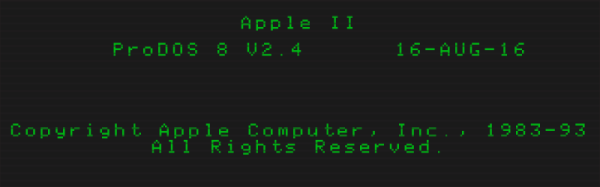
Although this sort of work is usually reserved for KansasFest and other forums for highly technical and very skilled Apple enthusiasts, [John Brooks]’s release of a new version of the ProDOS operating system is no less important. It is, without a doubt, the greatest release the Apple II platform will see for the next few years. This swan song of the Apple II platform is simply ProDOS 2.4, an update to the last version of Apple’s ProDOS, last released in 1993.

For a bit of historical context, ProDOS was not the operating system that shipped with the Apple ][ in 1977. That OS was simply called DOS. ProDOS, released in 1983, included support for the new 3.5″ floppy drives, allowed for hierarchical directories, supported hardware interrupts, and kept the Apple ][ line going well into the 90s. Despite these improvements, not all Apple ][ systems were supported. The original ][ and ][+ were out in the cold. Now, with the ability to add Compact Flash and USB devices to an Apple ][, even the latest version of ProDOS is horribly out of date.

[John]’s release of ProDOS 2.4 fixes all of this. This release is the most important development in the Apple ][ ecosystem in recent memory, and will remain so for at least a decade. The only person who still uses an Apple ][ as a daily driver agrees, and ProDOS 2.4 is now enshrined in The Archive for all eternity.
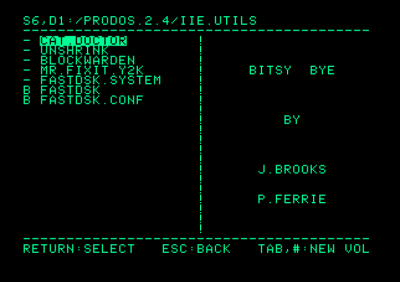
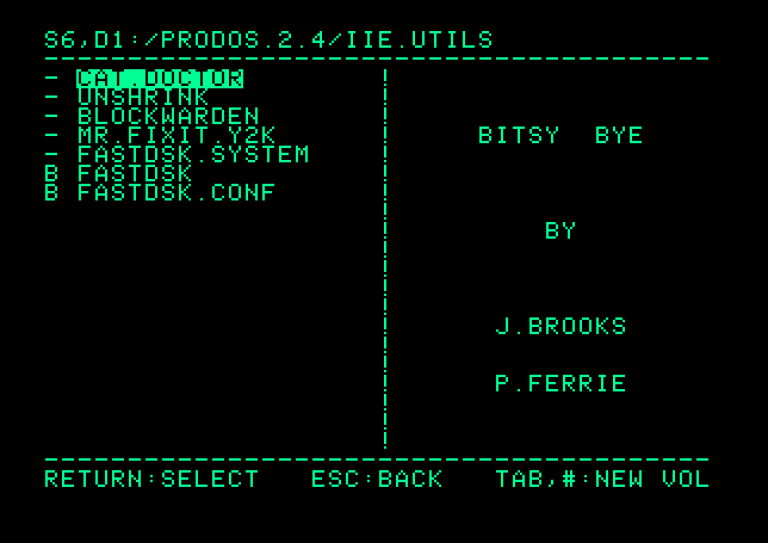
prodos-2-4-bitsy-bye-768x543New features abound, although most of them are geared toward the now thirty-year-old Apple IIGS. These features include enhanced utility in GS/OS – the Apple equivalent of the Commodore GEOS – slot remapping, and an OS that is both smaller and loads faster. Older machines aren’t left out, and ProDOS includes the usual features and improvements found in ProDOS 2.x that weren’t available in the Apple ][, Apple ][+ and un-enhanced Apple //e.

The killer feature and one more thing of this release is the BitsyBye utility, a small ($300!) system program that allows you to boot various Apple II devices and programs. Think of this as the Norton Commander of the Apple II ecosystem, allowing slots to be selected, booting the most recently used ProDOS device, and basic file system exploration. BitsyBye also includes an easter egg. A few utilities are also included on the ProDOS 2.4 disk image including ADTPro, Shrinkit archive expander, and disk utilities.

A 140k ProDOS 2.4 disk image is available on [John]’s site and on Archive.org. Since you’re probably not downloading directly to an Apple II disk, grab ADTPro and load it over audio.

Hackaday Prize Entry: Neopixel Pocket Watch

A timepiece is rather a rite of passage in the world of hardware hacking, and we never cease to be enthralled by the creativity of our community in coming up with new ones.

Today’s example comes from [Joshua Snyder], who has made a pocket watch. Not just any pocket watch, he’s taken the shell of a clockwork watch and inserted a ring of Neopixels, which he drives  from an ESP8266 module. Power comes from a small LiPo battery, and he’s cleverly engineered a small push-button switch so that it can be actuated by the knob from the original watch. Different colour LEDs traverse the ring to simulate the hands of a traditional timepiece, and the whole nestles behind the perforated cover of the watch shell for something of a steampunk feel.

He admits the battery life is not very good at the moment, probably because for now the WiFi is always enabled so he can reach its web interface for debugging. Sadly he appears to have not yet posted the software, but he does tell us it uses NTP to update its time, and that it supports over-the-air updating for new versions. He suggests a future version might dispense with the ESP and use an ATtiny or similar with a real-time clock giving better battery life.

We’ve covered a lot of LED timepieces over the years, including quite a few watches. Only a small selection are this PIC LED ring in a pocket watch case, another LED ring this time powered by an ATMega645, and this very stylish OLED wristwatch.

Yet Another Inductance Measuring Scheme

How do you measure the value of an unknown inductor? If you have an LCR bridge or meter, you are probably going to use that. If not, there are many different techniques you can use. All of them rely on the same thing my Algebra teacher Mr. Harder used to say back in the 1970’s: you have to use what you know to get what you don’t know.

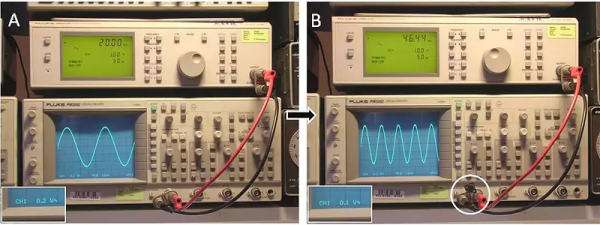
[Ronald Dekker] must think the same way. He took a 50-ohm signal generator and a scope. He puts the signal output to about 20kHz and adjusts for 1V peak-to-peak on the scope. Then he puts the unknown inductor across the signal and adjusts the frequency (and only the frequency) for an output of 1/2 volt peak-to-peak.

Continue reading “Yet Another Inductance Measuring Scheme”