WiFi Hacking Mr. Coffee

You wake up on a Sunday, roll out of bed, and make your way to the centerpiece of your morning, the magical device that helps you start your day: the coffee machine. You open the companion app, because everything has an app in 2020, and select a large latte with extra froth. As you switch open a browser to check Hackaday, the machine beeps. Then the built-in grinder cranks up to 100, the milk frother begins to whir, and the machine starts spraying water. Frantic, you look at the display for an error code and instead see a message instructing you to send $75 to a bitcoin wallet, lest your $300 machine become a doorstop.

Outlandish though it may seem, this has become quite a real possibility, as [Martin Hron] at the Avast Threat Labs demonstrates. In fact, he could probably make your modern macchiato machine do this without setting foot in your house (so long as it comes with a built-in ESP8266, like his did).

Building on others’ work that identified the simple commands that control the machine over it’s WiFi connection (nothing says “brew me a nice cup o’ joe” like 0x37), [Martin] reverse-engineered the Smarter Coffee companion app to extract and reverse engineer its firmware. He was actually able to find the entire firmware image packaged within the app- relatively uncommon in the world of Over-The-Air (OTA) updates, but convenient in this case. Using Interactive Disassembler (IDA) to sift through the firmware’s inner workings, he identified the functions that handle all basic operations, including displaying images on the screen, controlling the heating elements, and of course, beeping. From there, he modified the stock firmware image to include some malicious commands and ran an OTA update.

The mind-boggling part here is that not only was the firmware transmitted as unencrypted plaintext over unsecured WiFi, but the machine didn’t even require a user to confirm the update with a button press. With one quick reboot, the trap was set. The machine operated normally, while waiting for “Order 66,” causing it to turn all the heating elements on, spool up the built-in grinder, and beep. Constantly.

While a broken coffee machine seems relatively innocuous, there are some pretty significant lapses in hardware/firmware security here that, while avoidable, almost seem unnecessary in the first place. It makes us wonder- why does Mr. Coffee need a smartphone in the first place?


Continue reading “WiFi Hacking Mr. Coffee”

Bunnie’s Betrusted Makes First Appearance As Mobile, FPGA-Based SoC Development Kit

Recently, [Bunnie Huang] announced his Precursor project: a spiffy-looking case housing a PCB with two FPGAs, a display, battery and integrated keyboard. For those who have seen [bunnie]’s talk at 36C3 last year, the photos may look very familiar, as it is essentially the same hardware as the ‘Betrusted’ project is intended to use. This also explains the name, with this development kit being a ‘precursor’ to the Betrusted product.

In short, it’s a maximally open, verifiable, and trustworthy device. Even the processor is instantiated on an FPGA so you know what’s going on inside the silicon.

He has set up a Crowd Supply page for the Precursor project, which provides more details. The board features a Xilinx Spartan 7 (XC7S50) and Lattice iCE40UP5K FPGA, 16 MB SRAM, 128 MB Flash, integrated WiFi (Silicon Labs WF200-based), a physical keyboard and 1100 mAh Lio-Ion battery. The display is a 200 ppi monochrome 336 x 536 px unit, with both the display and keyboard backlit.

At this point [bunnie] is still looking at how much interest there will be for Precursor if a campaign goes live. Regardless of whether one has any interest in the anti-tamper and security features, depending on the price it might be a nice, integrated platform to tinker with.

State Of The Art For Nixies Gets A Boost From Dalibor Farny’s Supersize Prototype

Never one to pass up on a challenge, artisanal Nixie tube maker [Dalibor Farný] has been undertaking what he calls “Project H”, an enormous array of 121 Nixie tubes for an unnamed client. What’s so special about that? Did we mention that each Nixie is about the size of a sandwich plate?

Actually, we did, back in May when we first noted Project H in our weekly links roundup. At that time [Dalibor] had only just accepted the project, knowing that it would require inventing everything about these outsized Nixies from scratch. At 150 mm in diameter, these will be the largest Nixies ever made. The design of the tube is evocative of the old iconoscope tubes from early television history, or perhaps the CRT from an old oscilloscope.

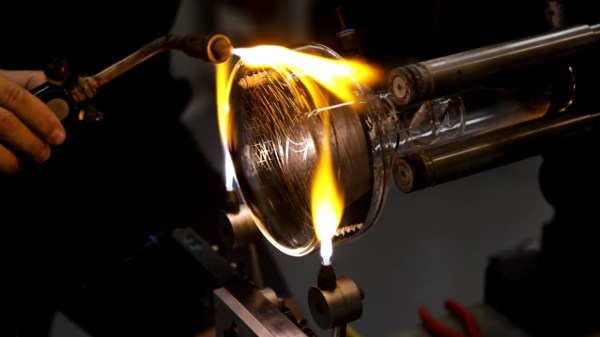
Since May, [Dalibor] has done most of the design work and worked out the bugs in a lot of the internal components. But as the video below shows, he still has some way to go. Everything about his normal construction process had to be scaled up, so many steps, like the chemical treatment of the anode cup, are somewhat awkward. He also discovered that mounting holes in the cathodes were not the correct diameter, requiring some clench-worthy manual corrections. The work at the glassblower’s lathe was as nerve wracking as it was fascinating; every step of the build appears fraught with some kind of peril.

Sadly, this prototype failed to come together — a crack developed in the glass face of the tube. But ever the pro, [Dalibor] took it in stride and will learn from this attempt. Given that he’s reduced the art of the Nixie to practice, we’re confident these big tubes will come together eventually.

Continue reading “State Of The Art For Nixies Gets A Boost From Dalibor Farny’s Supersize Prototype”

NASA Claims Cold Fusion Without Naming It

Do you remember in 1989 when two chemists announced they’d created a setup that created nuclear fusion at room temperature? Everyone was excited, but it eventually turned out to be very suspect. It wasn’t clear how they detected that fusion occurred and only a few of the many people who tried to replicate the experiment claimed success and they later retracted their reports. Since then, mentioning cold fusion is right up there with perpetual motion. Work does continue though, and NASA recently published several papers on lattice confinement fusion which is definitely not called cold fusion, although it sounds like it to us.

The idea of trapping atoms inside a metallic crystal lattice isn’t new, dating back to the 1920s. It sounds as though the NASA method uses erbium packed with deuterium. Photons cause some of the deuterium to fuse. Unlike earlier attempts, this method produces detectable neutron emissions characteristic of fusion.

Continue reading “NASA Claims Cold Fusion Without Naming It”

Sliding Screen Has Wheels, Will Travel

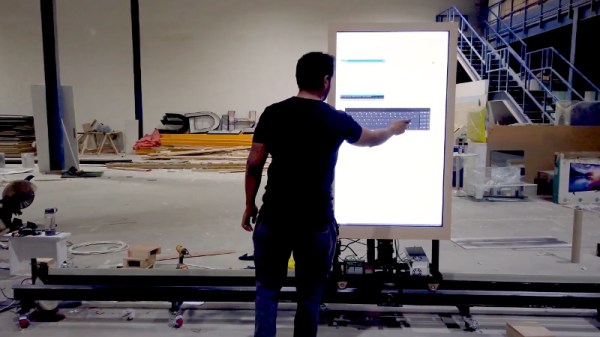
For a recent event, [MakerMan] was tasked with creating an interactive display that could move back and forth along an image of the Moscow skyline to highlight different points of interest. The end result is certainly gorgeous, but since this is Hackaday, we were more excited to see all the behind the scenes video of how it was built.

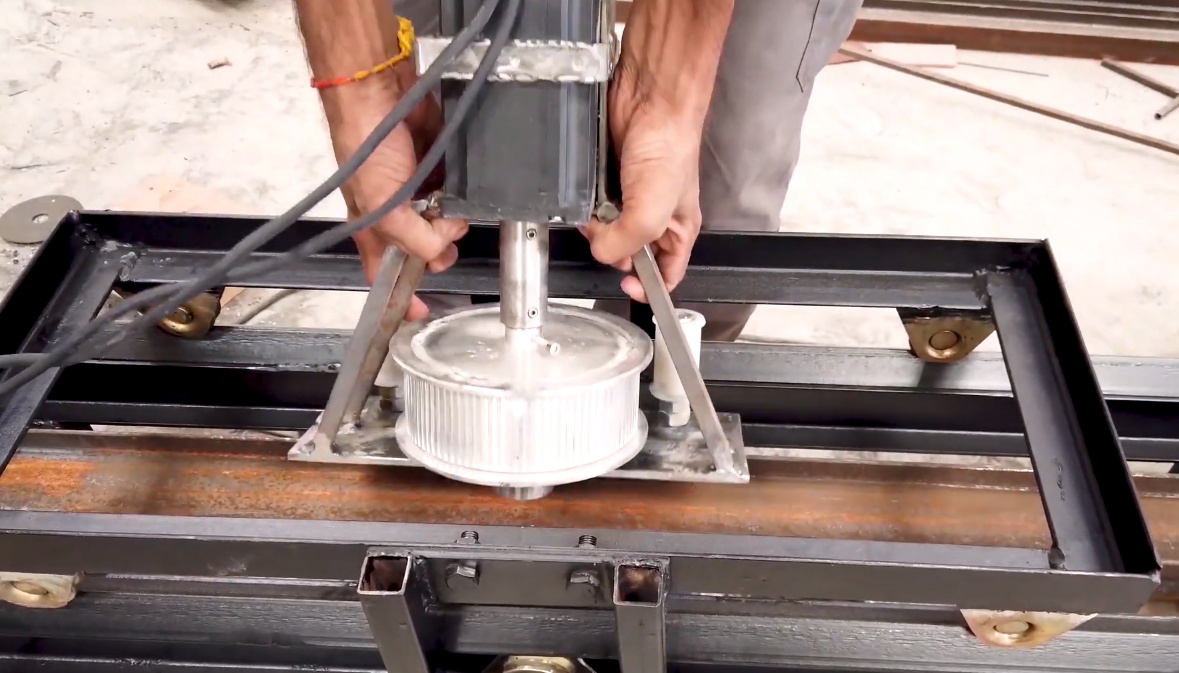
As with many of his projects, this one started with little more than scrap parts. Two metal I-beams were welded together to make a track, and a wheeled cart was fashioned to ride on it. Using a belt and pulley system that’s not unlike a scaled up version of what you might see on a desktop 3D printer, the motor in the cart is able to move the arrangement back and forth with minimal slop.

Installing the motor and pulley in the cart.

The cart actually holds all of the electronics in the project, including the power supplies, MA860H motor controller, a pair of endstop switches, and the Arduino that pulls it all together. A drag chain is used to keep the wires tight to the side of the rail without getting tangled up in anything.

[MakerMan] doesn’t explain much of the software side of this one, though we suppose he might only have been contracted to develop the hardware. But towards the end of the video you can see how the cart, now with large touch screen display mounted on top, moves back and forth when the appropriate commands are sent to the Arduino.

We’re not really sure what application such a contraption would have for the average hacker, but that doesn’t mean we can’t be jealous. There’s just something about huge illuminated screens that just speaks to us.

Continue reading “Sliding Screen Has Wheels, Will Travel”

Voice Controlled Sofa Meets Your Every Beverage Need

It’s often taken for grated, but the modern world is full of luxuries. Home automation, grocery delivery, and even access to the Internet are great tools to have at hand, but are trivial to most of us. If these modern wonders are not enough for you, and the lap of luxury is still missing a certain je ne sais quoi, allow us to introduce you to the ultimate convenience: a voice controlled, beer-dispensing sofa with a built-in refrigeration system.

This is a project from [Garage Avenger] and went through a number of iterations before reaching this level of polish. Metal work on the first version didn’t fit together as expected, and there were many attempts at actual refrigeration before settling on repurposing an actual refrigerator. With those things out of the way, he was able to get to the meat of a project. The couch-refrigerator holds 12 beers, and they are on a conveyor belt which automatically places the next beer onto the automated drawer. When commanded (by voice, app, or remote) the sofa opens the drawer so the occupant can grab one easily without having to move more than an arm. Everything, including the voice recognition module, is controlled by an Arduino, as is tradition.

The attention to detail is excellent as well. The remote control contains a built-in bottle opener, for one, there are backlights and a glass cover for the refrigerator, and the drawer is retracted automatically when it senses the beer has been obtained. We couldn’t ask for much more from our own couches, except maybe that they take us where we want to go. But maybe it’s best to keep these two couch use cases separate for now.

Continue reading “Voice Controlled Sofa Meets Your Every Beverage Need”

Check Your Pockets For Components

The ideal component tester is like a tricorder for electronics — it can measure whatever it is that you need it to, all the time. Maybe you have a few devices like an ohmmeter and maybe a transistor socket on our multimeter. But what do you do when you need to see if that thyristor is faulty? [Akshay Baweja] wants an everything-tester at the ready, so he’s building a comprehensive device that fits in a pocket. It will identify the type and size of: Continue reading “Check Your Pockets For Components”