Adding A Battery To Extend Speaker Life

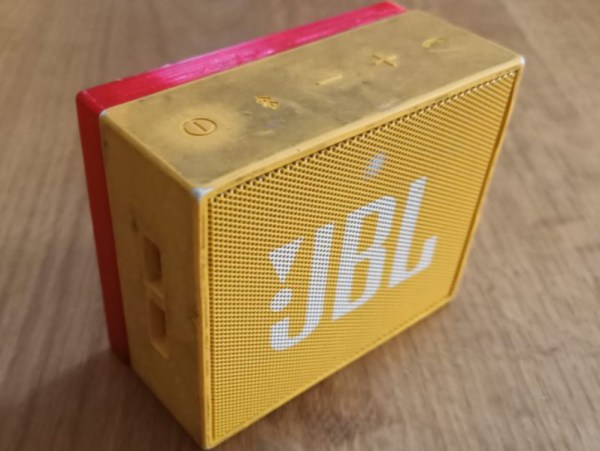
Perhaps the weakest point in modern electronics when it comes to user servicability is the lifecycle of the batteries included from the manufacturer. Without easily replaceable batteries, many consumer goods end up in the landfill when they’re otherwise working perfectly. If you’d like to get more out of your devices than the manufacturer intends, you might have to go to great lengths like [Théo] did with his JBL speaker.

This was a Bluetooth device produced by JBL nearly a decade ago, and while the original device boasted several hours of battery life, after so many years of service, it was lucky to get a half hour before the battery died. To replace it, [Théo] removed the original battery and extended the case to be able to hold a larger cell phone battery. He also decided to use the original battery management circuit from the speaker with the new battery after verifying the voltage and chemistry were close enough to the original.

Since the phone battery is a proprietary Samsung device, [Théo] also decided to build a version that uses standard 18650 cells instead, although he prefers the slimmer design with the phone battery for his use case.  Straightforward as this build may be, it does go a long way to demonstrate the principle that if you can’t fix your devices, you don’t really own them.
Tiny Pinball Machine Also Runs X86 Code

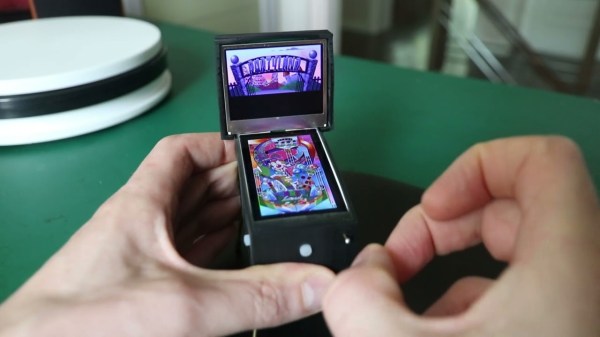
As arcades become more and more rare, plenty of pinball enthusiasts are moving these intricate machines to their home collections in basements, garages, and guest rooms. But if you’re not fortunate enough to live in a home that can support a space-intensive hobby like pinball machines, there are some solutions to that problem. This one, for example, fits on the palm of your hand and also happens to run some impressive software for its size.

The machine isn’t a mechanical pinball machine like its larger cousins, though. Its essentially a 3D printed case made to look like a pinball machine with two screens attached. It does have a working plunger for launching the ball and two buttons on the sides for the approximation of authenticity, but it’s actually running Pinball Fantasies — a pinball simulator designed to run on x86 hardware from the 90s. This sports an ESP32 on the inside, which has just enough computing capability to run an x86 emulator that can load these games in DOS.

The game includes haptic feedback and zips along at 60 frames per second, which really brings the pinball experience to its maximum level given the game’s minuscule size. It’s impressive for fitting a lot into a small space, both from physical and software points-of-view. For more full-sized digital pinball builds, take a look at this one which comes exceptionally close to replicating the real thing.

Continue reading “Tiny Pinball Machine Also Runs X86 Code”

Nokia 5110 Gets Android Stowaway And A Keyboard

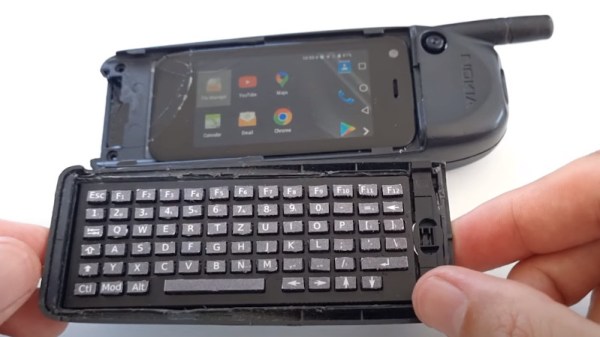
Even though Nokia is largely an afterthought in the phone market now, there was a time when their products represented the state-of-the-art in mobile devices. Some of the their handsets even featured slide-out keyboards and the ability to sent emails; largely unheard of for a device from the late 90s. [befinitiv] was a kid back then and couldn’t afford one of these revolutionary devices, so he built his own modern version that still looks and feels like the original.

To do this he borrowed the case and structure of a Nokia 5110 phone, but modified it to hold a small Android device in the old battery compartment along with a tiny Bluetooth keyboard (which was also built from scratch by [befinitiv]) that connects to the Android phone to mimic the old slide-out style. This isn’t just a case mod, though. He also reverse-engineered the original PCB of the phone and included a Bluetooth module there as well, which allows the phone’s screen and keypad to work mostly as originally intended.

This project goes pretty far to scratch the 90s phone nostalgia itch while still being largely usable as a real phone in the modern world. Assuming you aren’t too hung up on the literal phone aspect, the Notkia project is also an impressive effort to bring new life to these old handsets.

Continue reading “Nokia 5110 Gets Android Stowaway And A Keyboard”

Programmable Resistance Box

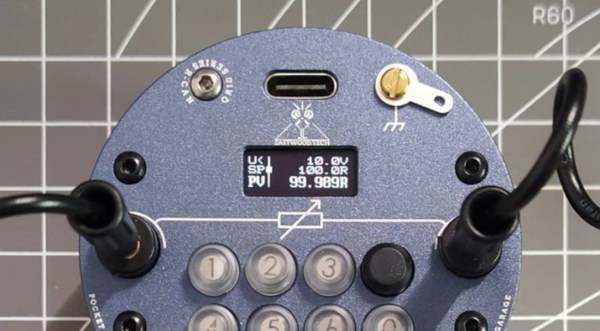
For prototype electronics projects, most of us have a pile of resistors of various values stored somewhere on our tool bench. There are different methods of organizing them for easy access and identification, but for true efficiency a resistance substitution box can be used on the breadboard to quickly change resistance values at a single point in a circuit. Until now it seemed this would be the pinnacle of quickly selecting differently-sized resistors, but thanks to this programmable resistor bank there’s an even better option available now.

Unlike a traditional substitution box or decade box, which uses switches or dials to select different valued resistors across a set of terminals, this one is programmable and uses a series of sealed relays instead. That’s not where the features stop, though. It also comes equipped with internal calibration circuitry which take into account the resistance of the relay contacts and internal wiring to provide a very precise resistance value across its terminals. It’s also able to be calibrated manually to account for temperature or other factors.

For an often-overlooked piece of test equipment, this one surely fits the bill of something we didn’t know we needed until now. Even though digital resistor substitution boxes are things we have featured in the past, the connectivity and calibration capabilities of this one make it intriguing.

Weed Eater String Made From Plastic Bottles

For those who don’t mind constantly adding tiny but measurable amounts of microplastics to their landscaping, string trimmers are an excellent way of maintaining edging around garden beds, trimming weeds, or maintaining ground covers on a steep hill. One problem with them, though, is that not only is the string consumable but it can be expensive. Plus, if you have a trimmer with a proprietary spool you need to hope the company never goes out of business. Or, you can simply refill your string spool with this handy tool.

The build uses plastic bottles to create the string from what would likely become garbage anyway. First, a sharp roller-style knife slices the plastic into a long thin strip. Once cut, it is fed through a heater similar to a hot end on a 3D printer which allows the plastic to be deformed or forged into a cylinder. From there the plastic is added onto a spool, which also has the motor in it that drives the entire mechanism. In this case it is using an old variable-speed drill.

From the comments on the video, there is some discussion about the economics of using this string in a weed eater. It’s likely the plastic won’t last as long as specialty string trimmer string, and the time and expense of making the plastic may never save much money. But we have to give credit to the ingenuity nonetheless. And, if you’re really into recycling plastic just for the sake of keeping it out of the landfill, there are plenty of other ways to go about accomplishing that goal.

I will NEVER buy weed whip line again! from landscaping

Pocket Radio Powered By Tiny Microcontroller

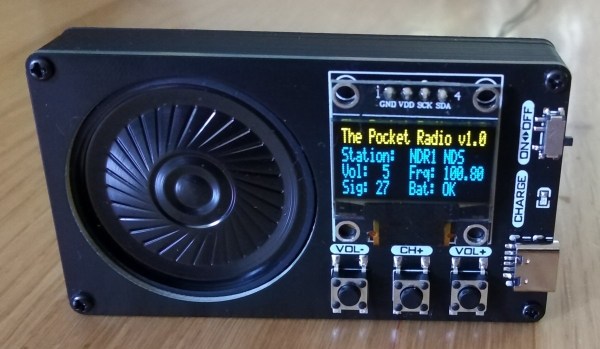
Before the days of MP3 players and smartphones, and even before portable CD players, those of us of a certain age remember that our cassette players were about the only way to take music on-the-go. If we were lucky, they also had a built-in radio for when the single tape exhausted both of its sides. Compared to then, it’s much easier to build a portable radio even though cassettes are largely forgotten, as [wagiminator] shows us with this radio design based on an ATtiny.

The build is about as compact as possible, with the aforementioned ATtiny 402/412 as its core, it also makes use of an integrated circuit FM tuner,  an integrated audio amplifier with its own single speaker, and a small OLED display. The unit also boasts its own lithium-polymer battery charger and its user interface consists of only three buttons, plenty for browsing radio stations and controlling volume.

The entire build fits easily in the palm of a hand and is quite capable for a mobile radio, plus all of the schematics and code is available on the project page. While it doesn’t include AM capability, just the fact that FM is this accessible nowadays when a few decades ago it was cutting-edge technology is quite remarkable. If you’re looking for an even smaller FM receiver without some of the bells and whistles of this one, take a look at this project too.

Computer Vision Extracts Lightning From Footage

Lightning is one of the more mysterious and fascinating phenomenon on the planet. Extremely powerful, but each strike on average only has enough energy to power an incandescent bulb for an hour. The exact mechanism that starts a lightning strike is still not well understood. Yet it happens 45 times per second somewhere on the planet. While we may not gain a deeper scientific appreciation of lightning anytime soon, but we can capture it in various photography thanks to this project which leverages computer vision machine learning to pull out the best frames of lightning.

The project’s creator, [Liam], built this as a tool for stormchasers and photographers so that they can film large amounts of time and not have to go back through their footage manually to pull out the frames with lightning strikes. The project borrows from a similar project, but this one adds Python 3 capabilities and runs on a tiny netbook for more easy field deployment. It uses OpenCV for object recognition, using video files as the source data, and features different modes to recognize different types of lightning.

The software is free and open source, and releases are supported for both Windows and Linux. So far, [Liam] has been able to capture all kinds of electrical atmospheric phenomenon with it including lightning, red sprites, and elves. We don’t see too many projects involving lightning around here, partly because humans can only generate a fraction of the voltage potential needed for the average lightning strike.