A Simpsons TV For A Golden Age

While the pace of technology continues to advance at breakneck speed, certain things in the past are left behind largely subject to the whims of nostalgia. Televisions, for example, are lighter, cheaper, and bigger than they were in the early 90s, but they did have a certain design aesthetic that doesn’t exist anymore. Meanwhile, Simpsons episodes have been (arguably) on the decline since the golden age of the 90s, so [buba447] decided to combine these two facets of a nostalgic past into a custom TV that only plays these older Simpsons episodes.

Update: Now there’s a build guide.

The TV is 3D printed but takes design cues from CRT-based technology from decades past. It even has working knobs emblematic of that era as well. Inside the “television” is a Raspberry Pi which is hooked up to a small screen. The Pi powers up and automatically starts playing Simpsons episodes once it boots. There is a power button at the top of the TV which mutes the sound and also turns off the display. As an added touch, the display outputs in 640×480 resolution, which is also somewhat historically accurate, even if the TV itself is much smaller than its ancient relatives.

Of course, the TV only plays episodes from The Simpson’s first eleven seasons, which includes all of the episodes of The Simpson’s golden era (and a few extra) and omits those episodes from the modern era, which will please certain Simpsons fans as well. This actually isn’t the first time we’ve seen a 24 hour Simpsons device. This Pi-based build serves up Simpsons episodes nonstop as well, but sends them out over the airwaves instead.

Continue reading “A Simpsons TV For A Golden Age”

Cash register keyboard

Custom Keyboard From A Cash Register

Having a high-quality mechanical keyboard is often a rite of passage in the computing world, with gamers and coders alike having strong opinions on the best devices. Even then, the standard keyboard layout can be substantially limiting, and often something a little extra and customizable is needed beyond even the highest-quality QWERTY keyboards. Reddit user [RonaldMcWhisky] was looking for a keyboard to use for macros, and discovered that it is possible to put cash register keyboards into service for any unique task.

Cash register keyboards have a number of advantages over a standard QWERTY design. They have big keys, the keys can be labeled, and the keys can be ordered in a way the user wants. The hardware is also cheap since cash registers are everywhere. Adapting one to work with a standard computer took a little bit of doing. Since this is /r/linuxhardware, you’re not going to find any Windows support here, but assuming you have the minimum system requirements of a Linux install to recognize the keyboard itself, a Python script can handle the events as the keys are pressed and interpret them in whatever way you want.

The actual hardware in this specific build was a Wincor Nixdorf TA85P — let us know in the comments if you’ve got one of those in your junk box. But the idea of using a cash register for a custom keyboard is interesting, and certainly a lot of work is already done for you if you don’t want to build your own custom keyboard from the ground up.

Razer Mouse Grants Windows Admin Privileges

As the common saying goes, “all networked computers are vulnerable to exploits, but some networked computers are more vulnerable than others”. While not the exact wording from Animal Farm, the saying does have plenty of merit nonetheless. Sure, there are some viruses and issues with Linux distributions but by far most of the exploits target Windows, if only because more people use it daily than any other operating system. The latest Windows 10 exploit, discovered by [jonhat], is almost comically easy too, and involves little more than plugging in a mouse.

While slightly comforting in that an attacker would need physical access to the device rather than simple network access, it is very concerning how simple this attack is otherwise. Apparently plugging in a Razer mouse automatically launches Windows Update, which installs a driver for the mouse. The installation is run with admin privileges, and a Power Shell can be opened by the user simply by pressing Shift and right-clicking the mouse. While [jonhat] originally tried to let the company know, they weren’t responsive until he made the exploit public on Twitter, and are now apparently working on solving the issue.

Others have confirmed the exploit does in fact work, so hopefully there is a patch released soon that solves the issue. In the meantime, we recommend not allowing strangers to plug any devices into your personal computers as a general rule, or plugging in anything where its origins are unknown. Also remember that some attacks don’t required physical or network access at all, like this one which remotely sniffs keystrokes from a wireless keyboard with less than stellar security, also coincidentally built by Microsoft.

Automated musical instrument with LED array

ESP32 Is The Brains Behind This Art Installation

The ESP32 has enabled an uncountable number of small electronics projects and even some commercial products, thanks to its small size, low price point, and wireless capabilities. Plenty of remote sensors, lighting setups, and even home automation projects now run on this small faithful chip. But being relegated to an electronics enclosure controlling a small electrical setup isn’t all that these tiny chips can do as [Eirik Brandal] shows us with this unique piece of audio and visual art.

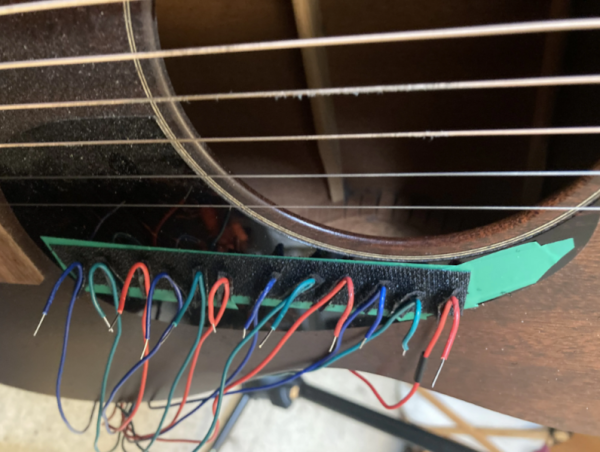
The project is essentially a small, automated synthesizer that has a series of arrays programmed into it that correspond to various musical scales. Any of these can be selected for the instrument to play through. The notes of the scale are shuffled through with some random variations, allowing for a completely automated musical instrument. The musical generation is entirely analog as well, created by some oscillators, amplifiers, and other filtering and effects. The ESP32 also controls a lighting sculpture that illuminates a series of LEDs as the music plays.

The art installation itself creates quite haunting, mesmerizing tunes that are illustrated in the video linked after the break. While it’s not quite to the realm of artificial intelligence since it uses pre-programmed patterns with some randomness mixed in, it does give us hints of some other projects that have used AI in order to compose new music.

Continue reading “ESP32 Is The Brains Behind This Art Installation”

Modern Tape Echo Made Easy

Modern popular music increasingly relies on more and more complicated and intricate equipment and algorithms to generate catchy tunes, but even decades ago this was still the case. The only difference between then and now was that most of the equipment in the past was analog instead of digital. For example, the humble tape echo was originally made by running a loop of magnetic tape over a recording head and then immediately playing it back. Old analog machines from that era are getting harder and harder to find, so [Adam Paul] decided to make his own.

At first, [Adam] planned to use standard cassette tapes in various configurations in order to achieve the desired effect, but this proved to be too cumbersome and he eventually switched his design to using the cassette internals in a custom tape deck. The final design includes a small loop of tape inside of the enclosure with a motor driving a spindle. The tape is passed over a record head, then a read head, and then an erase head in order to achieve the echo sound. All of this is done from inside of the device itself, with 1/4″ jacks provided so that the musician can plug in their instrument of choice just like a standard effects pedal would be configured.

The entire build is designed to be buildable and repairable using readily-available parts as well, which solves the problem of maintaining (or even finding) parts from dedicated tape echo machines from decades ago. We like the sound from the analog device, as well as the fact that it’s still an analog device in a world of otherwise digital substitutes. Much like this magnetic tape-based synthesizer we featured about a year ago.

Continue reading “Modern Tape Echo Made Easy”

Occam’s Razor: Gardening Edition

While the impulse to solving problems in complex systems is often to grab a microcontroller and some sensors to automate the problem away, interfacing with the real world is often a lot more difficult than it appears. Measuring soil moisture, for example, seems like it would be an easy way of ensuring plants get the proper amount of water, but soil is a challenging environment for electronics and this solution often causes more problems than it solves. [Kevin] noticed this problem with soil moisture sensors and set about solving this problem with a much simpler, though indirect, method of monitoring his plants electronically.

Rather than relying on soil conductivity for testing soil moisture levels, he has developed an alternate method of determining if the plants need to be watered simply by continuously weighing them. The hypothesis that he had was that a plant that needs water will weigh less as the available water respirates out of the plant or evaporates from the soil. This means that using a reliable sensor like a load cell to measure weight rather than an unreliable one like a soil moisture sensor will result in more reliable data he can use to automate his plants’ watering.

[Kevin]’s build is based around an ESP32 and a commercially-available load cell which are all built into the base of the plant’s pot. The design hides all of the electronics in a pleasant enclosure and is able to communicate relevant info wirelessly as well. The real story here, however, isn’t a novel use of an ESP32 chip, but rather out-of-the-box problem solving by using an atypical sensor to solve this problem. That’s not to say that you can’t ever use other sensors to directly monitor your garden and automate its health, though.

Beginning The Machine Shop Journey With A DIY CNC

Building a good quality machine shop may seem to present a chicken-and-egg problem, at least for anyone not willing to mortgage their home for the money needed to buy all of these tools new. Namely, that building good tools often requires good tools. To help solve this problem, [Ryan] designed and built this CNC machine which can be built with nothing other than common tools, hardware store supplies, and some readily available parts from the internet.

Since it’s being built from consumer-grade material, [Ryan] has the design philosophy of “buying precision” which means that most of the parts needed for this build are precise enough for their purpose without needing to be worked in any way before incorporation into the mill. For example, he uses a granite plate because it’s hard, flat, heavy, and sturdy enough at the time of purchase to be placed into the machine right away. Similarly, his linear guides do not need to be modified before being put to work with a high degree of precision and minimal calibration. From there, he applies the KISS principle and uses the simplest parts available. With this design process he is able to “bootstrap” a high quality mill for around $1500 USD without needing any extra tools than the ones you likely already have.

The RIG-CNC as it is known has also been made completely open source which further cements its bootstrapability, and there is a lot more detail on the project page and in the video linked below. This project is unique not simply for the mill build from common parts and tools, but because this design philosophy is so robust. Good design goes a lot farther in our builds than a lot of us might realize, and good design often results in more maintainable, hackable things that work for more uses than the original creators may have even thought about.

Continue reading “Beginning The Machine Shop Journey With A DIY CNC”