There Is No Spoon; Automatic Self Stirring Mug

Sometimes it’s helpful to realize the truth that there is no spoon. At least, not with [Ronaldo]’s automatic self-stirring mug. At first it was just a small propeller in the bottom of the mug that turned on by pushing a button in the handle, but this wasn’t as feature-rich as [Ronaldo] hoped it could be, so he decided to see just how deep the automatic beverage-mixing rabbit hole goes.

The first thing to do was to get a microcontroller installed to handle the operation of the motor. The ATtiny13a was perfect for the job since it’s only using one output pin to control the motor, and can be configured to only draw 0.5 microamps in power-saving mode. This ensures a long life for the two AAA batteries that power the microcontroller and the motor.

As far as operation goes, the motor operates in different modes depending on how many times the button in the handle is pushed. It can be on continuously or it can operate at pre-determined intervals for a certain amount of time, making sure to keep the beverage thoroughly mixed for as long as the power lasts. Be sure to check out the video below for a detailed explanation of all of the operating modes. We could certainly see some other possible uses for more interesting beverages as well.

Continue reading “There Is No Spoon; Automatic Self Stirring Mug”

The Stork Looks Different Than We Thought

What the Internet of Things really needs is more things, and the more ridiculous the better. At least, that’s the opinion of [Eric] who has created a tongue-in-cheek gadget to add to the growing list of connected devices. It’s a Bluetooth-enabled pregnancy test that automatically releases the results to the world. Feeling lucky?

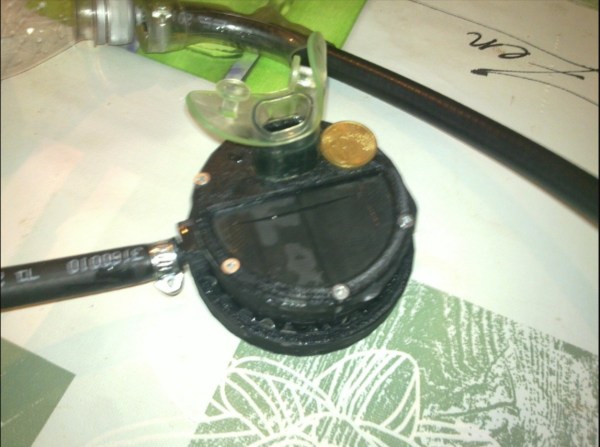
The theory of operation is fairly straightforward. A Bluetooth low-energy module is integrated into the end of a digital pregnancy test. These tests have a set of photo detectors to read the chemical strip after the test is conducted. If the test is positive, the module sends a signal to a Raspberry Pi which tweets the results out for the world to see. It also has an option to send a text message to your mom right away!

[Eric]’s project to live-tweet a pregnancy test also resulted in a detailed teardown of a digital pregnancy test, so if you need any technical specifications for pregnancy tests (for whatever reason) his project site has a wealth of information. He does note that his device can be used on other similar devices with directly driven LCD screens, too. The fun doesn’t end there, though! Once the pregnancy is a little further along you’ll be able to get the baby on Twitter, too.

Continue reading “The Stork Looks Different Than We Thought”

Truck-Sized Star Destroyer Takes Flight

While some of you may have been to see the new Star Wars movie, you might be sad that everything happened a long time ago in a galaxy far away. But there’s a group of RC enthusiasts called [Flite Test] who are trying to bring at least a little bit of that fantasy into real life. They’ve created a truck-sized Star Destroyer that actually flies. It looks kind of terrifying, too.

While it’s not as big as a “real” Star Destroyer, it’s certainly one of the biggest we’ve ever seen in real life. Built out of foam, this monstrosity is 15 feet long and powered by two huge electric motors and a large lithium polymer battery. Of course they didn’t start out by building this huge flying spaceship; they created a smaller model as proof-of-concept and flew that one around for a while to make sure everything was shipshape. While it’s exciting to see the small model in flight, it’s another thing to see the 15-foot version swooping around.

We’re sad to report that the Star Destroyer did meet a similar fate as the one that Rey was scavenging at the beginning of the movie (spoilers: it crashed), we hope that the RC team rebuilds it so it’s space worthy again. Maybe they can even add a real-life ion drive or a few lasers to make it even more real.

Continue reading “Truck-Sized Star Destroyer Takes Flight”

Guerrilla Grafters Grow Great Gifts For Greater Good

If you’ve been to downtown San Francisco lately, you might have noticed something odd about the decorative trees in the city: they’re now growing fruit. This is thanks to a group of people called the Guerrilla Grafters who are covertly grafting fruit-bearing twigs to city tress which would otherwise be fruitless. Their goal is to create a delicious, free source of food for those living in urban environments.

Biology-related hacks aren’t something we see every day, but they’re out there. For those unfamiliar with grafting, it’s a process that involves taking the flowering, fruiting, or otherwise leafy section of one plant (a “scion”) and attaching them to the vascular structure of another plant that has an already-established root system (the “stock”). The Guerrilla Grafters are performing this process semi-covertly and haven’t had any run-ins with city officials yet, largely due to lack of funding on the city’s part to maintain the trees in the first place.

This hack doesn’t stop at the biological level, though. The Grafters have to keep detailed records of which trees the scions came from, when the grafts were done, and what characteristics the stock trees have. To keep track of everything they’ve started using RFID tags. This is an elegant solution that can be small and inconspicuous, and is a reliable way to keep track of all of one’s “inventory” of trees and grafts.

It’s great to see a grassroots movement like this take off, especially when it seems like city resources are stretched so thin that the trees may have been neglected anyway. Be sure to check out their site if you’re interested in trying a graft yourself. If you’re feeling really adventurous, you can take this process to the extreme.

Thanks to [gotno] for the tip!

ATtiny Does 170×240 VGA With 8 Colors

The Arduino is a popular microcontroller platform for getting stuff done quickly: it’s widely available, there’s a wealth of online resources, and it’s a ready-to-use prototyping platform. On the opposite end of the spectrum, if you want to enjoy programming every bit of the microcontroller’s flash ROM, you can start with an arbitrarily tight resource constraint and see how far you can push it. [lucas][Radical Brad]’s demo that can output VGA and stereo audio on an eight-pin DIP microcontroller is a little bit more amazing than just blinking an LED.

[lucas][RB] is using an ATtiny85, the larger of the ATtiny series of microcontrollers. After connecting the required clock signal to the microcontroller to get the 25.175 Mhz signal required by VGA, he was left with only four pins to handle the four-colors and stereo audio. This is accomplished essentially by sending audio out at a time when the VGA monitor wouldn’t be expecting a signal (and [lucas][Rad Brad] does a great job explaining this process on his project page). He programmed the video core in assembly which helps to optimize the program, and only used passive components aside from the clock and the microcontroller.

Be sure to check out the video after the break to see how a processor with only 512 bytes of RAM can output an image that would require over 40 KB. It’s a true testament to how far you can push these processors if you’re determined. We’ve also seen these chips do over-the-air NTSC, bluetooth, and even Ethernet.

Continue reading “ATtiny Does 170×240 VGA With 8 Colors”

Capture The Flag With Lightsabers

There’s a great game of capture-the-flag that takes place every year at HITCON. This isn’t your childhood neighborhood’s capture-the-flag in the woods with real flags, though. In this game the flags are on secured servers and it’s the other team’s mission to break into the servers in whatever way they can to capture the flag. This year, though, the creators of the game devised a new scoreboard for keeping track of the game: a lightsaber.

In this particular game, each team has a server that they have to defend. At the same time, each team attempts to gain access to the other’s server. This project uses a lightsaber stand that turns the lightsabers into scoreboards for the competition at the 2015 Hacks In Taiwan Conference. It uses a cheap OpenWRT Linux Wi-Fi/Ethernet development board, LinkIt Smart 7688 which communicates with a server. Whenever a point is scored, the lightsaber illuminates and a sound effect is played. The lightsabers themselves are sourced from a Taiwanese lightsabersmith and are impressive pieces of technology on their own. As a bonus the teams will get to take them home with them.

While we doubt that this is more forced product integration advertisement from Disney, it certainly fits in with the theme of the game. Capture-the-flag contests like this are great ways to learn about cyber security and how to defend your own equipment from real-world attacks. There are other games going on all around the world if you’re looking to get in on the action.

Continue reading “Capture The Flag With Lightsabers”

NFC Tags Add Old-School Functionality To New Phone

Back in the day, we had smartphones with physical buttons. Not just power, volume, and maybe another button on the front. Whole, slide-out QWERTY keyboards right on the underside of the phone. It was a lawless wasteland, but for those who yearn for the wild-west days of the late 2000s, [Liviu] has recreated the shortcut buttons that used to exist on the tops of these keyboards for modern-day smartphones.

There were lots of phones that had shortcut keys on their keyboards, but [Liviu] enjoyed using the ones that allowed him to switch between applications (or “apps” as the kids are saying these days) such as the calendar, the browser, or the mail client. To recreate this, he went with a few NFC tags. These devices are easily programmed via a number of apps from your app store of choice, and can be placed essentially anywhere. In order to make them visible to the phone at any time, though, he placed the tags inside a clear plastic case for his phone and can now use them anytime.

If you’ve never used or programmed an NFC tag, this would be a great project to get yourself acquainted with how they operate. Plus, you could easily upgrade this project to allow the tags to do any number of other things. You can take projects like this as far as you want.

Continue reading “NFC Tags Add Old-School Functionality To New Phone”