SandBot Happily And Tirelessly Rolls Patterns In Sand

The patience and precision involved with drawing geometric patterns in sand is right up a robot’s alley, and demonstrating this is [rob dobson]’s SandBot, a robot that draws patterns thanks to an arm with a magnetically coupled ball.

SandBot, SCARA version. The device sits underneath a sand bed, and a magnet (seen at the very top at the end of the folded “arm”) moves a ball bearing through sand.

SandBot is not a cartesian XY design. An XY frame would need to be at least as big as the sand table itself, but a SCARA arm can be much more compact. Sandbot also makes heavy use of 3D printing and laser-cut acrylic pieces, with no need of an external frame.

[rob]’s writeup is chock full of excellent detail and illustrations, and makes an excellent read. His previous SandBot design is also worth checking out, as it contains all kinds of practical details like what size of ball bearing is best for drawing in fine sand (between 15 and 20 mm diameter, it turns out. Too small and motion is jerky as the ball catches on sand grains, and too large and there is noticeable lag in movement.) Design files for the SCARA SandBot are on GitHub but [rob] has handy links to everything in his writeup for easy reference.

Sand and robots (or any moving parts) aren’t exactly a natural combination, but that hasn’t stopped anyone. We’ve seen Clearwalker stride along the beach, and the Sand Drawing Robot lowers an appendage to carve out messages in the sand while rolling along.

Laser Cut Cardboard Robot Construction Kit Eases Learning And Play

It has never been easier to put a microcontroller and other electronics into a simple project, and that has tremendous learning potential. But when it comes to mechanical build elements like enclosures, frames, and connectors, things haven’t quite kept the same pace. It’s easier to source economical servos, motors, and microcontroller boards than it is to arrange for other robot parts that allow for cheap and accessible customization and experimentation.

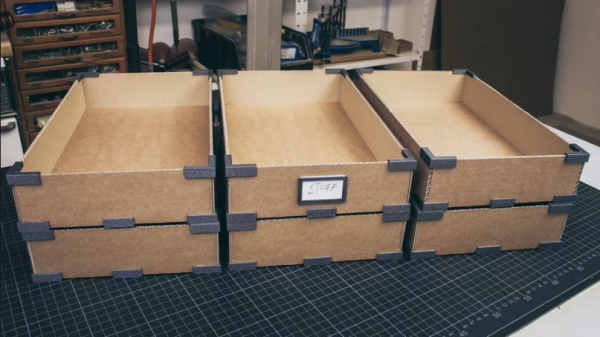
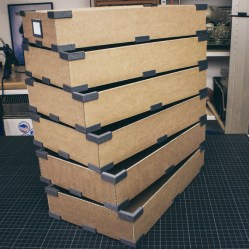
That’s where [Andy Forest] comes in with the Laser Cut Cardboard Robot Construction Kit, which started at STEAMLabs, a non-profit community makerspace in Toronto. The design makes modular frames, enclosures, and basic hardware out of laser-cut corrugated cardboard. It’s an economical and effective method of creating the mechanical elements needed for creating robots and animatronics while still allowing easy customizing. The sheets have punch-out sections for plastic straws, chopstick axles, SG90 servo motors, and of course, anything that’s missing can be easily added with hot glue or cut out with a knife. In addition to the designs being open sourced, there is also an activity guide for educators that gives visual examples of different ways to use everything.

Cardboard makes a great prototyping material, but what makes the whole project sing is the way the designs allow for easy modification and play while being easy to source and produce.

Sonic Robots Don’t Play Instruments, They Are The Instruments

[Moritz Simon Geist]’s experiences as both a classically trained musician and a robotics engineer is clearly what makes his Techno Music Robots project so stunningly executed. The robotic electronic music he has created involves no traditional instruments of any kind. Instead, the robots themselves are the instruments, and every sound comes from some kind of physical element.

A motor might smack a bit of metal, a hard drive arm might tap out a rhythm, and odder sounds come from stranger devices. If it’s technological and can make a sound, [Moritz Simon Geist] has probably carefully explored whether it can be turned into one of his Sonic Robots. The video embedded below is an excellent example of his results, which is electronic music without a synthesizer in sight.

We’ve seen robot bands before, and they’re always the product of some amazing work. The Toa Mata Lego Band are small Lego units and Compressorhead play full-sized instruments on stage, but robots that are the instruments is a different direction that still keeps the same physical element to the music.

Continue reading “Sonic Robots Don’t Play Instruments, They Are The Instruments”

Hybrid Robot Walks, Transforms, And Takes Flight

[Project Malaikat] is a 3D printed hybrid bipedal walker and quadcopter robot, but there’s much more to it than just sticking some props and a flight controller to a biped and calling it a day. Not only is it a custom design capable of a careful but deliberate two-legged gait, but the props are tucked away and deployed on command via some impressive-looking linkages that allow it to transform from walking mode to flying mode.

Creator [tang woonthai] has the 3D models available for download (.rar file) and the video descriptions on YouTube contain a bill of materials, but beyond that there doesn’t seem to be much other information available about [Malaikat]. The creator does urge care to be taken should anyone use the design, because while the robot may be small, it does essentially have spinning blades for hands.

Embedded below are videos that show off the robot’s moves, as well as a short flight test demonstrating that while control was somewhat lacking during the test, the robot is definitely more than capable of actual flight.

Continue reading “Hybrid Robot Walks, Transforms, And Takes Flight”

Listen To A Song Made From Custom Nintendo LABO Waveform Cards

[Hunter Irving] has been busy with the Nintendo LABO’s piano for the Nintendo Switch. In particular he’s been very busy creating his own custom waveform cards, which greatly expands the capabilities of the hackable cardboard contraption. If this sounds familiar, it’s because we covered his original method of creating 3D printed waveform cards that are compatible with the piano, but he’s taken his work further since then. Not only has he created new and more complex cards by sampling instruments from Super Nintendo games, he’s even experimented with cards based on vowel sounds in an effort to see just how far things can go. By layering the right vowel sounds just so, he was able to make the (barely identifiable) phrases I-LIKE-YOU, YOU-LIKE-ME, and LET’S-A-GO.

Those three phrases make up the (vaguely recognizable) lyrics of a song he composed using his custom waveform cards for the Nintendo LABO’s piano, appropriately titled I Like You. The song is at the 6:26 mark in the video embedded below, but the whole video is worth a watch to catch up on [Hunter]’s work. The song is also hosted on soundcloud.

Continue reading “Listen To A Song Made From Custom Nintendo LABO Waveform Cards”

Video Shows Power Isn’t Everything In Laser Engraving

When it comes to power tools, generally speaking more watts is better. But as laser maestro [Martin Raynsford] shows, watts aren’t everything. He shares a brief video showing his older 100 W laser being handily outperformed by a newer 30 W machine. Shouldn’t the higher power laser be able to do the same job in less time? One might think so, but wattage isn’t everything. The 30 W laser engraves and cuts a wooden tile in just under half the time it takes the 100 W machine to do the same job, and with a nicer end result, to boot.

Why such a difference? Part of the answer to that question lies in that the newer machine has better motion control and can handle higher speeds, but the rest is due to the tubes themselves. The older 100 W machine uses a DC-excited (big glass water-cooled tube) CO2 laser, and the newer 30 W machine uses an RF-excited laser that looks a bit like a big metal heat sink instead of oversized lab glassware. Both tubes output what is essentially the same beam, but the RF tube is overall capable of a more refined, more stable, and more finely focused point than that of the glass tube. Since engraving uses only a small fraction of even the 30 W laser’s power, the finer control that the RF laser has over the low end of the power scale results in a much higher quality engraving.

Embedded below is a short video showing both machines engraving and cutting the same tile, side by side. You may wish to consider watching this one full screen, to better see the fine details.

Continue reading “Video Shows Power Isn’t Everything In Laser Engraving”

One-Legged Jumping Robot Shows That Control Is Everything

Robots that can jump have been seen before, but a robot that jumps all the time is a little different. Salto-1P is a one-legged jumping robot at UC Berkeley, and back in 2017 it demonstrated the ability to hop continuously with enough control to keep itself balanced. Since then it has been taught some new tricks; having moved beyond basic stability it can now jump around and upon things with an impressive degree of control.

Key to doing this is the ability to plant its single foot exactly where it wants, which allows for more complex behaviors such as hopping onto and across different objects. [Justin Yim] shows this off in the video embedded below, which demonstrates the Salto-1P bouncing around in a remarkably controlled fashion, even on non-ideal things like canted surfaces. Two small propellers allow the robot to twist in midair, but all the motive force comes from the single leg.

Continue reading “One-Legged Jumping Robot Shows That Control Is Everything”