Pocket High Voltage Generator Becomes Great Test Tool

[The LED Artist] often found a need for a relatively high voltage (100 to 200 Volt) but low current DC power supply, and it turns out that a small HV generator that uses a single AA cell only took about an hour to make. The device ended up being a pretty handy tool for testing things like LED filaments (which have a forward voltage of over 60 V), or even neon and nixie tubes.

The device’s low current means that nixie and neon elements won’t light up very brightly, but they will light up enough to verify function and operation. [The LED Artist] reports that touching the output terminals of the generator only causes a slight tingling sensation.

Open-circuit voltage generated from a single AA cell is about 200 V, but that voltage drops rapidly under any kind of load. Even regular LEDs can be safely lit with the circuit, with less than a milliamp being supplied at the two to three volts at which most regular LEDs operate.

[The LED Artist] fit the device into a two-AA battery holder, with a single AA cell on one side and the circuit in the other, and says it’s one of the more useful tools they’ve ever made. LED filaments are fairly common nowadays, but if they intrigue you, don’t forget that [Mike Harrison] covered everything you need to know about experimenting with them.

SENSEation Shows The Importance Of Good Physical Design

Sensor network projects often focus primarily on electronic design elements, such as architecture and wireless transmission methods for sensors and gateways. Equally important, however, are physical and practical design elements such as installation, usability, and maintainability. The SENSEation project by [Mario Frei] is a sensor network intended for use indoors in a variety of buildings, and it showcases the deep importance of physical design elements in order to create hardware that is easy to install, easy to maintain, and effective. The project logs have an excellent overview of past versions and an analysis of what worked well, and where they fell short.

One example is the power supply for the sensor nodes. Past designs used wall adapters to provide constant and reliable power, but there are practical considerations around doing so. Not only do power adapters mean each sensor requires some amount of cable management, but one never really knows what one will find when installing a node somewhere in a building; a power outlet may not be nearby, or it may not have any unoccupied sockets. [Mario] found that installations could take up to 45 minutes per node as a result of these issues. The solution was to move to battery power for the sensor nodes. With careful power management, a node can operate for almost a year before needing a recharge, and removing any cable management or power adapter meant that installation time dropped to an average of only seven minutes.

That’s just one example of the practical issues discovered in the deployment of a sensor network in a real-world situation, and the positive impact of some thoughtful design changes in response. The GitHub repository for SENSEation has all the details needed to reproduce the modular design, so check it out.

The Magic Flute Of Rat Mind Control Aims To Mix Magic And Science

Well this is unusual. Behold the Magic Flute of Rat Mind Control, and as a project it is all about altering the response to the instrument, rather than being about hacking the musical instrument itself. It’s [Kurt White]’s entry to the Musical Instrument Challenge portion of The Hackaday Prize, and it’s as intriguing as it is different.

The Raspberry-Pi controlled, IoT Skinner box for rats, named Nicodemus.

[Kurt] has created a portable, internet-connected, automated food dispenser with a live streaming video feed and the ability to play recorded sounds. That device (named Nicodemus) is used as a Skinner Box to train rats — anywhere rats may be found — using operant conditioning to make them expect food when they hear a few bars of Black Sabbath’s Iron Man played on a small recorder (which is a type of flute.)

In short, the flute would allow one to summon hordes of rats as if by magic, because they have been trained by Nicodemus to associate Iron Man with food.

Many of the system’s elements are informed by the results of research into sound preference in rats, as well as their ability to discriminate between different melodies, so long as the right frequencies are present. The summoning part is all about science, but what about how to protect oneself from the hordes of hungry rodents who arrive with sharp teeth and high expectations of being fed? According to [Kurt], that’s where the magic comes in. He seems very certain that a ritual to convert a wooden recorder into a magic flute is all the protection one would need.

Embedded below is something I’m comfortable calling the strangest use case video we’ve ever seen. Well, we think it’s a dramatized use case. Perhaps it’s more correctly a mood piece or motivational assist. Outsider Art? You decide.

Continue reading “The Magic Flute Of Rat Mind Control Aims To Mix Magic And Science”

Watch The Snappy, Insect-like Moves Of This DIY Quadruped Robot

Some legged robots end up moving with ponderous deliberation, or wavering in unstable-looking jerks. A few unfortunates manage to do both at once. [MusaW]’s 3D Printed Quadruped Robot, on the other hand, moves in rapid motions that manage to look sharp and insect-like instead of unstable. Based on an earlier design he made for a 3D printable quadruped frame, [MusaW] has now released this step-by-step guide for building your own version. All that’s needed is the STL files and roughly $50 in parts from the usual Chinese resellers to have the makings of a great weekend project.

The robot uses twelve SG90 servos and an Arduino nano with a servo driver board to control them all, but there’s one additional feature: Wi-Fi control is provided thanks to a Wemos D1 Mini (which uses an ESP-8266EX) acting as a wireless access point to serve up a simple web interface through which the robot can be controlled with any web browser.

Embedded below is a brief video. The first half is assembly, and the second half demonstrates the robot’s fast, sharp movements.

Continue reading “Watch The Snappy, Insect-like Moves Of This DIY Quadruped Robot”

Gesture Control Without Fancy Sensors, Just Pots And Weights

[Dennis] aims to make robotic control a more intuitive affair by ditching joysticks and buttons, and using wireless gesture controls in their place. What’s curious is that there isn’t an accelerometer or gyro anywhere to be seen in his Palm Power! project.

The gesture sensing consists not of a fancy IMU, but of two potentiometers (one for each axis) with offset weights attached to the shafts. When the hand tilts, the weights turn the shafts of the pots, and the resulting readings are turned into motion commands and sent over Bluetooth. The design certainly has a what-you-see-is-what-you-get aspect to it, and as a whole it works much like an inverted, weighted joystick hanging from one’s palm.

It’s an economical way to play with the idea of motion sensing, and when it comes to prototyping, being able to test a concept while keeping costs to a minimum is a good skill to have.

These 3D Printed Supports Can Take Hard Use, Thanks To Resin Filling

Liquid two-part resins that cure into a solid are normally used for casting, and [Cuddleburrito] also found them useful to add strength and rigidity to 3D printed pillar supports. In this case, the supports are a frame for some arcade-style buttons, which must stand up to a lot of forceful mashing. Casting the part entirely out of a tough resin would require a mold, and it turns out that filling a 3D print with resin gets comparable benefits while making it easy to embed fastener hardware, if done right.

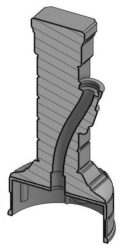
Cap design shows how the nut will be encased and the cap anchored even if the pillar is slightly underfilled with resin. The screw can be backed out after the resin cures.

Filling the inside of an object with some kind of epoxy or resin to reinforce it isn’t a new idea, but [Cuddleburrito] learned how a few small design considerations can lead to less messy and more successful results. The first is that resin can be poured with screws in place without any worry of trapping the screws in the resin, if done correctly. As long as only the threads of the screw are in the resin, they can be backed out after the resin has cured. Embedding nuts into the resin to act as fasteners becomes a much easier task when one can simply pour resin with both nut and screw in place, and remove the screw afterwards. A thin layer of a lubricant on the threads to act as a release may help, but [Cuddleburrito] didn’t seem to need any.

The second thing learned was that, for a pillar that needs a cap and embedded nut on both ends, it can be tricky to fill the object’s void with the perfect amount of required resin before capping it off. On [Cuddleburrito]’s first attempt, he underfilled and there wasn’t enough resin to capture the nut on the top lid of the pillar he was making. The way around this was to offset the nut on a riser, and design in either a witness hole or an overflow relief. A small drain hole or a safe area for runoff allows for filling things right up without an uncontrolled mess in the case of overfilling.

Something worth keeping in mind when experimenting in this area is that in general the faster a resin cures, the more it heats up in the process. It may be tempting to use something like 5 minute epoxy in a pinch, but the heat released from any nontrivial amount of it risks deforming a thin-walled 3D print in the process. For cases where resin would be overkill and the fasteners are small, don’t forget we covered the best ways to add fasteners directly to 3D printed parts.

Faux Aircon Units, Made Entirely From 2D Cuts

2D design and part fabrication doesn’t limit one to a 2D finished product, and that’s well-demonstrated in these Faux Aircon Units [Martin Raynsford] created to help flesh out the cyberpunk-themed Null Sector at the recent 2018 Electromagnetic Field hacker camp in the UK. Null Sector is composed primarily of shipping containers and creative lighting and props, and these fake air conditioner units helped add to the utilitarian ambiance while also having the pleasant side effect of covering up the occasional shipping container logo. Adding to the effect was that the fan blades can spin freely in stray air currents; that plus a convincing rust effect made them a success.

Fan hubs, showing spots for fan blades to be glued. With the exception of embedded bearings, the entire hub (like the rest of the unit) is made from laser-cut MDF.

The units are made almost entirely from laser-cut MDF. The fan blades are cut from the waste pieces left over from the tri-pronged holes, and really showing off the “making 3D assemblies out of 2D materials” aspect are the fan hubs which are (with the exception of bearings) made from laser-cut pieces; a close-up of the hubs is shown here.

Capping off the project is some paint and the rusted appearance. How did [Martin] get such a convincing rust effect? By using real rust, as it turns out. Some cyanoacrylate glue force-cured with misted water for texture, followed by iron powder, then vinegar and hydrogen peroxide with a dash of salt provided the convincing effect. He was kind enough to document the fake rust process on his blog, complete with photos of each stage.

Null Sector showcased a range of creativity; it’s where this unusual headdress was spotted, a device that also showed off the benefits of careful assembly and design.