LED Matrix Hack Chat

Join us on Wednesday, June 9 at noon Pacific for the LED Matrix Hack Chat with Garrett Mace!

It’s pretty amazing how quickly light-emitting diodes went from physics lab curiosity to a mainstream commodity product made in the millions, if not billions. Everything about LEDs has gotten better, smaller, and cheaper over the years, going from an “any color you want as long as it’s red” phase to all the colors of the rainbow and beyond in a relatively short time. LEDs have worked their way into applications that just didn’t seem likely not that long ago, like architectural lighting, automotive applications, and even immense displays covering billboards, buildings, and sporting venues with multicolor, high-resolution displays.

It’s that latter application that seems to have provided a boon to electronics hobbyists, in the form of cheap and plentiful LED matrix modules. These are easily sourced at the usual places, and with their tightly packed pinpoints that can show any color at any intensity, they have a ton of fun and useful applications for the hacker. But how exactly do you put them to use? Usually the electronics end is pretty straightforward, but some of the math involved in figuring out how to address all these LEDs can be a little mind-bending.

To help us sort all this out, Garrett Mace will drop by the Hack Chat. You’ve probably seen Garrett’s cool LED matrix shades, which have gone through a ton of revisions and are a much-copied fashion accessory among the cool hackers. They look simple, but there are tricks to making them work right, and Garrett will share his secrets. Come with your questions on putting LED matrix modules to work, especially those odd-size modules and strange arrangements that defy simple Cartesian coordinates.

join-hack-chatOur Hack Chats are live community events in the Hackaday.io Hack Chat group messaging. This week we’ll be sitting down on Wednesday, June 9 at 12:00 PM Pacific time. If time zones have you tied up, we have a handy time zone converter.

Click that speech bubble to the right, and you’ll be taken directly to the Hack Chat group on Hackaday.io. You don’t have to wait until Wednesday; join whenever you want and you can see what the community is talking about.


Hackaday Links Column Banner

Hackaday Links: June 6, 2021

There are a bunch of newly minted millionaires this week, after it was announced that Stack OverFlow would be acquired for $1.8 billion by European tech investment firm Prosus. While not exactly a household name, Prosus is a big player in the Chinese tech scene, where it has about a 30% stake in Chinese internet company Tencent. They trimmed their holdings in the company a bit recently, raising $15 billion in cash, which we assume will be used to fund the SO purchase. As with all such changes, there’s considerable angst out in the community about how this could impact everyone’s favorite coding help site. The SO leadership are all adamant that nothing will change, but only time will tell.

Continue reading “Hackaday Links: June 6, 2021”

3D-Printed Scale Model Of Perseverance Rover Seems As Complicated As The Real One

Sometimes the best way to figure out how something works is to make a model of it. 3D-modeling software makes it possible to do the job in silico, and sometimes that’s enough. But to really get inside the designer’s head, executing a physical model, like this quarter-scale RC-controlled Perseverance rover, is a great way to go.

If you’re looking for cutting-edge tech or groundbreaking design, this build will probably not light your fire. But a closer look will show not only great details about how JPL designs robots that can operate on Mars, but some great design and 3D-printing tips too. [Dejan]’s modeling process started with the 3D renderings of Perseverance available on the NASA website, which went into SolidWorks via Blender. [Dejan] was intent on capturing all the details of the rover, even those that ended up just for looks. But there’s plenty of functionality, too — the running gear looks and functions just like the six-wheel double-bogie design used on Perseverance, as well as Curiosity before it. This revealed an interesting fact that we didn’t previously realize — that the hull is suspended from a single pivot point on each side, while a linkage across the deck both prevents the body from pivoting and provides differential control of the drive bogies on either side of the rover.

The video below shows both the impressive amount of 3D printing needed to make all the model’s parts as well as the involved assembly process. It also shows the Arduino-controlled model being piloted around via radio control. There’s a lot to learn from this model, and [Dejan]’s craftsmanship here is top-notch too. We’ve seen such builds before from him, like this 3D-printed SCARA arm, a CNC hot-wire foam cutter, and an automated wire bender.

Continue reading “3D-Printed Scale Model Of Perseverance Rover Seems As Complicated As The Real One”

Mariner 4: Our First Up-Close Look At Mars

In the grand scheme of things, it wasn’t all that long ago that the entire body of knowledge of our solar system was built solely with Earth-based observations. Turning first their naked eyes to the heavens, and then a succession of increasingly complex and sensitive optical and radio telescopes gathering light from all across the spectrum, our astronomically curious forbears did a commendable job working out the broad strokes of what’s going on in the neighborhood.

But there’s only so much information that can be gathered by instruments operating at the bottom of a roiling ocean of air, so when the opportunity to send instruments to our planetary neighbors began to be possible some 60 years ago, scientists started planning how to accomplish it. What resulted was the Mariner program, a series of interplanetary probes launched between 1962 and 1973 that performed flyby missions of the inner planets.

The list of accomplishments of the Mariner program is long indeed, and the number of firsts achieved by its ten spacecraft is impressive. But it is Mariner 4, the first flyby mission of Mars, which set the stage for a lot of the science being done on and around Mars today, and the first mission where NASA wisely took a “pics or it didn’t happen” approach to planetary science. It was the first time a TV camera had traveled to another world, and it was anything but a sure bet that it would pay dividends.

Continue reading “Mariner 4: Our First Up-Close Look At Mars”

Adding A Laser Blaster To Classic Atari 2600 Games With Machine Vision

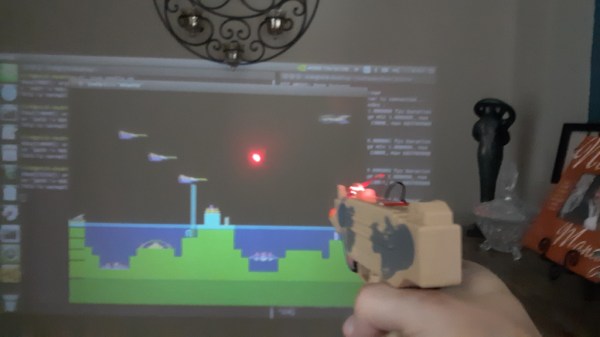
Remember the pistol controller for the original Atari 2600? No? Perhaps that’s because it never existed. But now that we’re living in the future, adding a pistol to the classic games of the 2600 is actually possible.

Possible, but not exactly easy. [Nick Bild]’s approach to the problem is based on machine vision, using an NVIDIA Xavier NX to run an Atari 2600 emulator. The game is projected on a wall, while a camera watches the game field. A toy pistol with a laser pointer attached to it blasts away at targets, while OpenCV is used to find the spots that have been hit by the laser. A Python program matches up the coordinates of the laser blasts with coordinates within the game, and then fires off a sequence of keyboard commands to fire the blasters in the game. Basically, the game plays itself based on where it sees the laser shots. You can check out the system in the video below.

[Nick Bild] had a busy weekend of hacking. This was the third project write-up he sent us, after his big-screen Arduboy build and his C64 smartwatch.

Continue reading “Adding A Laser Blaster To Classic Atari 2600 Games With Machine Vision”

Make Your Desoldering Easier By Minding Your Own Bismuth

Any video that starts with a phase diagram has instantly earned our attention. Admittedly, we have a pretty low bar for that kind of stuff, but eye candy aside, [Robin Debreuil]’s quick outline of his technique for desoldering with the help of bismuth is worth watching.

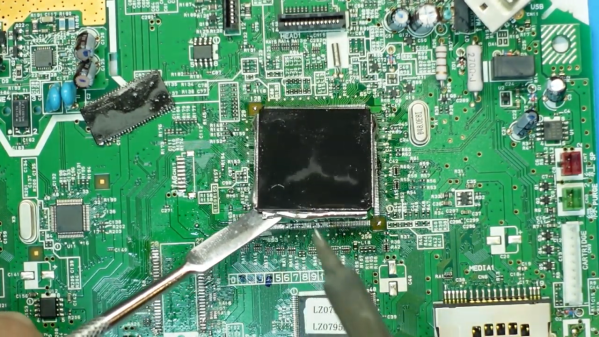
Aside from its use in those pink gloopy solutions one takes for an upset stomach, bismuth has a lot of commercial applications. For the purposes of desoldering, though, its tendency to lower the melting point of tin and tin alloys like solder is what makes it a valuable addition to the toolkit. [Robin] starts with a demonstration of just how far a little bismuth depresses the melting point of tin solder — to about 135°. That allows plenty of time to work, and freeing leads from pads becomes a snap. He demonstrates this with some large QFP chips, which practically jump off the board. He also demonstrates a neat technique for cleaning the bismuth-tin mix off the leads, using a length of desoldering braid clamped at an angle to the vertical with some helping-hands clips. The braid wicks the bismuth-tin mix away from the leads along one side of the chip, while gravity pulls it down the braid to pool safely on the bench. Pretty slick.

Lest leaded solder fans fret, [Robin] ensures us this works well for lead-tin solder too. You won’t have to worry about breaking the bank, either; bismuth is pretty cheap and easily sourced. And as a bonus, it’s pretty non-toxic, at least as far as heavy metals go. But alas — it apparently doesn’t machine very well.

Continue reading “Make Your Desoldering Easier By Minding Your Own Bismuth”

Satellite Communications Hack Chat

Join us on Wednesday, June 2 at noon Pacific for the Satellite Comms Hack Chat with Paul Marsh!

All things considered, space isn’t that far away; you could drive the equivalent distance in an hour or two, with time for a couple of stops on the way. Of course, getting to space isn’t as simple as a Sunday drive, and yet despite the expense and trouble, we’ve still managed to fill our little corner of the solar system with an astonishing number of satellites.

Almost every single one of the spacecraft we’ve put in orbit represents a huge capital investment, both in terms of building something that can withstand the extreme environment up there and as far as the expense involved in getting it there. So once it gets there, it needs to start producing results, and for the most part that means sending some kind of messages back down to Earth. And those communications can be tempting indeed to hardware hackers.

Monitoring messages from on high is what the satcom radio hobby is all about. Learning how to do it properly can be tricky, though. What frequencies does one use? What are the modulation schemes? What kind of antennas would someone need? And what about tracking these birds as they whizz overhead?

To answer these questions and more, Paul Marsh from UHF-Satcom will stop by the Hack Chat. Paul has been interested in satellites since the early 1990s and coupled with his background in infosec and pentesting, he has uncovered a lot about the ins and outs of satellite snooping. Stop by the Hack Chat and learn how to sniff in on what’s going on upstairs.

join-hack-chatOur Hack Chats are live community events in the Hackaday.io Hack Chat group messaging. This week we’ll be sitting down on Wednesday, June 2 at 12:00 PM Pacific time. If time zones have you tied up, we have a handy time zone converter.

Click that speech bubble to the right, and you’ll be taken directly to the Hack Chat group on Hackaday.io. You don’t have to wait until Wednesday; join whenever you want and you can see what the community is talking about.