Precision Optics Hack Chat With Jeroen Vleggaar Of Huygens Optics

Join us on Wednesday, December 2nd at noon Pacific for the Precision Optics Hack Chat with Jeroen Vleggaar!

We sometimes take for granted one of the foundational elements of our technological world: optics. There are high-quality lenses, mirrors, filters, and other precision optical components in just about everything these days, from the smartphones in our pockets to the cameras that loom over us from every streetlight and doorway. And even in those few devices that don’t incorporate any optical components directly, you can bet that the ability to refract, reflect, collimate, or otherwise manipulate light was key to creating the electronics inside it.

The ability to control light with precision is by no means a new development in our technological history, though. People have been creating high-quality optics for centuries, and the methods used to make optics these days would look very familiar to them. Precision optical surfaces can be constructed by almost anyone with simple hand tools and a good amount of time and patience, and those components can then be used to construct instruments that can explore the universe wither on the micro or macro scale.

Jeroen Vleggaar, know better as Huygens Optics on YouTube, will drop by the Hack Chat to talk about the world of precision optics. If you haven’t seen his videos, you’re missing out!

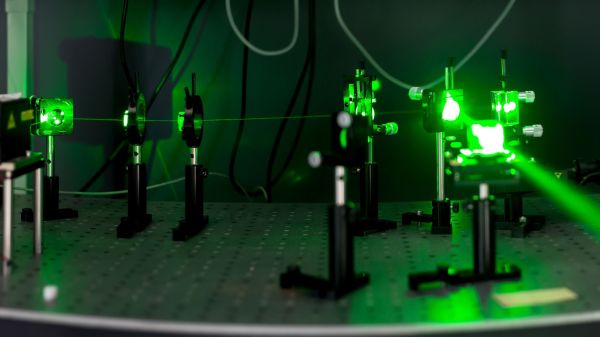
When not conducting optical experiments such as variable surface mirrors and precision spirit levels, or explaining the Double Slit Experiment, Jeroen consults on optical processes and designs. In this Hack Chat, we’ll talk about how precision optical surfaces are manufactured, what you can do to get started grinding your own lenses and mirrors, and learn a little about how these components are measured and used.

join-hack-chatOur Hack Chats are live community events in the Hackaday.io Hack Chat group messaging. This week we’ll be sitting down on Wednesday, December 2 at 12:00 PM Pacific time. If time zones baffle you as much as us, we have a handy time zone converter.

Click that speech bubble to the right, and you’ll be taken directly to the Hack Chat group on Hackaday.io. You don’t have to wait until Wednesday; join whenever you want and you can see what the community is talking about.

Continue reading “Precision Optics Hack Chat With Jeroen Vleggaar Of Huygens Optics”
TMD-2: A Bigger, Better, More Collaborative Turing Machine

One of the things we love best about the articles we publish on Hackaday is the dynamic that can develop between the hacker and the readers. At its best, the comment section of an article can be a model of collaborative effort, with readers’ ideas and suggestions making their way into version 2.0 of a build.

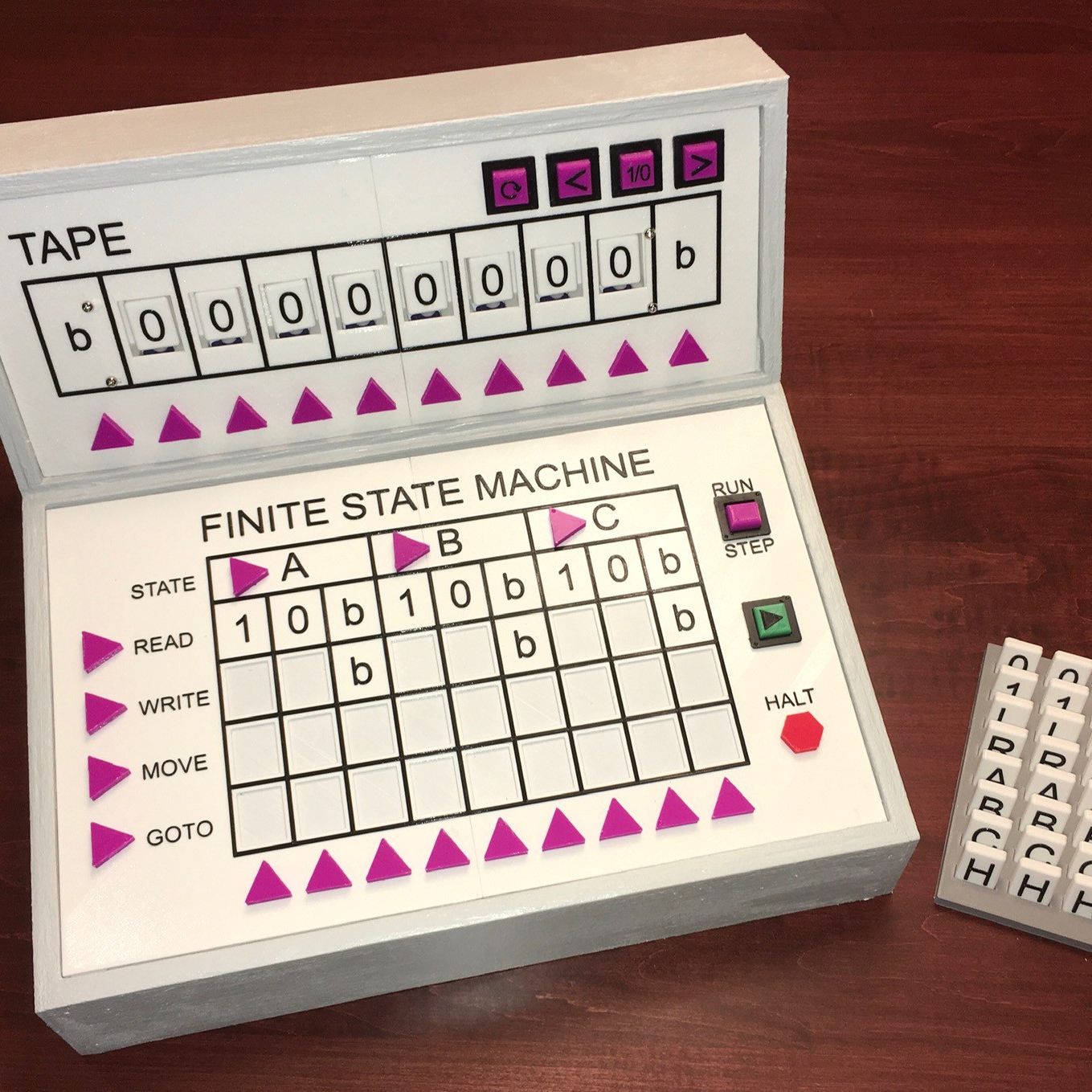
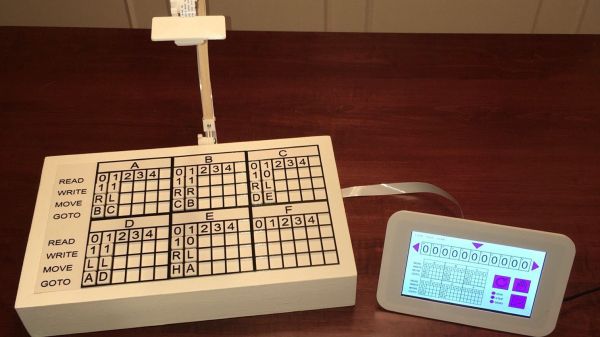
This collegial dynamic is very much on display with TMD-2, [Michael Gardi]’s latest iteration of his Turing machine demonstrator. We covered the original TMD-1 back in late summer, the idea of which was to serve as a physical embodiment of the Turing machine concept. Briefly, the TMD-1 represented the key “tape and head” concepts of the Turing machine with a console of servo-controlled flip tiles, the state of which was controlled by a three-state, three-symbol finite state machine.

TMD-1

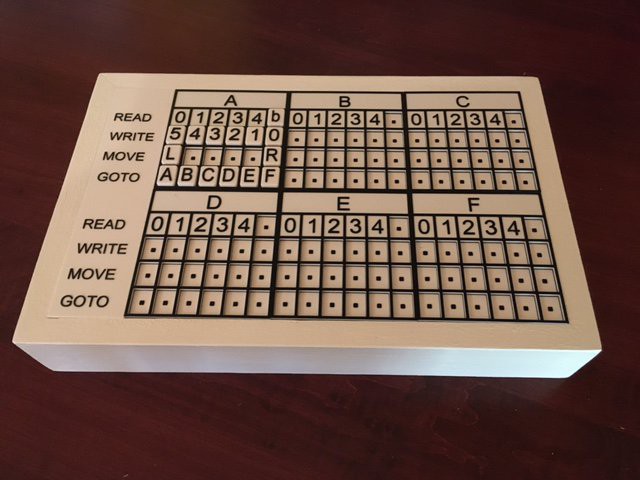
TMD-1 was capable of simple programs that really demonstrated the principles of Turing machines, and it really seemed to catch on with readers. Based on the comments of one reader, [Newspaperman5], [Mike] started thinking bigger and better for TMD-2. He expanded the finite state machine to six states and six symbols, which meant coming up with something more scalable than the Hall-effect sensors and magnetic tiles of TMD-1.

TMD-2 has a camera for computer vision of the state machine tiles

[Mike] opted for optical character recognition using a Raspberry Pi cam along with Open CV and the Tesseract OCR engine. The original servo-driven tape didn’t scale well either, so that was replaced by a virtual tape displayed on a 7″ LCD display. The best part of the original, the tile-based FSM, was expanded but kept that tactile programming experience.

Hats off to [Mike] for tackling a project with so many technologies that were previously new to him, and for pulling off another great build. And kudos to [Newspaperman5] for the great suggestions that spurred him on.

The Wow! Signal And The Search For Extraterrestrial Intelligence

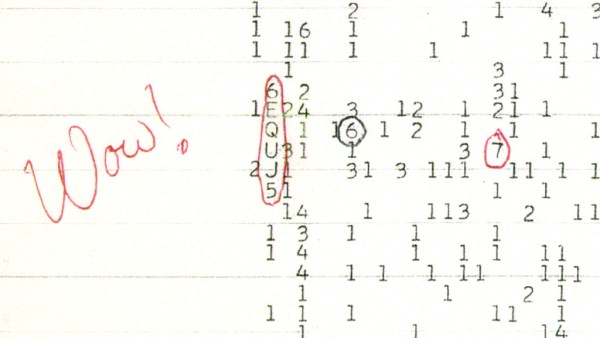
On a balmy August evening in 1977, an enormous radio telescope in a field in the middle of Ohio sat silently listening to the radio universe. Shortly after 10:00 PM, the Earth’s rotation slewed the telescope through a powerful radio signal whose passage was noted only by the slight change in tone in the song sung every twelve seconds by the line printer recording that evening’s data.

When the data was analyzed later, an astronomer’s marginal exclamation of the extraordinarily powerful but vanishingly brief blip would give the signal its forever name: the Wow! Signal. How we came to hear this signal, what it could possibly mean, and where it might have come from are all interesting details of an event that left a mystery in its wake, one that citizen scientists are now looking into with a fresh perspective. If it was sent from a region of space with habitable planets, it’s at least worth a listen.

Continue reading “The Wow! Signal And The Search For Extraterrestrial Intelligence”

Over-the-Top Cyberdeck Is Really A Geiger-Deck

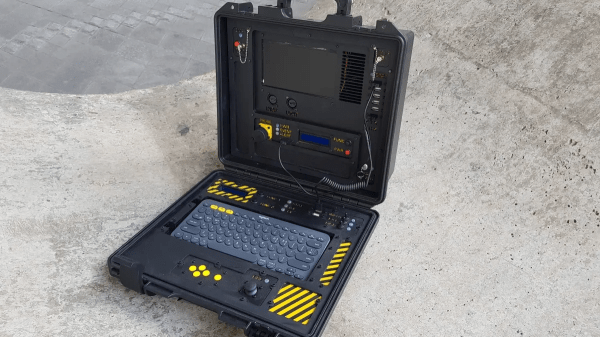
If you like it when a hack has a little backstory, then you’re going to love this cyberdeck build log, the first half of which reads like a [Tom Clancy] novel. And the build itself looks the part, like something that fell off a military helicopter as the Special Forces operators were fast-roping into a hot LZ. Or something like that.

The yarn that [Paul Hoets] spins around his cyberdeck, dubbed RATIS for Remote Assault and Tactical Intelligence System, is pretty good reading and pretty imaginative. The cyberdeck itself looks very much the part, built into a Pelican-style air travel case as such things usually are. Based on a Raspberry Pi 4, the lid of the case serves as a housing for keyboard and controls, while the body houses the computer, an LCD display, and an unusual peripheral: a Geiger counter, which is very much in keeping with the device’s “mission profile”. The handheld pancake probe and stout coiled cord with its MILSPEC connectors really sell the look, too.

Imaginative backstory aside, the construction method here is what really shines. Lacking access to a 3D-printer to produce the necessary greebling, [Paul] instead used a laser cutter to make acrylic panels with cutouts. The contrast between the black panels and the yellow backgrounds makes it all look official, and it’s a technique to keep in mind for builds of a more serious nature, too.

Feel free to look through our fine collection of cyberdeck builds. Some have a fanciful backstory like [Paul]’s, others are intended for more practical purposes. Build whatever you want, just make sure to tip us off when you’re done.

A CPU-Less Computer With A Single NOR-Gate ALU

We see a lot of discrete-logic computer builds these days, and we love them all. But after a while, they kind of all blend in with each other. So what’s the discrete logic aficionado to do if they want to stand out from the pack? Perhaps this CPU-less computer with a single NOR-gate instead of an arithmetic-logic unit is enough of a hacker flex? We certainly think so.

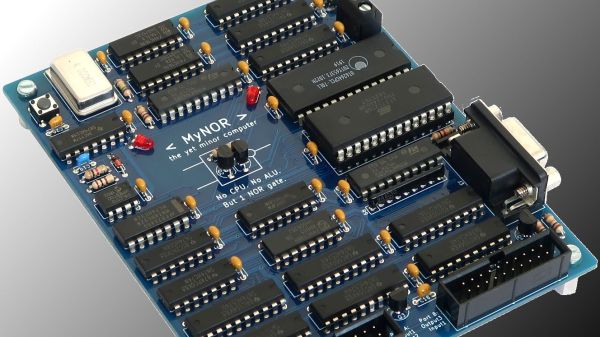
We must admit that when we first saw [Dennis Kuschel]’s “MyNor” we thought all the logic would be emulated by discrete NOR gates, which of course can be wired up in various combinations to produce every other logic gate. And while that would be really cool, [Dennis] chose another path. Sitting in the middle of the very nicely designed PCB is a small outcropping, a pair of discrete transistors and a single resistor. These form the NOR gate that is used, along with MyNor’s microcode, to perform all the operations normally done by the ALU.

While making the MyNor very slow, this has the advantage of not needing 74-series chips that are no longer manufactured, like the 74LS181 ALU. It may be slow, but as seen in the video below, with the help of a couple of add-on cards of similar architecture, it still manages to play Minesweeper and Tetris and acts as a decent calculator.

We really like the look of this build, and we congratulate [Dennis] on pulling it off. He has open-sourced everything, so feel free to build your own. Or, check out some of the other CPU-less computers we’ve featured: there’s the Gigatron, the Dis-Integrated 6502, or the jumper-wire jungle of this 8-bit CPU-less machine.

Continue reading “A CPU-Less Computer With A Single NOR-Gate ALU”

Booting A PC From Vinyl For A Warmer, Richer OS

If you’ve scrolled through the list of boot options offered on any PC’s BIOS, it reads like a history of storage technology. Up top we have the options to boot from disk, often a solid-state drive, then USB disk, optical drive, removable media, and down the bottom there’s usually an option to boot from the network. Practically no BIOS, however, has an option to boot a PC from a vinyl record — at least until now.

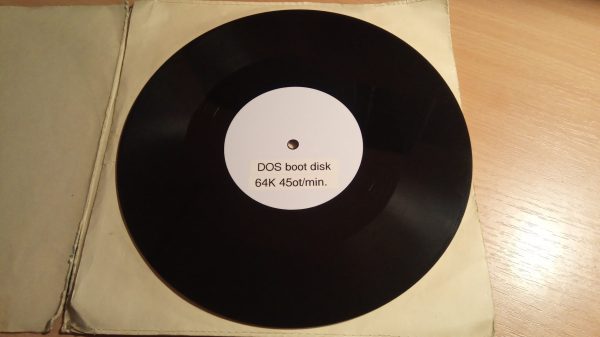
Clearly a project from the “Because why not?” school of hacking, [Jozef Bogin] came up with the twist to the normal booting process for an IBM-PC. As in the IBM-PC — a model 5150, with the putty-colored case, dual 5-1/4″ floppies, and one of those amazing monochrome displays with the green slow-decay phosphors. To pull off the trick, [Jozef] leverages the rarely used and little known cassette tape interface that PCs had back in the early days. This required building a new bootloader and burning it to ROM to make the PC listen to audio signals with its 8255 programmable peripheral interface chip.

Once the PC had the right bootloader, a 64k FreeDOS bootable disk image was recorded on vinyl. [Jozef] provides infuriatingly little detail about the process other than to mention that the audio was sent directly to the vinyl lathe; we’d have loved to learn more about that. Nonetheless, the resulting 10″ record, played back at 45 RPM with some equalization tweaks to adapt for the RIAA equalization curve of the preamp, boots the PC into FreeDOS just fine, probably in no more time than it would have taken to boot from floppy.

It’s may not be the first time we’ve seen software on vinyl, but it’s still a pretty cool hack. Want to try it yourself but lack a record-cutting lathe? Maybe laser-cutting your boot disc will work.

Continue reading “Booting A PC From Vinyl For A Warmer, Richer OS”

Hackaday Links Column Banner

Hackaday Links: November 22, 2020

Remember DSRC? If the initialism doesn’t ring a bell, don’t worry — Dedicated Short-Range Communications, a radio service intended to let cars in traffic talk to each other, never really caught on. Back in 1999, when the Federal Communications Commission set aside 75 MHz of spectrum in the 5.9-GHz band, it probably seemed like a good idea — after all, the flying cars of the future would surely need a way to communicate with each other. Only about 15,000 vehicles in the US have DSRC, and so the FCC decided to snatch back the whole 75-MHz slice and reallocate it. The lower 45 MHz will be tacked onto the existing unlicensed 5.8-GHz band where WiFi now lives, providing interesting opportunities in wireless networking. Fans of chatty cars need not fret, though — the upper 30 MHz block is being reallocated to a different Intelligent Transportation System Service called C-V2X, for Cellular Vehicle to Everything, which by its name alone is far cooler and therefore more likely to succeed.

NASA keeps dropping cool teasers of the Mars 2020 mission as the package containing the Perseverance rover hurtles across space on its way to a February rendezvous with the Red Planet. The latest: you can listen to the faint sounds the rover is making as it gets ready for its date with destiny. While we’ve heard sounds from Mars before — the InSight lander used its seismometer to record the Martian windPerseverance is the first Mars rover equipped with actual microphones. It’s pretty neat to hear the faint whirring of the rover’s thermal management system pump doing its thing in interplanetary space, and even cooler to think that we’ll soon hear what it sounds like to land on Mars.

Speaking of space, back at the beginning of 2020 — you know, a couple of million years ago — we kicked off the Hack Chat series by talking with Alberto Caballero about his “Habitable Exoplanets” project, a crowd-sourced search for “Earth 2.0”. We found it fascinating that amateur astronomers using off-the-shelf gear could detect the subtle signs of planets orbiting stars half a galaxy away. We’ve kept in touch with Alberto since then, and he recently tipped us off to his new SETI Project. Following the citizen-science model of the Habitable Exoplanets project, Alberto is looking to recruit amateur radio astronomers willing to turn their antennas in the direction of stars similar to the Sun, where it just might be possible for intelligent life to have formed. Check out the PDF summary of the project which includes the modest technical requirements for getting in on the SETI action.

Continue reading “Hackaday Links: November 22, 2020”