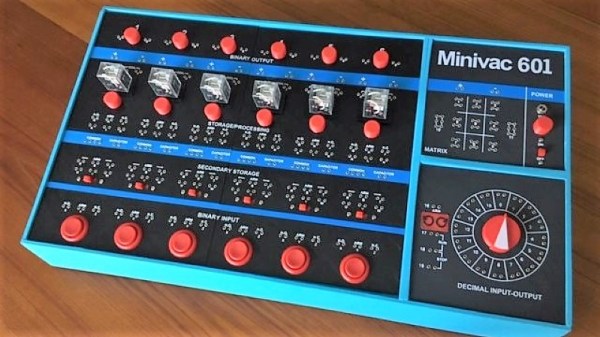
A Faithful Replica Of An Early Computer Trainer

Turn the clock back six decades or so and imagine you’re in the nascent computer business. You know your product has immense value, but only to a limited customer base with the means to afford such devices and the ability to understand them and put them to use. You know that the market will eventually saturate unless you can create a self-sustaining computer culture. But how does one accomplish such a thing in 1961?

Enter the Minivac 601. The brainchild of no less a computer luminary than Claude Shannon, the father of information theory, the Minivac 601 was ostensibly a toy in the vein of the “100-in-1” electronics kits that would appear later. It used electromechanical circuits to teach basic logic, and now [Mike Gardi] has created a replica of the original Minivac 601.

Both the original and the replica use relays as logic switches, which can be wired in various configurations through jumpers. [Mike]’s version is as faithful to the original as possible with modern parts, and gets an extra authenticity boost through the use of 3D-printed panels and a laser-cut wood frame to recreate the look of the original. Sadly, the unique motorized rotary switch, used for both input and output on the original, has yet to be fully implemented on the replica. But everything else is spot on, and the vintage look is great. Extra points to [Mike] for laboriously recreating the original programming terminals with solder lugs and brass eyelets.

We love seeing this retro replica, and appreciate the chance to reflect on the genius of its inventor. Our profile of Claude Shannon is a great place to start learning about his other contributions to computer science. We’ve also got a deeper dive into information theory for the curious.

Thanks to [Granz] for the tip.

Automate The Freight: Autonomous Delivery Hits The Mainstream

It should come as no surprise that we here at Hackaday are big boosters of autonomous systems like self-driving vehicles. That’s not to say we’re without a healthy degree of skepticism, and indeed, the whole point of the “Automate the Freight” series is that economic forces will create powerful incentives for companies to build out automated delivery systems before they can afford to capitalize on demand for self-driving passenger vehicles. There’s a path to the glorious day when you can (safely) nap on the way to work, but that path will be paved by shipping and logistics companies with far deeper pockets than the average commuter.

So it was with some interest that we saw a flurry of announcements in the popular press recently regarding automated deliveries. Each by itself wouldn’t be worthy of much attention; companies are always maneuvering to be seen as ahead of the curve on coming trends, and often show off glitzy, over-produced videos and well-crafted press releases as a low-effort way to position themselves as well as to test markets. But seeing three announcements at one time was unusual, and may point to a general feeling by manufacturers that automated deliveries are just around the corner. Plus, each story highlighted advancements in areas specifically covered by “Automate the Freight” articles, so it seemed like a perfect time to review them and perhaps toot our own horn a bit.

Continue reading “Automate The Freight: Autonomous Delivery Hits The Mainstream”

Add Scroll Wheels And Buttons To Smartphones With 3D-Printed Widgets Read By Accelerometer

The first LED digital wristwatches hit the market in the 1970s. They required a button push to turn the display on, prompting one comedian to quip that giving one to a one-armed man would be in poor taste. While the UIs of watches and other wearables have improved since then, smartphones still present some usability challenges. Some of the touch screen gestures needed to operate a phone, like pinching, are nigh impossible when one-handing the phone, and woe unto those with stubby thumbs when trying to take a selfie.

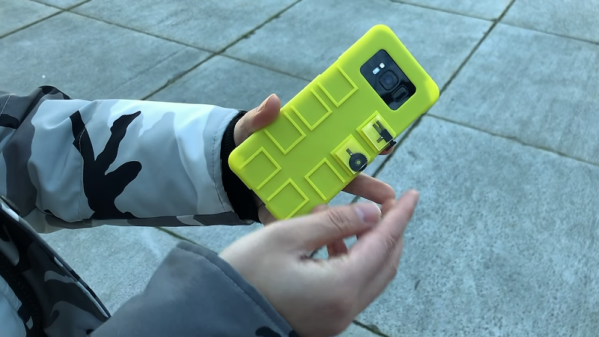
You’d think that the fleet of sensors and the raw computing power on board would afford better ways to control phones. And you’d be right, if the modular mechanical input widgets described in a paper from Columbia University catch on. Dubbed “Vidgets” by [Chang Xiao] et al, the haptic devices are designed to create characteristic acceleration profiles on a phone’s inertial measurement unit (IMU) when actuated. Vidgets take various forms, from push buttons to scroll wheels, each of a similar size and shape and designed to dock into one of eight positions on the back of a 3D-printed phone case. Once trained, the algorithm watches for the acceleration signature caused by actuating a Vidget, and sends commands to the phone to mimic the corresponding gestures. The video below demonstrates a couple of use cases, of which the virtual saxophone is our favorite.

This is really clever stuff, and ventures deep into “Why didn’t I think of that?” territory. Need to get ahead of the curve on IMUs to capitalize on what they can do? You could start with [Al Williams]’ primer on micro-electromechanical systems, or MEMS.

Continue reading “Add Scroll Wheels And Buttons To Smartphones With 3D-Printed Widgets Read By Accelerometer”

Let The Cards Fall Where They May, With A Robotic Rain Man

Finally,  a useful application for machine vision! Forget all that self-driving nonsense and facial recognition stuff – we’ve finally got an AI that can count cards at the blackjack table.

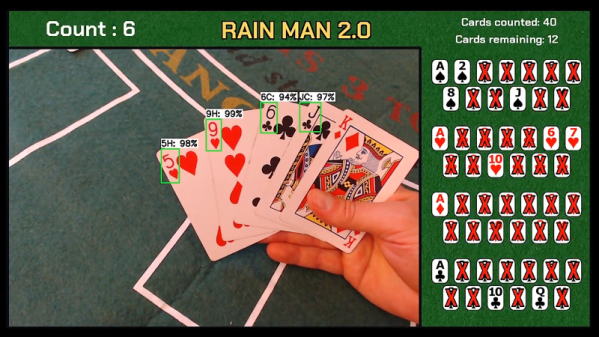
The system that [Edje Electronics] has built, dubbed “Rain Man 2.0” in homage to the classic title character created by [Dustin Hoffman] for the 1988 film, aims to tilt the odds at the blackjack table away from the house by counting cards. He explains one such strategy, a hi-low count, in the video below, which Rain Man 2.0 implements with the help of a webcam and YOLO for real-time object detection. Cards are detected in any orientation based on their suit and rank thanks to an extensive training set of card images, which [Edje] generated synthetically via some trickery with OpenCV. A script automated the process and yielded a rich training set of 50,000 images for YOLO. A Python program implements the trained model into a real-time card counting application.

Rain Man 2.0 is an improvement over [Edje]’s earlier Tensor Flow card counter, but it still has limitations. It can’t count into a six-deck shoe as the fictional [Rain Man] could, at least not yet. And even though cheater’s justice probably isn’t all cattle prods and hammers these days, the hardware needed for this hack is not likely to slip past casino security. So [Edje] has wisely limited its use to practicing his card counting skills. Eventually, he wants to turn Rain Man into a complete AI blackjack player, and explore its potential for other games and to help the visually impaired.

Continue reading “Let The Cards Fall Where They May, With A Robotic Rain Man”

Well-Built Sentry Gun Addresses The Menace Of Indoor Micro-UAVs

What is this world coming to when you can’t even enjoy sitting in your living room without some jamoke flying a drone in through the window? Is nothing sacred? Won’t someone think of the children?

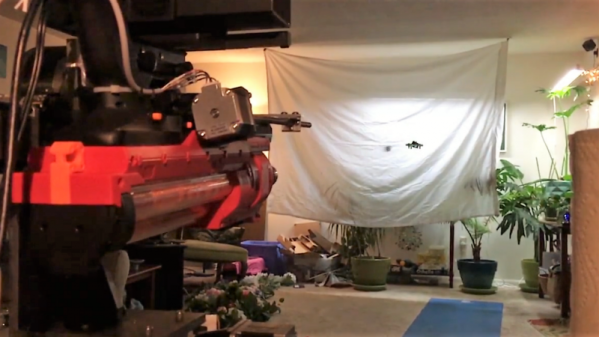
Apparently [Drew Pilcher] did, and the result is this anti-drone sentry gun.  It’s a sturdily built machine – one might even say it’s overbuilt. The gimbal is made from machined steel pieces, and the swivels are a pair of Sherline stepper-controlled rotary tables with 1/40 of a degree accuracy selling for $400 each. Riding atop that is a Nerf rifle, which is cocked by a stepper-actuated linear slide, as well as a Kinect for object tracking. The tracking app is a little rough – just OpenCV hacked onto the Kinect SDK – but good enough for testing. The gun tracks as smoothly as one would expect given the expensive hardware, and the auto-cocking feature works well if a bit slowly. Based as it is on Nerf technology, this sentry is only indicated for the control of the micro-drones seen in the snuff video below, but really, anyone afflicted by indoor infestations of Phantoms or Mavics has bigger problems to worry about.

Over-engineered? Perhaps, but it’s better than letting the menace of indoor drones go unanswered. And it’s far from the first sentry gun we’ve seen, targeting everything from cats to squirrels using lasers, paintballs, and even plain water.

Continue reading “Well-Built Sentry Gun Addresses The Menace Of Indoor Micro-UAVs”

Perovskites: Not Just For Solar Cells Anymore

If you’ve been around long enough, you’ll know there’s a long history of advances in materials science that get blown far out of proportion by both the technical and the popular media. Most of the recent ones seem to center on the chemistry of carbon, particularly graphene and nanotubes. Head back a little in time and superconductors were all the rage, and before that it was advanced ceramics, semiconductors, and synthetic diamonds. There’s always some new miracle material to be breathlessly and endlessly reported on by the media, with hopeful tales of how one or the other will be our salvation from <insert catastrophe du jour here>.

While there’s no denying that each of these materials has led to huge advancements in science, industry, and the quality of life for billions, the development cycle from lab to commercialization is generally a tad slower than the press would have one believe. And so when a new material starts to gain traction in the headlines, as perovskites have recently, we feel like it’s a good opportunity to take a close look, to try to smooth out the ups and downs of the hype curve and manage expectations.

Continue reading “Perovskites: Not Just For Solar Cells Anymore”

Prusa Printer Gets An LCD-ectomy, Gains A VFD

What’s wrong with the OEM display on a Prusa I3 Mk3? Nothing at all. Then why replace the stock LCD with a vacuum fluorescent display? Because VFDs are much, much cooler than LCDs.

(Pedantic Editor’s Note: VFDs actually run a little warm.)

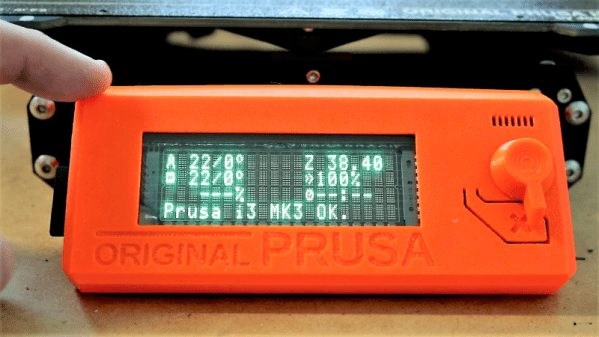
At least that’s the reasoning [Scott M. Baker] applied to his Prusa upgrade. We have to admit to a certain affection for all retro displays relying on the excitation of gasses. Nixies, Numitrons, and even the lowly neon pilot light all have a certain charm of their own, but by our reckoning the VFD leads the pack. [Scott] chose a high-quality Noritake 4×20 alphanumeric display module for his upgrade, thriftily watching eBay for bargains rather than buying from the big distributors. The module has a pinout that’s compatible with the OEM LCD, so replacing it is a snap. [Scott] simplified that further by buying a replacement Prusa control board with no display, to which he soldered the Noritake module. Back inside the bezel, the VFD is bright and crisp. We like the blue-green digits against the Prusa red-orange, but [Scott] has an orange filter on order for the VFD to make everything monochromatic. That’ll be a nice look too.

A completely none functional hack, to be sure, but sometimes aesthetics need attention too. And it’s possible that a display switch would help the colorblind use the UI better, like this oscilloscope mod aims to do.

Continue reading “Prusa Printer Gets An LCD-ectomy, Gains A VFD”