Super Simple, Super Cheap FPV Drone Tracking

What’s more disruptive to the drone first-person view (FPV) experience than dropouts in your video feed when you’re in the middle of a race? Probably nothing, and there’s probably also not much you can do about it. Or is there? Might a simple tracker based on RSSI help keep your video signal locked in?

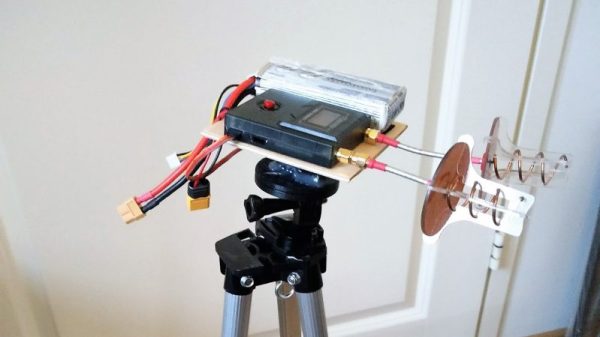
Honestly, we’re not sure it would, but we think it’s pretty nifty to see [FlyerFpv]’s tracker following his drone around. The idea is simple and uses the full-diversity FPV receiver he already has. Diversity receivers constantly monitor signal strength from multiple antennas to determine which one to listen to, which improves reception quality. [FlyerFpv] sends the RSSI outputs to analog inputs on an Arduino which drives a servo to keep the signals as close to each other as possible. The Arduino and the DC-DC converter needed to power it fit nicely inside the receiver case with no modifications, which is a nice touch. With a 3D-printed servo mount and some fancy directional antennas, the setup keeps pretty good track of his drone now. See it in action below.

Sure, the response could be snappier, and we’d love to see another receiver and servo added to track pitch as well as yaw. For a first pass, we think it’s great, but [FlyerFpv] should enjoy it while he can in case AI takes over our flying fun soon.

Continue reading “Super Simple, Super Cheap FPV Drone Tracking”
Making Vintage Computing Easy, The Hard Way

If you want to not take for granted how easy and seamless computers have become, take up vintage computing as a hobby. If you venture down the retro path, you’ll quickly question how anyone ever got any useful work done with computers, and the farther back you go in computer history, the more difficult everything seems to become.

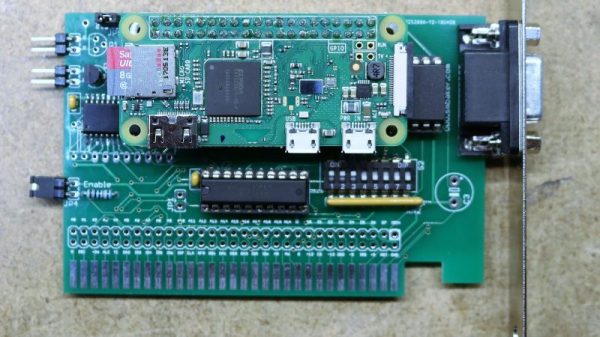
Case in point: how do you easily transfer files between a home-brew PC/XT and your modern desktop? Back in the day we did it with null modem cables or by sneaker-netting stacks of floppies, but [Scott M. Baker] found another way — putting a Raspberry Pi on the ISA bus as a virtual floppy drive. The heart of the ISA card is an IDT7130, a 1-kb RAM chip that allows simultaneous asynchronous access over dual ports. One port talks to the ISA bus and the other talks to the GPIO of the Pi, after level-shifting to make everything voltage compatible, of course. [Scott] wrote a driver for the card, plugged a Pi Zero W into the header pins, and threw a Python server together that makes local images available to the shared memory on the card. The upshot of this is that the retro machine thinks it has a floppy in it, but it’s actually a server. The video below has tons of detail and shows the card in action. Pretty slick.

[Scott]’s projects are always fun to check out, and he really seems to have the retro life dialed in. Whether it’s old jukebox hacks or a Unix-ish OS for Z80s, there’s plenty to learn. Although we’d like to see more about that PC/XT in the video; are those Nixies we spy along the front panel?

Continue reading “Making Vintage Computing Easy, The Hard Way”

Hacked Fitness Trackers Aim To Improve Mental And Physical Health

We all know that the mind can affect the body in dramatic ways, but we tend to associate this with things like the placebo effect or psychosomatic illnesses. But subtle clues to the mind-body relationship can be gleaned from the way the body moves, and these hacked fitness monitors can be used to tease data from the background noise of everyday movements to help treat mental health issues.

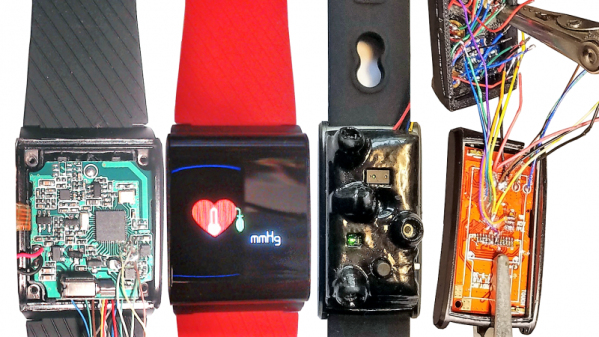
Over the last few years, [Curt White] of the Child Mind Institute has been able to leverage an incredibly cheap but feature-packed platform, the X9 Pro Sports Bracelet, a fitness band that looks more or less like a watch. Stuffed with an ARM Cortex processor, OLED screen, accelerometer, pulse sensor, and a ton of other stuff, the $35 wearable is a hacker’s dream. And hack it he did. One version of the bracelet is called Tingle, which is used to detect and avert body-focused repetitive behaviors (BFRBs), compulsive disorders that can result in self-harm through pulling at hair or pinching. The Tingle is trained to recognize the motions associated with these behaviors and respond with haptic feedback through the vibration motor. Another hacked X9 was attached to a dental retainer and equipped with sensors to monitor respirations intraorally, in an attempt to detect overdoses. It’s fascinating stuff, and the things [Curt] has done with these cheap fitness bands is mighty impressive.

This project is yet another entry in the 2018 Hackaday Prize, which is currently in the Robot Modules phase. Got an idea for something to make robots easier to build? Start a project page on Hackaday.io and get entered. Maybe your module will even feature a hacked fitness tracker.

Continue reading “Hacked Fitness Trackers Aim To Improve Mental And Physical Health”

Make 3D-Modeling Child’s Play With A Can Of Play-Doh

You need to replicate a small part on a 3-D printer, so you start getting your tools together. Calipers, rulers, and a sketch pad at a minimum, and if you’re extra fancy, maybe you pull out a 3D-scanner to make the job really easy. But would you raid your kid’s stash of Play-Doh too?

You might, if you want to follow [Vladimir Mariano]’s lead and use Play-Doh for accurately modeling surface features in the part to be replicated. Play-Doh is a modeling compound that kids and obsolete kids alike love to play with, especially a nice fresh can before it gets all dried out or mixed in with other colors or gets dog hair stuck in it.

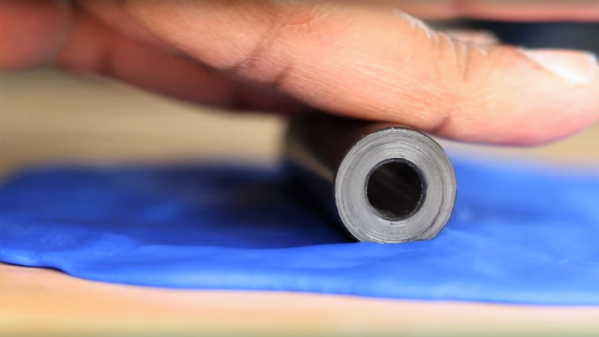
For [Vladimir], the soft, smooth stuff was the perfect solution to the problem of measuring the spacing of small divots in the surface of a cylinder that he was asked to replicate. Rather than measuring the features directly on the curved surface, he simply rolled it across a flattened wad of Play-Doh. The goop picked up the impressions on the divots, which were then easy to measure and transfer to Fusion 360. The video below shows the Play-Doh trick up front, but stay tuned through the whole thing to get some great tips on using the sheet metal tool to wrap and unwrap cylinders, as well as learning how to import images and recalibrate them in Fusion 360.

Run into a modeling problem that Play-Doh can’t solve? Relax, we’ve got a rundown on the basics for you.

Continue reading “Make 3D-Modeling Child’s Play With A Can Of Play-Doh”

Ask Hackaday: Whatever Happened To Wire Wrapping?

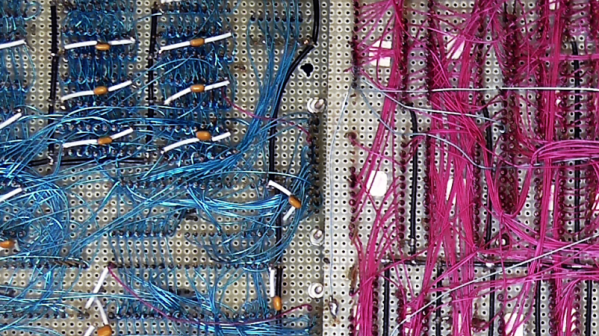
Back in the 70s when I started getting interested in electronics, tons of magazines catered to the hobbyist market. Popular Electronics was my favorite, and I think I remember the advertisements more than anything, probably because they outnumbered articles by a large margin. Looking back, it seemed like a lot of ad space was sold to companies hawking the tools and materials needed for wire wrapping, which was very popular for prototyping in the days before solderless breadboards were readily available. I remember beauty shots of neat rows of small, gold posts, with stripped wires wrapped evenly around them.

To the budding hobbyist, wire wrapping looked like the skill to have. With a huge selection of posts, terminals, and sockets for ICs and discrete components, as well as a wide range of manual and powered wrapping tools, it seemed like you could build anything with wire wrapping. But fast forward just a decade or so, and wire wrapping seemed to drop out of favor. And today — well, does anyone even wire wrap anymore?

Continue reading “Ask Hackaday: Whatever Happened To Wire Wrapping?”

Inside Mechanical Calculators

For as busy as things can get at the grocery store on a typical afternoon just before the dinner hour, at least the modern experience has one thing going for it: it’s relatively quiet. Aside from the mumbled greetings and “Paper or plastic?” questions from the cashier, and the occasional screaming baby in the next aisle, the only sound you tend to hear is the beeping of the barcode scanner as your purchase is tallied up.

Jump back just 40 years and the same scene was raucous, with cashiers reading price tags and pounding numbers into behemoth electromechanical cash registers. Back then, if you wanted help with any arithmetic with more than just a few operations, some kind of mechanical calculator was your only choice. From simple “one-banger” adding machines to complex analog computers, mechanical devices were surprisingly capable data processing tools. Here’s a brief look at how some of the simpler ones worked.

Continue reading “Inside Mechanical Calculators”

Umbrella And Tin Cans Turned Into WiFi Dish Antenna

There’s something iconic about dish antennas. Chances are it’s the antenna that non-antenna people think about when they picture an antenna. And for many applications, the directionality and gain of a dish can really help reach out and touch someone. So if you’re looking to tap into a distant WiFi network, this umbrella-turned-dish antenna might be just the thing to build.

Stretching the limits of WiFi connections seems to be a focus of [andrew mcneil]’s builds, at least to judge by his YouTube channel. This portable, foldable dish is intended to increase the performance of one of his cantennas, a simple home-brew WiFi antenna that uses food cans as directional waveguides. The dish is built from the skeleton of an umbrella-style photographer’s flash reflector; he chose this over a discount-store rain umbrella because the reflector has an actual parabolic shape. The reflective material was stripped off and used as a template to cut new gores of metal window screen material. It’s considerably stiffer than the reflector fabric, but it stretches taut between the ribs and can still fold up, at least sort of. An arm was fashioned from dowels to position the cantenna feed-horn at the focus of the reflector; not much detail is given on the cantenna itself, but we assume it’s similar in design to cantennas we’ve featured before.

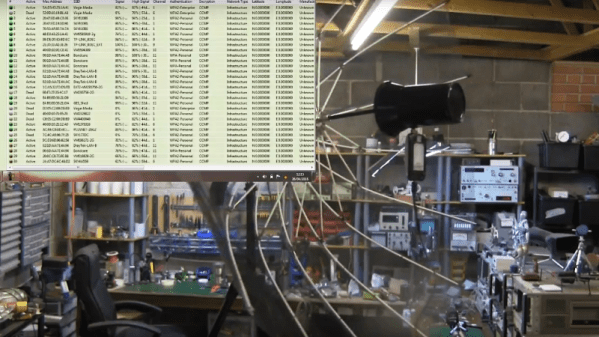
[andrew] hasn’t done rigorous testing yet, but a quick 360° scan from inside his shop showed dozens of WiFi signals, most with really good signals. We’ll be interested to see just how much this reflector increases the cantenna’s performance.

Continue reading “Umbrella And Tin Cans Turned Into WiFi Dish Antenna”