Lithium Sulfur Batteries Slated For Takeoff

Spectrum recently published a post on a new lithium sulfur battery technology specifically targeting electric aviation applications. Although lots of electric vehicles could benefit from the new technology, airplanes are especially sensitive to heavy batteries and lithium-sulfur batteries can weigh much less than modern batteries of equivalent capacity. The Spectrum post is from Oxis Energy who is about to fly tests with the new batteries which they claim have twice the energy density of conventional lithium-ion batteries. The company also claims the batteries are safer, which is another important consideration when flying through the sky.

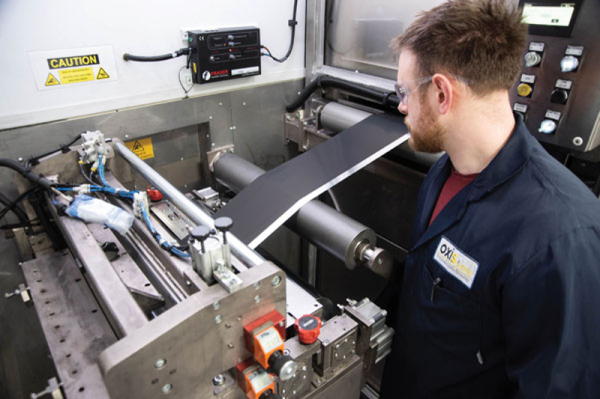
The batteries have a cathode comprised of aluminum foil coated with carbon and sulfur — which avoids the use of cobalt, a cost driver in traditional lithium cell chemistries. The anode is pure lithium foil. Between the two electrodes is a separator soaked in an electrolyte. The company says the batteries go through multiple stages as they discharge, forming different chemical compounds that continue to produce electricity through chemical action.

The safety factor is due to the fact that, unlike lithium-ion cells, the new batteries don’t form dendrites that short out the cell. The cells do degrade over time, but not in a way that is likely to cause a short circuit. However, ceramic coatings may provide protection against this degradation in the future which would be another benefit compared to traditional lithium batteries.

We see a lot of exciting battery announcements, but we rarely see real products with them. Time will tell if the Oxis and similar batteries based on this technology will take root.


The CIA’s Corona Project Was About Satellites, Not A Virus

We take orbital imagery for granted these days, but there was a time that it was high technology and highly secretive. [Scott Manley] has a good overview of the CIA’s Corona spy satellites, along with declassified images from the early days of the program.

It seems strange today, but the spy images needed high resolution and the only practical technology at the time was film. The satellite held a whopping 3,000 feet of film and, once shot, a capsule or bucket would return to Earth for retrieval and development. They didn’t make it to land — or at least they weren’t supposed to. The CIA didn’t want opponents sweeping up the film so an airplane was supposed to snag the bucket as it descended on a parachute, a topic covered in [Tom Nardi’s] article about the history of catching stuff as it falls from space.

The early cameras could see detail down to about 40 feet. By the end of the program in the 1970s, improved cameras could see down to 3 feet or less. Later satellites had a 3D-capable camera and multiple return buckets. The satellites were — officially — a program to expose biological samples to the space environment and return them for analysis. The Discover program was pure cover and the whole thing was declassified in 1992.

Of course, film from airplanes also had a role. Some spy satellites tried to scan film and send the data back, but that saw more use on lunar missions where returning a capsule to Earth was a lot more difficult.

Continue reading “The CIA’s Corona Project Was About Satellites, Not A Virus”

FBI Reports On Linux Drovorub Malware

The FBI and the NSA released a report on the Russian-based malware that attacks Linux known as Drovorub (PDF) and it is an interesting read. Drovorub uses a kernel module rootkit and allows a remote attacker to control your computer, transfer files, and forward ports. And the kernel module takes extraordinary steps to avoid detection while doing it.

What is perhaps most interesting though, is that the agencies did the leg work to track the malware to its source: the GRU — Russian intelligence. The name Drovorub translates into “woodcutter” and is apparently the name the GRU uses for the program.

A look inside the code shows it is pretty mundane. There’s a server with a JSON configuration file and a MySQL backend. It looks like any other garden-variety piece of code. To bootstrap the client, a hardcoded configuration allows the program to make contact with the server and then creates a configuration file that the kernel module actively hides. Interestingly, part of the configuration is a UUID that contains the MAC address of the server computer.

The rootkit won’t persist if you have UEFI boot fully enabled (although many Linux computers turn UEFI signing off rather than work through the steps to install an OS with it enabled). The malware is easy to spot if you dump raw information from the network, but the kernel module makes it hard to find on the local machine. It hooks many kernel functions so it can hide processes from both the ps command and the /proc filesystem. Other hooks remove file names from directory listings and also hides sockets. The paper describes how to identify the malware and they are especially interested in detection at scale — that is, if you have 1,000 Linux PCs on a network, how do you find which ones have this infection?

This is a modern spy story, but not quite what we’ve come to expect in Bond movies. “Well, Moneypenny, it appears Spectre is using the POCO library to generate UUIDs,” is hard to work into a trailer. We prefer the old days when high-tech spying meant nonlinear junction detectors, hacking Selectrics, moon probe heists, and passive bugging.

Stealing Keys From The Sound Of The Lock

If you are smart, you wouldn’t hand your house key over to a stranger for a few minutes, right? But every time you use your key to unlock your door, you are probably broadcasting everything an attacker needs to make their own copy. Turns out it’s all in the sound of the key going into the lock.

Researchers in Singapore reported that analyzing metallic clicks as the key slides past the pins gives them the data they need to 3D print a working key. The journal published research is behind a paywall, but there is a copy on co-author [Soundarya Ramesh’s] website which outlines the algorithm used to decode the clicks of key teeth on lock pins into usable data.

The attack didn’t require special hardware. The team used audio capture from common smartphones. While pushing your phone close to the lock while the victim inserts a key might be problematic, it isn’t hard to imagine a hacked phone or smart doorbell picking up the audio for an attacker. Long-range mikes or hidden bugs are also possible.

There are practical concerns, of course. Some keys have a plateau that causes some clicks to skip, so the algorithm has to deal with that. It sounds like the final result be a small number of key possibilities and not just converge on one single key, but even if you had to carry three or four keys with you to get in, it is still a very viable vulnerability.

The next step is to find a suitable defense. We’ve heard that softening the pins might reduce the click, but we wondered if it would be as well to put something in that deliberately makes loud clicks as you insert the key to mask the softer clicks of the pins.

While a sound recording is good, sometimes a picture is even better. Of course, if you want to go old school, you can 3D print your lockpicks.

Continue reading “Stealing Keys From The Sound Of The Lock”

Student Rover Explores The Backyard In Tribute

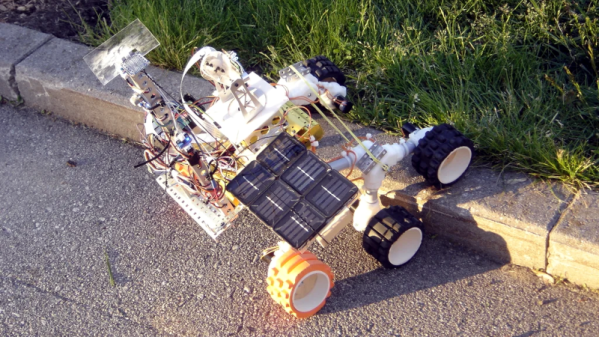
Three students were a little sad when NASA’s Opportunity rover went silent after 15 years on the Martian surface. So they decided to build their own rover inspired by Opportunity to roam their backyards using an off-the-shelf robot chassis, a Raspberry Pi, and the usual list of parts like motors, H-bridges, and batteries.

Like the real rover, the vehicle uses a rocker-bogie system, although it is a little less complex than the version NASA sent blasting off towards the Red Planet. The plucky vehicle comes complete with miniature solar panels to recharge its onboard battery, courtesy of some dollar-store garden lights. A pair of videos after the break show how the rover is controlled, as well as the view sent back from its onboard camera.

The rover ran a simulated Mars mission as part of a school project where it had to find an object and transmit an image of it back to home base, and by the looks of it, is was a rousing success. But the young explorers aren’t resting on their laurels, and are already working on a second version of their exploration vehicle that can operate in inclement weather and includes some new tools such as a robotic arm and infrared illumination for low-light imaging.

We’ve seen plenty of Mars rover clones in the past, but there’s always room for more. Of course, if you’re looking for something a bit easier to start with, you can always go the LEGO route.

Continue reading “Student Rover Explores The Backyard In Tribute”

Microsoft Flight Simulator’s Data Insanity Spawns Enormous Buildings And Anomalies From OpenStreetMap

The OpenStreetMap project is an excellent example of how powerful crowdsourced data can be, but that’s not to say the system is perfect. Invalid data, added intentionally or otherwise, can sometimes slip through the cracks and lead to some interesting problems. A fact that developers Asobo Studio are becoming keenly aware of as players explore their recently released Microsoft Flight Simulator 2020.

Like a Wiki, users can update OpenStreetMap and about a year ago, user nathanwright120 marked a 2 story building near Melbourne, Australia as having an incredible 212 floors (we think it’s this commit). The rest of his edits seem legitimate enough, so it’s a safe bet that it was simply a typo made in haste. The sort of thing that could happen to anyone. Not long after, thanks to the beauty of open source, another user picked up on the error and got it fixed up.

But not before some script written by Asobo Studio went through sucked up the OpenStreetMap data for Australia and implemented it into their virtual recreation of the planet. The result is that the hotly anticipated flight simulator now features a majestic structure in the Melbourne skyline that rises far above…everything.

The whole thing is great fun, and honestly, players probably wouldn’t even mind if it got left in as a Easter egg. It’s certainly providing them with some free publicity; in the video below you can see a player by the name of Conor O’Kane land his aircraft on the dizzying edifice, a feat which has earned him nearly 100,000 views in just a few days.

But it does have us thinking about filtering crowdsourced data. If you ask random people to, say, identify flying saucers in NASA footage, how do you filter that? You probably don’t want to take one person’s input as authoritative. What about 10 people? Or a hundred?

Continue reading “Microsoft Flight Simulator’s Data Insanity Spawns Enormous Buildings And Anomalies From OpenStreetMap”

Fire Pit Burns To The Beat With Bluetooth

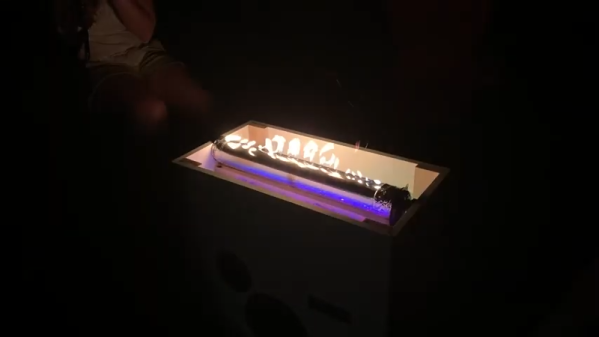
Humans have several primal fascinations and perhaps two of the biggest ones are fire and music. While you can picture some cavemen and cavewomen sitting around a fire beating on sticks for rhythm, we think they’d be impressed if the fire danced along with the music. Through the power of Bluetooth, that’s exactly what [Random Tech DIY’s] new fire pit does.

Technically, this is called a Rubens tube, and while it’s an old technology, the Bluetooth is a certainly a modern touch. As you might expect, most of this project is workshop time, cutting MDF and plastic. The audio system is off-the-shelf and drives some car stereo speakers. The results looked good, and although it always makes us nervous building things that carry propane gas, it seems to work well enough from where we’re sitting.

We had to wonder what things you could change that would affect the display. Changing the number of holes, the diameter of the holes, or the gas pressure, for example, would certainly change how the flames look and react to the sound waves.

We have seen other Rubens tube projects, of course. However, we were really interested in the use of these as crude oscilloscopes before the availability of cathode ray tubes. We’ve seen a modern take on that, too.

Continue reading “Fire Pit Burns To The Beat With Bluetooth”