New Resin Printing Method Creates Objects In Seconds

For anyone looking to buy a 3D printer at home, the first major decision that needs to be made is whether to get a resin printer or a filament printer. Resin has the benefits of finer detail, but filament printers are typically able to produce stronger prints. Within those two main camps are various different types and sizes to choose from, but thanks to some researchers at Switzerland’s École polytechnique fédérale de Lausanne (EPFL) there’s a new type of resin printer on the horizon that can produce prints nearly instantaneously.

The method works similarly to existing resin printers by shining a specific light pattern on the resin in order to harden it. The main difference is that the resin is initially placed in a cylinder and spun at a high speed, and the light is shined on the resin at different angles with very precise intensities and timings in order to harden the resin in specific areas. This high-speed method allows the printer to produce prints in record-breaking time. The only current downside, besides the high price for the prototype printer, is that it’s currently limited to small prints.

With the ability to scale in the future and the trend of most new technologies to come down in price after they have been on the market for some amount of time, it would be groundbreaking to be able to produce prints with this type of speed if printers like these can be scalable. Especially if they end up matching the size and scale of homemade printers like this resin printer.

Thanks to [suicidal.banana] for the tip!

Rogue Waves Are Mysterious And Big

Stand by the shore and watch the waves roll in, and you’ll notice that most come in at roughly the same size. There’s a little variation, but the overwhelming majority don’t stand out from the crowd. On all but the stormiest of days, they have an almost soothing regularity about them.

Every so often though, out on the high seas, a rogue wave comes along. These abnormally large waves can strike with surprise, and are dangerous to even the largest of ships. Research is ongoing as to what creates these waves, and how they might be identified and tracked ahead of time.

Continue reading “Rogue Waves Are Mysterious And Big”

English Words In French Gaming? Non Merci!

Are you a gamer? If you’re French, it seems that you shouldn’t be using so much English in pursuit of your goals.

It’s a feature of an active language, that it will readily assimilate words from others. Pizza, karaoke, vuvuzela, parka, gateau, schadenfreude, they have all played their part in bringing a little je ne sais quoi into our everyday speech. This happens as a natural process as whatever the word is describing becomes popular, and sometimes these new words cause a backlash from those who see themselves as the language’s defenders.

Often this is a fringe activity such as the British politician who made a fool of himself in a radio interview by insisting on the now-archaic Wade-Giles “Peking” rather than the vastly more common Pinyin “Beijing”, but for some tongues it’s no laughing matter. Nowhere is this more the case than in the Francophone world, in which the Academie Francaise and the French and Quebecquois governments see themselves as very much the official guardians of French. And now it seems that the French ministry of culture have turned their eyes upon gamers.

It’s nothing new for words associated with technology to fall under this scrutiny, a quarter century ago in the CD-ROM business it was de rigeur for localized discs to talk about le logicel, l’ordinateur, and telecharger instead of program, computer, and download. The talk of the industry was that Sony refused to do this for PlayStation consoles sold in Quebec during the 1990s, and thus all their sales in the province had to be under-the-counter. But there’s a sense from reading the reports that this intervention is a little clumsy; while it’s easy to say logicel we’re not so sure that jeu video de competition  or video game competition for e-sports and joueur-animateur en direct or live player-animator for streamer aren’t just too much of a mouthful for easy adoption. For the first one, we can’t help remembering that sport is also an everyday French word, so couldn’t they have come up with something less clumsy such as reseau-sports or network-sports?

Here at Hackaday more than one of us are unrepentant Francophiles, so the evolution of French words in our field is of interest to us. Habitez-vous en France ou Quebec? Donnez-nous votres idees dans les commentaires! (mais en Anglais s’il vous plait pour les Americains, excusez-nous)

Header image: Christopher Macsurak, CC BY-SA 4.0.

Automatic Water Turret Keeps Grass Watered

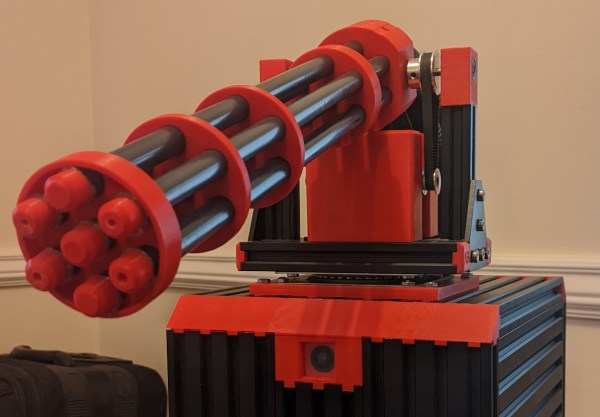
Summer is rapidly approaching (at least for those of us living in the Northern Hemisphere) and if you are having to maintain a lawn at your home, now is the time to be thinking about irrigation. Plenty of people have built-in sprinkler systems to care for their turf, but this is little (if any) fun for any children that might like to play in those sprinklers. This sprinkler solves that problem, functioning as an automatic water gun turret for anyone passing by.

This project was less a specific sprinkler build and more of a way to reuse some Khadas VIM3 single-board computers that the project’s creator, [Neil], wanted to use for something other than mining crypto. The boards have a neural processing unit (NPU) in them which makes them ideal for computer vision projects like this. The camera input is fed into the NPU which then directs the turret to the correct position using yaw and pitch drivers. It’s built out of mostly aluminum extrusion and 3D printed parts, and the project’s page goes into great details about all of the parts needed if you are interested in replicating the build.

[Neil] is also actively working on improving the project, especially around the turret’s ability to identify and track objects using OpenCV. We certainly look forward to more versions of this build in the future, and in the meantime be sure to check out some other automated sprinkler builds we’ve seen which solve different problems.

Continue reading “Automatic Water Turret Keeps Grass Watered”

Saving Birds With 3D Printed Boats

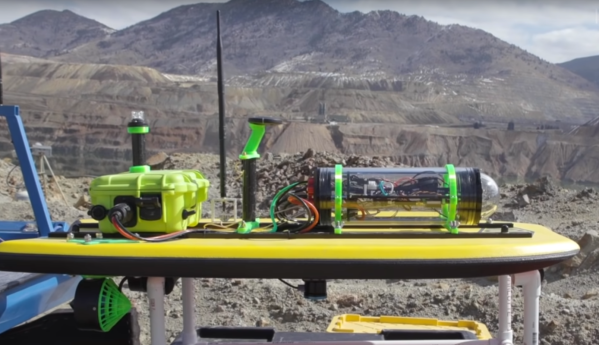
Montana, rightfully nicknamed the big sky country, is a beautiful state with abundant wide open landscapes, mountains, and wildlife. It’s a fantastic place to visit or live, but if you happen to reside in the city of Butte, that amazing Montana landscape is marred by the remnants of an enormous open pit mine. Not only is it an eyesore, but the water that has filled the pit is deadly to any bird that lands there. As a result, a group of people have taken to some ingenious methods to deter birds from landing in the man-made toxic lake for too long.

When they first started, the only tool they had available was a rifle. Scaring birds this way is not the most effective way for all species, though, so lately they have been turning to other tools. One of which is a custom boat built on a foam bodyboard which uses a plethora of 3D printed parts and sensors to allow the operator to remotely pilot the boat on the toxic lake. The team also has a drone to scare birds away, plus an array of other tools like high-powered lasers, propane cannons, and various scopes in order to put together the most effective response to help save wildlife.

While this strategy runs the gamut of the tools most commonly featured here, from 3D printers to drones to lasers, the only thing that’s missing is some automation like we have seen with other drone boat builds we’ve featured in the past. It takes quite a bit of time to continually scare birds off this lake, even through the winter, so every bit of help the team can get could go even further.

Continue reading “Saving Birds With 3D Printed Boats”

Retrotechtacular: Clay Pipe The Hard Way

Troll YouTube long enough and chances are good that you’ll come across all kinds of videos of the “How It’s Made” genre. And buried in with the frying pans and treadmills and dental floss manufacturers, there no doubt will be deep dives on how pipe is made. Methods will vary by material, but copper, PVC, cast iron, or even concrete, what the pipe factories will all have in common is the high degree of automation they employ. With a commodity item like pipe, it’s hard to differentiate yourself from another manufacturer on features, so price is about the only way to compete. That means cutting costs to the bone, and that means getting rid of as many employees as possible.

Such was not always the case, of course, as this look at how Irish Stoneware & Fireclays Ltd. made clay pipe, drain tiles, and chimney flues back in the 1980s shows. The amount of handwork involved in making a single, simple piece of clay pipe is astonishing, as is the number of hands employed at the various tasks. The factory was located in Carrickmacross, County Monaghan, Ireland, near an outcropping of shale that forms the raw material for its products. Quarrying the shale and milling it into clay were among the few mechanized steps in the process; although the extrusion of the pipe itself was also mechanized, the machines required teams of workers to load and unload them.

Continue reading “Retrotechtacular: Clay Pipe The Hard Way”

Remote Screen Viewer Is Text-Only

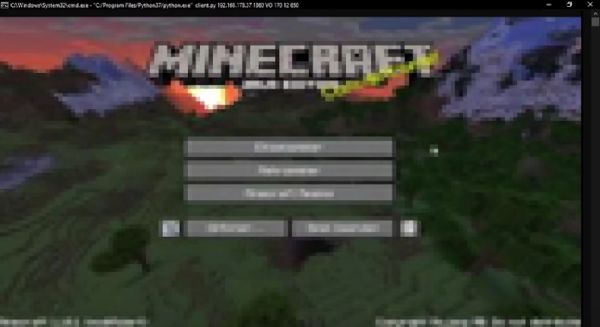
Have you been slowly falling down a rabbit hole of Stallman-like paranoia of computers ever since installing Ubuntu for the first time in 2007? Do you now abhor anything with a GUI, including browsers? Do you check your mail with the command line even though you’re behind seven proxies? But, do you still want to play Minecraft? If so, this command-line-only screen viewer might just be the tool to use a GUI without technically using one.

This remote screen viewer is built in Python by [louis-e] and, once installed, allows the client to view the screen of the server even if the client is a text-only console. [louis-e] demonstrates this from within a Windows command prompt. The script polls the server screen and then displays it in the console using the various colors and textures available. As a result, the resolution and refresh rate are both quite low, but it is still functional enough to play Minecraft and do other GUI-based tasks as long as there’s no fine text to read anywhere.

The video below only shows a demonstration of the remote screen viewer, and we can imagine plenty of uses beyond this proof-of concept game demonstration. Installing a desktop environment and window manager is not something strictly necessary for all computers, so this is a functional workaround if you don’t want to waste time and resources installing either of those components. If you’re looking for remote desktop software for a more specific machine, though, take a look at this software which enables remote desktop on antique Macs.

Continue reading “Remote Screen Viewer Is Text-Only”