The border between consumer electronics and DIY projects is getting harder and harder to define. First it was PCBs, which quickly went from homemade to professional with quick-turn services. Then low-cost CAD/CAM packages and high-end fabrication services gave us access to enclosures that were more than black plastic boxes with aluminum covers. Where will it end?
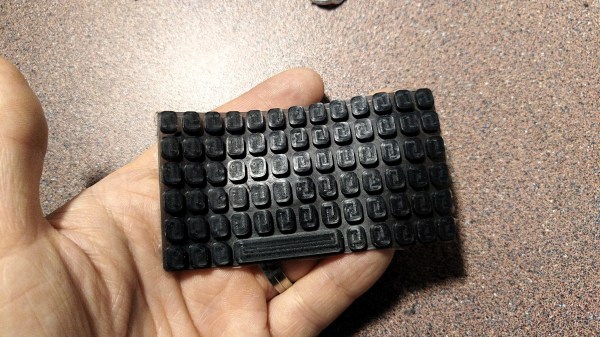
That’s a question [arturo182] begins to answer with this custom-molded silicone keyboard for a handheld device. There’s no formal writeup, but the Twitter thread goes into some detail about the process he used to make the tiny qwerty keypad. The build started by milling a two-part mold from acrylic. Silicone rubber was tinted and degassed before injecting into the mold with a baster. The keys are connected by a thin membrane of silicone, and each has a small nub on the back for actuating a switch.
There’s clearly room for improvement in this proof of concept – tool marks from the milling process mar the finish of the keys slightly, for instance. There may be tips to be had from this article on silicone keyboard refurbishment to improve the process, but overall, we’d say [arturo182] is well on his way here.
During the Second World War, the United States was pumping out weapons, aircraft, and tanks at an absolutely astonishing rate. The production of military vehicles and equipment was industrialized like never before, and with luck, never will be again. But even still, soldiers overseas would occasionally find themselves in unique situations that required hardware that the factories back at home couldn’t provide them with.
A Stinger machine gun in WWII
Which is precisely how a few United States Marines designed and built the “Stinger” light machine gun (LMG) during the lead-up to the invasion of Iwo Jima in 1945. The Stinger was a Browning .30 caliber AN/M2, salvaged from a crashed or otherwise inoperable aircraft, that was modified for use by infantry. It was somewhat ungainly, and as it was designed to be cooled by the air flowing past it while in flight, had a tendency to overheat quickly. But even with those shortcomings it was an absolutely devastating weapon; with a rate of fire at least twice that of the standard Browning machine guns the Marines had access to at the time.
Six Stingers were produced, and at least on a Battalion level, were officially approved for use in combat. After seeing how successful the weapon was during the invasion of Iwo Jima, there was even some talk of putting the Stinger into larger scale production and distributing them. But the war ended before such a plan could be put into place.
As such, the Stinger is an exceedingly rare example of a field modified weapon that was not only produced in significant numbers, but officially recognized and even considered for adoption by the military. But the story of this hacked machine gun actually started years earlier and thousands of kilometers away, as Allied forces battled for control of the Solomon Islands.
The Apollo missions still inspire people today, decades after they took place. A fortunate side effect of the global public relations campaign is that a lot of information is publicly available for us to review and process. We’re right around the 49th anniversary of Apollo 14 mission, so it was a good time for [Frank O’Brien] to take readers through Apollo Guidance Computer and the hack that saved Apollo 14 (while it was in lunar orbit).
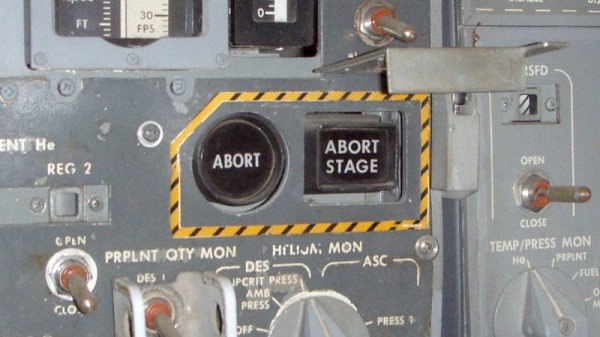
Space fans would already know many parts of this piece, but [Frank] weaves it together into a single narrative around a problematic “Abort” button that was found to be making intermittent contact as the crew were preparing to land on the moon. An inconvenient timing would have unnecessarily aborted the mission, which was obviously Not Good. [Frank] brings us up to speed on AGC fundamentals, just enough to understand the technical constraints for the hack, devised within the time constraints they faced.
For those that prefer a short video summary [Scott Manley] covered this same hack on YouTube. And for another perspective on the scope of this task, remember this was years before we had vi or emacs. When they were contemplating flipping status bits as programs were running, it’s not trivial to do a global search for code that might examine those bits. Look at the tome of source code AGC programmer [Don Eyles] worked with. Space fans who want to learn more can check out [Don]’s book.
If you ask those of us who grew up somewhere in the 1950s to 1970s what our car would be like in the year 2020, we might have described an Avrocar. This top secret vehicle from Canadian Avro was part hovercraft and part jet-powered vertical takeoff vehicle. There were two prototypes actually made and [Real Engineering] has a short video on how the prototypes worked, how the real design might have worked, and even has a lot of footage of the actual devices. You can see the video below.
The designer, [Jack Frost], experimented with ground effect and the Coanda effect. The Canadian branch of Avro, a British company, worked with the U.S. military and if you look at it, you wonder how many UFO sightings it caused. Nothing like a flying disk 18 feet in diameter going over your backyard to make you call the newspapers. On second thought, it probably never got enough altitude for that to happen.
While there’s been a lot of advancements in VR gaming over the last couple of years, plenty of folks are still happy enough to just stare at their monitor. But that’s not to say some of those fancy head-tracking tricks wouldn’t be a welcome addition to their repertoire. For players who are literally looking to get their head in the game, [Adrian Schwizgebel] has created qeMotion.
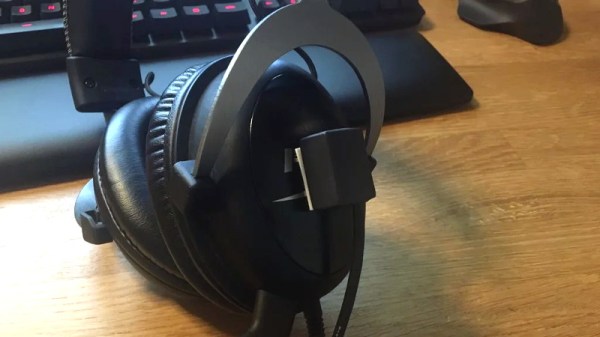
The idea here is simple enough: attach a motion sensor to a standard gaming headset (here a MPU-6050 IMU), and use the data from it to virtually “press” keys through USB HID emulation. Many first person shooter games offer the ability to lean left or right by pressing Q or E respectively, so all [Adrian] had to do was map the appropriate accelerometer readings to those keys for it to work seamlessly with popular titles such as Tom Clancy’s Rainbow Six Siege and Insurgency.
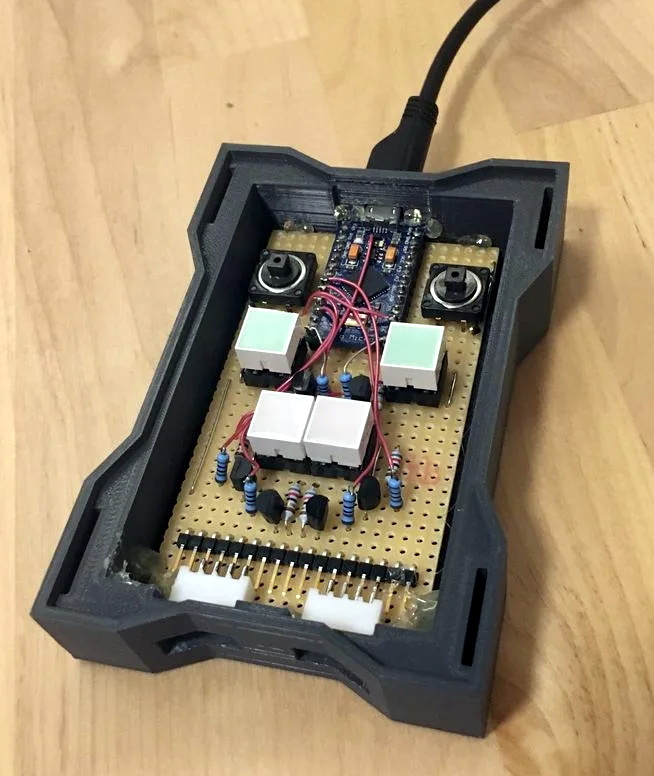
The concept might be basic, but the execution is anything but. Rather than just duct taping an Arduino to his headset, [Adrian] designed a very slick 3D printed enclosure for the electronics that sits on his desk. While they haven’t all been implemented yet, the devices features indicator lights and buttons to switch through various modes. The sensor on the headset has similarly been encased in a very professional looking 3D printed box, complete with a nice braided cable to link it to the desk unit.
It is no secret that most people like to play with Lego, but some people really like it to an extreme degree. Lego’s Idea platform lets people submit designs for review and also lets users vote on these designs. If accepted, the company works with the designer to put a kit in production and they share in the profits. [Christophe Ruge] submitted his design for the International Space Station and three years later, you can buy it on the Lego website.
The kit has 864 parts and the finished model is 12″ x 19″ x 7″ — probably will take longer than a coffee break to finish it. The model even includes the two rotating Solar Alpha Rotary Joints that allow the solar panels to align with the sun. You can see [Scott] building his on a recorded live stream below if you have 3 hours to kill.
Is it just me or did January seem to last for about three months this year? A lot has happened since the turn of the decade 31 days ago, both in the normie world and in our space. But one of the biggest pieces of news in the hacker community is something that won’t even happen for four more months: Hackaday Belgrade. The annual conference in Hackaday’s home-away-from-home in Serbia was announced, and as usual, one had to be a very early bird to score discount tickets. Regular tickets are still on sale, but I suspect that won’t last long. The call for proposals for talks went out earlier in the month, and you should really consider standing up and telling the world what you know. Or tell them what you don’t know and want to find out – there’s no better way to make connections in this community, and no better place to do it.
Someone dropped a tip this week about the possible closing of Tanner Electronics, the venerable surplus dealer located in Carrollton, Texas, outside of Dallas and right around the corner from Dallas Makerspace. The report from someone visiting the store is that the owner has to either move the store or close it down. I spoke to someone at the store who didn’t identify herself, but she confirmed that they need to either downsize or close. She said they’re actively working with a realtor and are optimistic that they’ll find a space that fits their needs, but the clock is ticking – they only have until May to make the change. We covered Tanner’s in a 2015 article on “The Death of Surplus”. It would be sad to lose yet another surplus store; as much as we appreciate being able to buy anything and everything online, nothing beats the serendipity that can strike walking up and down aisles filled with old stuff. We wish them the best of luck.
Are you finding that the smartphone in your pocket is more soul-crushing than empowering? You’re not alone, and more and more people are trying a “digital detox” to free themselves from the constant stimulation. And there’s no better way to go about this than by turning your smartphone into a not-so-smart phone. Envelope, a paper cocoon for your phone, completely masks the screen, replacing it with a simple printed keypad. A companion app allows you to take and make phone calls or use the camera, plus provides a rudimentary clock, but that’s it. The app keeps track of how long you can go before unwrapping your phone and starting those sweet, sweet dopamine hits again. It reminds us a bit of the story we also saw this week about phone separation anxiety in school kids, and the steps schools are taking to mitigate that problem.
We saw a lot of articles this week on a LoRaWAN security vulnerability. The popular IoT network protocol has been billed as “secure by default”, but a white paper released by cybersecurity firm IOActive found a host of potential attack vectors. Their main beef seems to be that client devices which are physically accessible can be reverse engineered to reveal their encryption keys. They also point out the obvious step of taking the QR code off of client devices so an attacker can’t generate session keys for the device.
And finally, the mummy speaks! If you ever wondered what the voice of someone who lived 3,000 years ago sounded like, wonder no more. Using computed tomography (CT) data, scientists in the UK and Germany have recreated the vocal tract of Nesyamun, an Egyptian scribe and priest from the time of pharaoh Rameses XI. He died in his mid-50s, and his mummified remains have been studied since the 1800s. CT data was used to 3D-print Nesyamun’s larynx and nasopharynx, which was then placed atop a “Vocal Tract Organ”, possibly the strangest musical instrument in existence. The resulting vowel-like utterance is brief, to say the least, but it’s clear and strong, and it’s pretty impressive that we can recreate the voice of someone who lived and died three millennia ago.