Hackaday Links Column Banner

Hackaday Links: September 8, 2019

We start this week with very sad news indeed. You may have heard about the horrific fire on the dive boat Conception off Santa Cruz Island last week, which claimed 33 lives. Sadly, we lost one of our own in the tragedy: Dan Garcia, author of the wildly popular FastLED library. Dan, 46, was an Apple engineer who lived in Berkley; his partner Yulia Krashennaya died with him. Our community owes Dan a lot for the work he put into FastLED over the last seven years, as many an addressable LED is being driven by his code today. Maybe this would be a good chance to build a project that uses FastLED and add a little light to the world, courtesy of Dan.

In happier news, the biggest party of the hardware hacking year is rapidly approaching. That’s right, the 2019 Hackaday Superconference will be upon us before you know it. Rumor has it that there aren’t that many tickets left, and we haven’t even announced the slate of talks yet. That’s likely to clean out the remaining stock pretty darn quickly. Are you seriously prepared to miss this? It seems like a big mistake to us, so why don’t you hop over and secure your spot before you’re crying into your Club-Mate and wondering what all the cool kids will be doing in November.

Of course one of the highlights of Superconference is the announcement of the Hackaday Prize winner. And while we naturally think our Prize is the best contest, that doesn’t mean there aren’t others worth entering. MyMiniFactory, the online 3D-printing community, is currently running a “Design with Arduino” competition that should be right up the alley of Hackaday readers. The goal is simple: submit a 3D-printed design that incorporates Arduino or other electronics. That’s it! Entries are accepted through September 16, so you’ve still got plenty of time.

Sometimes you see something that just floors you. Check out this tiny ESP32 board. It doesn’t just plug into a USB port – it fits completely inside a standard USB Type A jack. The four-layer board sports an ESP32, FTDI chip, voltage regulator, an LED and a ceramic antenna for WiFi and Bluetooth. Why would you want such a thing? Why wouldn’t you! The board is coming soon on CrowdSupply, so we hope to see projects using this start showing up in the tipline soon.

Here’s a “why didn’t I think of that?” bench tip that just struck us as brilliant. Ever had to probe a board to trace signal paths? It’s a common enough task for reverse engineering and repairs, but with increasingly dense boards, probing a massive number of traces is just too much of a chore. Hackaday superfriend Mike Harrison from “mikeselectricstuff” makes the chore easier with a brush made from fine stainless wires crimped into a ring terminal. Attached to one probe of a multimeter, the brush covers much more of the board at a time, finding the general area where your trace of interest ends up. Once you’re in the neighborhood you can drop back to probing one pad at a time. Genius! We’d imagine a decent brush could also be made from a bit of coax braid too.

Another shop tip to wrap up this week, this one for woodworkers and metalworkers alike. Raw materials are expensive, and getting the most bang for your buck is often a matter of carefully laying out parts on sheet goods to minimize waste. Doing this manually can be a real test of your spatial relations skills, so why not automate it with this cut list optimizer? The app will overlay parts onto user-defined rectangles and snuggle them together to minimize waste. The program takes any units, can account for material lost to kerfs, and will even respect grain direction if needed. It’s built for wood, but it should prove useful for sheet metal on a plasma cutter, acrylic on a laser, or even PCBs on a panel.
Tiny LED Cube Packs Six Meters Of Madness

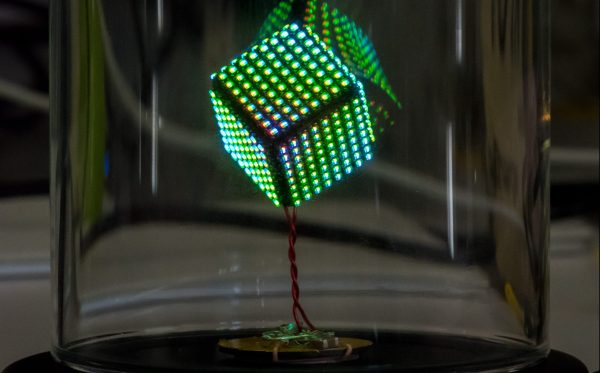
When [Freddie] was faced with the challenge of building a sendoff gift for an an LED-loving coworker he hatched a plan. Instead of making a display from existing video wall LED panels he would make a cube. But not just any cube, a miniature desk sized one that wasn’t short of features or performance. We’d be over the moon if someone gifted us with this itty-bitty Qi coil-powered masterpiece of an RGB cube.

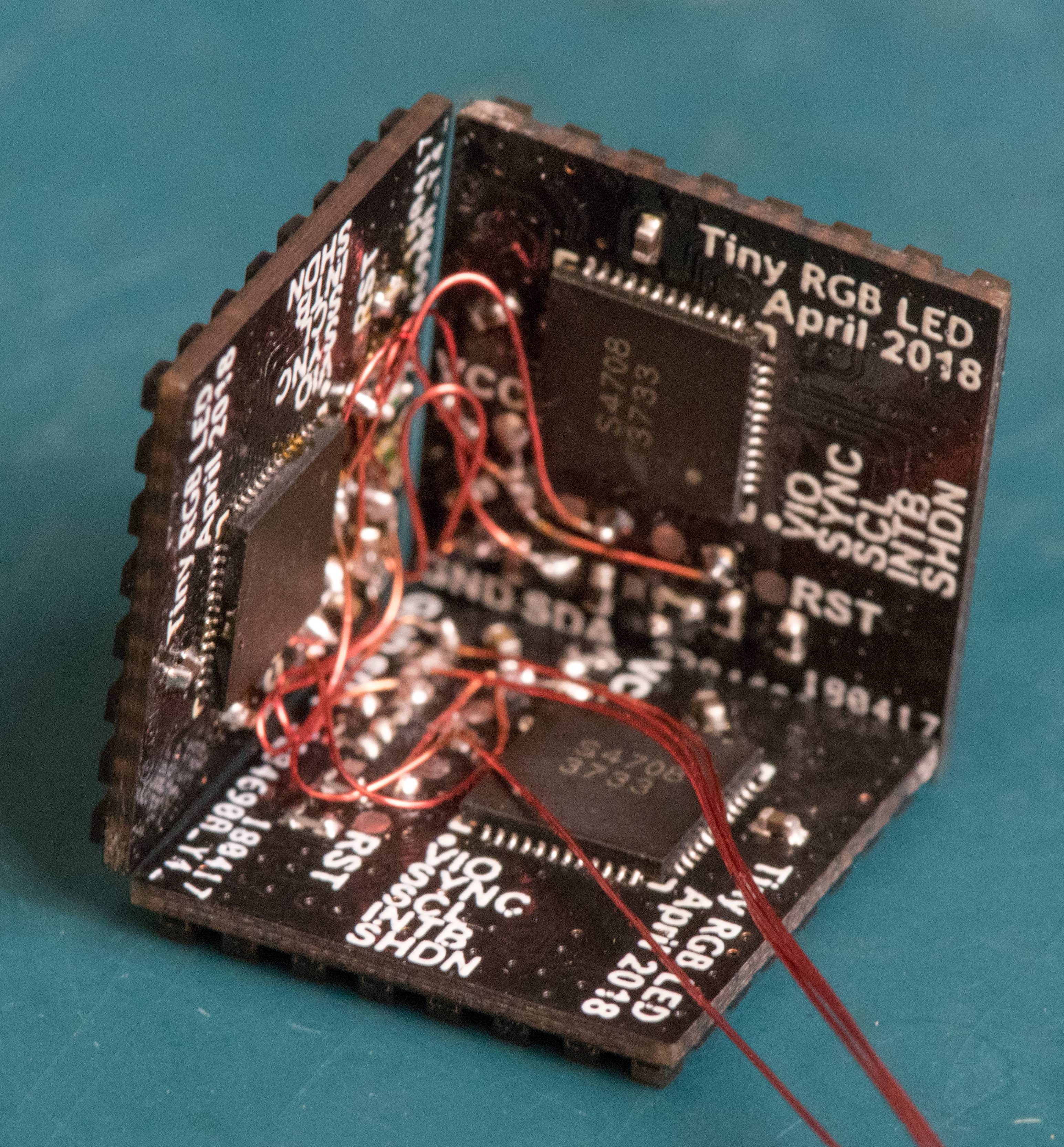
Recently we’ve been blessed with a bevy of beautiful, animated RGB cubes but none hit quite this intersection of size and function. The key ingredient here is tiny but affordable RGB LEDs which measure 1 mm on a side. But LEDs this small are dwarfed by the otherwise minuscule “2020” package WS2812’s and APA102s of the world. Pushing his layout capabilities to the max [Freddie] squeezed each package together into a grid with elements separated by less than 1 mm, resulting in a 64 LED panel that is only 16 mm x 16 mm panel (with test points and controller mounted to the back). Each of these four-layer PCBs that makes up the completed cube contains an astonishing 950 mm of tracking, meaning the entire cube has nearly six meters of traces!

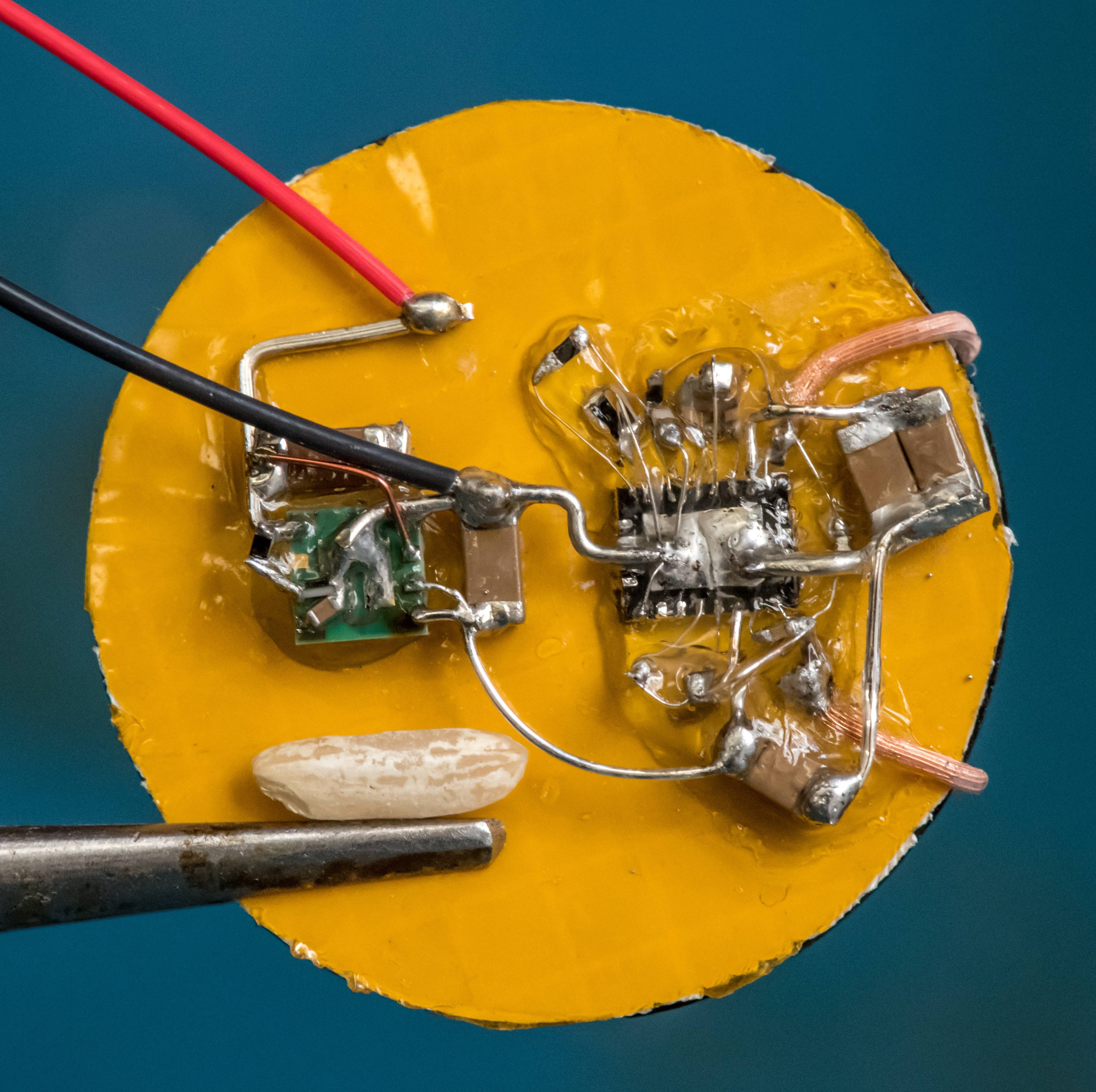
How do you power such a small device with no obvious places to locate a connector? By running magnet wire through a corner and down to a Qi coil of course. Not to let the cube itself outshine the power supply [Freddie] managed to deadbug a suitably impressive supply on the back of the coil itself. Notice the grain of rice in the photo to the left! The only downside here is that the processor – which hangs diagonally in the cube on a tiny motherboard – cannot be reprogrammed. Hopefully future versions will run programming lines out as well.

Check out the video of the cube in action after the break, and the linked photo album for much higher resolution macro photos of the build. While you’re there take a moment to admire the layout sample from one of the panels! If this sets the tone, we’re hoping to see more of [Freddie]’s going-away hacks in the future!

Continue reading “Tiny LED Cube Packs Six Meters Of Madness”

ALEKYA Builds With Bricks And Mortar

Construction is often a labor-intensive task, particularly in the developing world where access to electricity and machinery can be limited. As always, robots promise to help ease the burden. [Nishant Agarwal] is working on just such a project, known as ALEKYA.

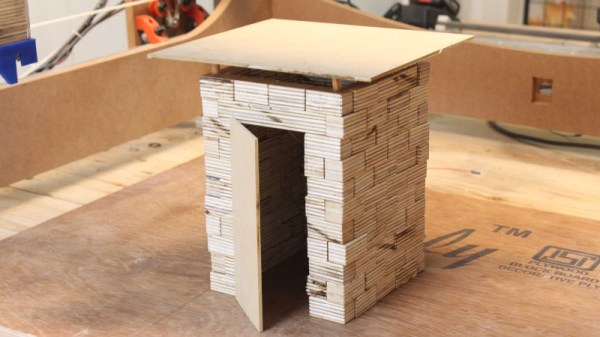
The aim of ALKEYA is to make construction easier and more automated, with the help of robotics. We’ve seen large-scale concrete printers before, but ALEKYA takes a different tack. With a focus on making use of local materials, it combines two gantries on a single frame. One lays down a bead of mortar, before the other swoops in to drop bricks into position. This is followed by another layer of mortar, and the build continues.

By using this manner of construction, progress can be much more rapid compared to more traditional 3D printing techniques which must build up height layer by layer. Currently operating on a small scale, the next step for the project is the construction of a 20×20 foot version for creating full-sized buildings.

We think there’s definite promise in this hybrid approach, and can’t wait to see what comes next! Video after the break.

Continue reading “ALEKYA Builds With Bricks And Mortar”

Cheap Stereo Microscope Helps With SMD

Soldering is best done under magnification. Parts become ever smaller and eyes get weaker, so even if you don’t need magnification now, you will. [Makzumi] didn’t want to shell out $400 or more for a good microscope so he hacked one from some cheap binoculars from the toy section on Amazon.

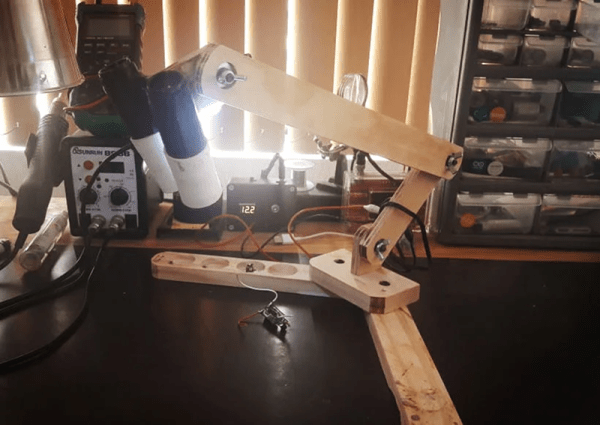
A lot of magnifiers aren’t really good for soldering because the distance between the work and the lens isn’t very large. The hacked ‘scope has about 4 inches of working distance, which is plenty of room to stick some solder and a hot iron under there. The resulting magnification is about 12 or 15X and he claims that the cell phone pictures he’s included aren’t as good as really looking through the eyepieces yourself.

Continue reading “Cheap Stereo Microscope Helps With SMD”

An RFID Ring For The Body Mod Squeamish

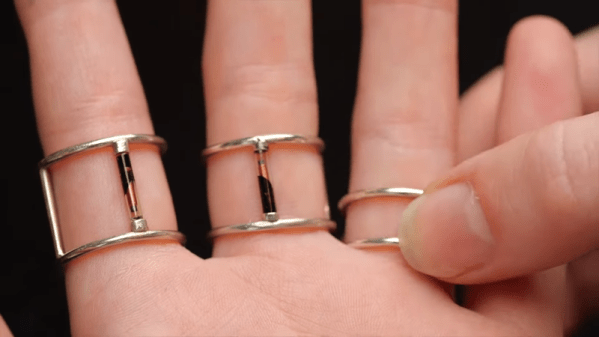
Some people get inked, while others get henna or those water transfer tattoos you might find in a box of Cracker Jack. [Becky] wanted the benefits of having an RFID tag in her finger — unlock doors or log into your computer with a swipe of your finger — but wasn’t ready to get an implant. Her solution: make an artistic ring that conceals a tiny glass capsule RFID tag.

Besides not having to shove some tech under your epidermis, there are a few other advantages: you can change out tags as easy as changing rings, for one. You can also easily loan your ring to someone just as you might give them keys to your door.

Continue reading “An RFID Ring For The Body Mod Squeamish”

You Didn’t See Graphite Around This Geiger Counter

Even if you don’t work in a nuclear power plant, you might still want to use a Geiger counter simply out of curiosity. It turns out that there are a lot of things around which emit ionizing radiation naturally, for example granite, the sun, or bananas. If you’ve ever wondered about any of these objects, or just the space you live in, it turns out that putting together a simple Geiger counter is pretty straightforward as [Alex] shows us.

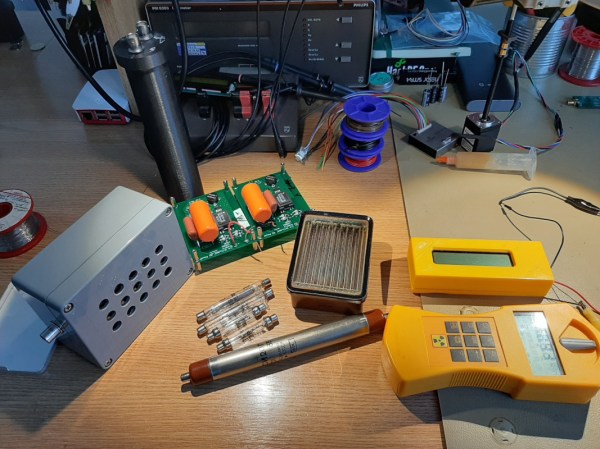
The core of the Geiger counter is the tube that detects the radiation. That’s not something you’ll be able to make on your own (probably) but once you have it the rest of the build comes together quickly. A few circuit boards to provide the tube with the high voltage it needs, a power source, and a 3D printed case make this Geiger counter look like it was ordered from a Fluke catalog.

The project isn’t quite finished ([Alex] is still waiting on a BNC connector to arrive) but seems to work great and isn’t too complicated to put together, as far as Geiger counters go. He did use a lathe for some parts which not everyone will have on hand, but a quick trip to a makerspace or machinist will get you that part too. We’ve seen some other parts bin Geiger counters too, so there’s always a way around things like this.

How Many Commodores Does It Take To Crack A Nut?

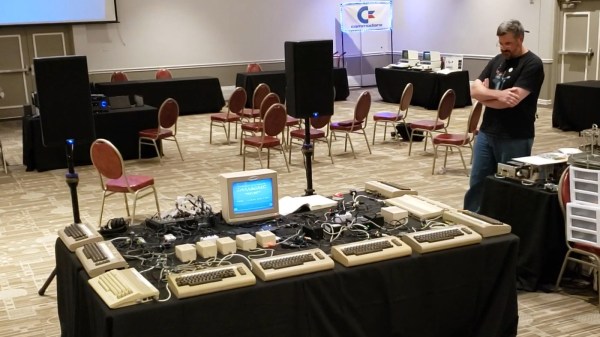
It’s brilliant enough when composers make use of the “2SID” technique to double the channels in a Commodore 64 with two sound chips, but even then some people like to kick things up a notch. Say, five times more. [David Youd], [David Knapp] and [Joeri van Haren] worked together to bring us just that, ten Commodore computers synchronously playing a beautiful rendition of the Dance of the Sugar Plum Fairy at this year’s Commodore Retro eXpo.

The feat is composed of nine Commodore 64 computers and one Commodore 128, all fitted with the SID chip. It is a notorious synthesizer chip for utilizing both analog and digital circuitry, making each and every one of its revisions unique to a trained ear, not to mention impossible to faithfully reproduce in emulation. The SID was designed by Bob Yannes at MOS Technology, who later went on to co-found Ensoniq with his experience in making digital synthesizers.

How this orchestra of retro computers came to be, including details on how everything is pieced together can be found on this slideshow prepared by the authors of the exhibition. It’s interesting to note that because of timing differences in each computer’s crystal clock and how only the start of the song is synchronized between them, they can’t play long music tracks accurately yet, but a 90-second piece works just fine for this demonstration.

These synthesizer chips are slowly going extinct since they’re no longer being manufactured, so if you need a new replacement solution, FPGAs can fill that SID-shaped hole in your heart. If you need the whole computer though, the newer Teensy 3.6 will do just fine emulating it all. Check out this beast of a display in action after the break. While we’re at it, this isn’t the only time multiple 8-bit computers have been combined as an orchestra, though these Commodores sound a lot better than a table full of ZX Spectrums.

Continue reading “How Many Commodores Does It Take To Crack A Nut?”