Announcing The 2026 Hackaday Retrocomputing Challenge

What is it about retrocomputing? For some people, it’s nostalgia. For others, it’s the appeal of simplicity. For still others, it’s the chance to save old machines from the graveyard. Whatever your motivation, there’s no denying that we’ve seen a metric ton of retrocomputer projects here at Hackaday. And we’d like to see more!

We’re happy to announce the 2026 Hackaday Retrocomputing Challenge!

Now’s the chance to put your retrocomputer project up for all to see. Open up a Hackaday.io project that features your retrocomputer project, and we’ll pick our three favorites for a $150 gift certificate courtesy of this contest’s sponsor, DigiKey. You have until Tuesday, October 27th. So get hacking!

Continue reading “Announcing The 2026 Hackaday Retrocomputing Challenge”

So, You Want To Fix An Old Camera

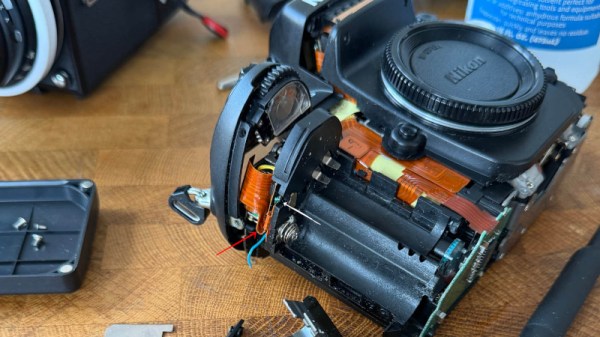
Old cameras are a fantastic way to experiment with photography, and outside a few brands, they can be an inexpensive way too. It’s easy to find older cameras in a broken condition for  a lot less money, but if you’re tempted to fix one then [enthdegree] has some advice for you.

It’s ostensibly a set of notes on the disassembly and repair of a Nikon F100 35mm film SLR, but along the way it’s full of useful tips and tricks for camera disassembly. he materials you’ll need, advice on not losing screws is one, and warnings against disassembling too much is another. It’s all the stuff he wished he’d known before starting, and now you can know it too.

Fixing up old cameras in this way is rewarding, and something we’ve certainly been known to do ourselves. But it’s worth bearing in mind that it’s not for the faint-hearted, and with decades of old film cameras sitting unused, often a working example might make more sense.

Smartphones And The Next Generation Of Hearing Aids

If you don’t actually need one, you’d be forgiven for thinking a hearing aid just makes everything louder for the wearer. Especially since there are plenty of shady products out there which will do exactly that for just four easy payments of $29.99. But the reality is considerably more complex, as a proper hearing aid needs to be capable of selectively enhancing certain frequencies while squashing down others.

The technical challenges involved in pulling that off in a device small enough to fit inside the human ear and run off of a tiny battery are considerable — and while there’s undoubtedly been some degree of artificial price inflation going on over the years, there’s a reason proper hearing aids have been so much more expensive than their “As Seen on TV” counterparts. These same challenges are also why DIY and open source hardware hearing aids have struggled to gain much traction.

But over the last few years the situation has changed. In 2022 the United States Food and Drug Administration (FDA) established the framework by which hearing aids could be sold over the counter (OTC). Although they’re generally less capable than their prescription counterparts and not suitable for individuals with profound hearing loss, the wide commercial availability of OTC hearing aids has kicked off a competition between manufacturers to deliver more affordable devices.

That competition entered a new phase earlier this month when the FDA granted approval for Samsung’s Galaxy Earbuds to fall under the same category. This follows a similar decision made about Apple’s AirPods back in 2024. The two biggest players in the smartphone market being able to offer their earbuds as OTC hearing aids represents a unique value proposition. Not only are they priced for mass market consumption, but many individuals who would be interested in purchasing an OTC hearing aid will already own them and need only to enable the feature with a software update.

Given how different the situation is today than even just five years ago it’s worth asking just what qualifies as a over-the-counter hearing aid, and how the shifting definition of these devices can inform the community’s efforts to develop open hardware solutions.

Continue reading “Smartphones And The Next Generation Of Hearing Aids”

Watch Soldering Up Close And From Any Angle, In VR

A manual skill like soldering is so much easier to learn and grasp when one can watch it in action, and there’s a brand new way to do that using virtual reality (VR). It isn’t just a series of 3D videos shot at someone’s workbench, either.

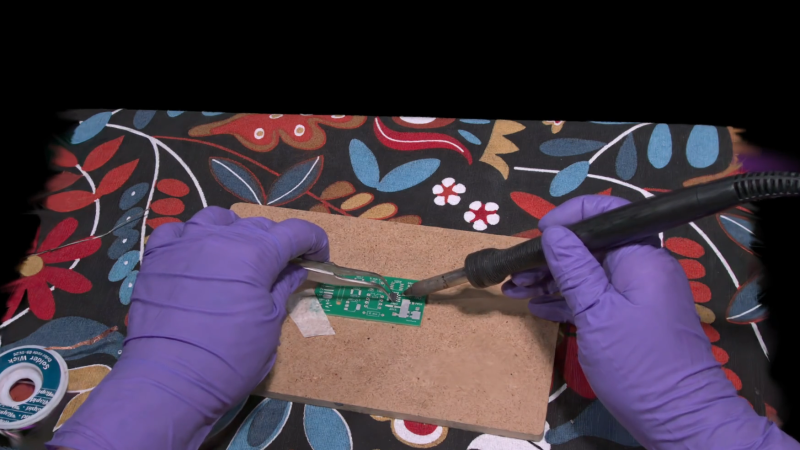
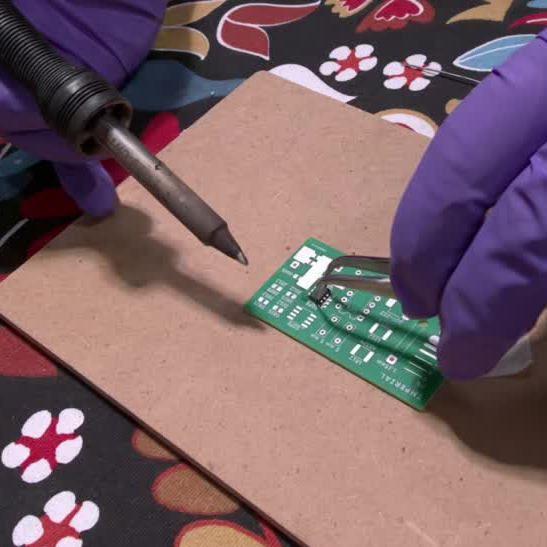
See soldering in action from any angle, with fine details preserved even close up.

PCB Hand-Soldering Basics is a series of thirteen videos that demonstrate soldering using Gaussian splats, a method of displaying 3D content that allows the viewer to freely look at things from any angle. Gaussian splats aren’t new, but what makes this different is the sheer level of detail and the fact that it’s focused on handheld tool use rather than displaying a famous location, landmark, or something similarly “big”.

Throughout the videos fine detail on the iron, parts, and the PCB itself remain visible from any angle and even from close up. Here’s a short video captured from within a VR headset that is probably the next best thing to seeing it yourself.

An educational production, it was was made in cooperation with the Department of Electrical and Electronic Engineering at Imperial College London. A few more details are in a LinkedIn post by [Tanmay Lad], who was part of the team involved in the production. The goal is to offer a unique, front-row seat to hand soldering with the ability to zoom in or look at it in 3D from any angle.

Not familiar with Gaussian splats? We’ve previously covered a great overview. They look great and are computationally cheap to render, and being able to get up close and see such detail is not really something one expects.

Store Tunes On Paper And Stream Them Over LoRA

Some projects seem too good to be true until you dig into it and find the secret magic that makes it all work. Take Paper Tunes by [Makestreame], a project which purports to store a song on a single sheet of paper via QR code and transmit the data over LoRA. If it was a MIDI sequence, maybe. But the promise of Paper Tunes is to take any MP3 and give it this treatment, and that just seems like an impossible level of compression at first glance.

The music is heavily compressed, make no doubt about that. There’s samples in the Instructables link above and in the video below, but it sounds far better than it has any right to. The secret is Meta’s EnCodec neural codec, which like you’d guess uses neural nets to squeeze the absolute minimum information needed to reconstruct a sample. With it [Makestreame] is able to get a 2.9 MB MP3 file down to just 21.44 kB.

Of course, that’s still not going to fit in a 3.3 kB QR code. But by simply making eight of them, [Makestreame] is able to fit the song onto the front and back of a piece of paper. Yes, each song has an “A” and a “B” side — and you thought flipping a record halfway through got old fast. Having to scan eight codes to get one song may strike some as a bit silly, but we do enjoy some silly things here.

The same EnCodec compression that gets the song so tiny as to fit in a brace of QR codes is obviously also what enables its transmission over LoRA. While it’s got far lower bandwidth than something like WiFi, 21 kB is well within its limits. It’s often said that LoRA isn’t suitable for audio, but this project is another example that one person’s “unsuitable” is another person’s “challenge accepted”.

We’ve seen other LoRA audio projects before. Speaking of things not suitable for audio, we once featured an entire album crammed onto a floppy disk. Continue reading “Store Tunes On Paper And Stream Them Over LoRA”

Using Acoustic Resonators As Thrusters For Small Robots

There are quite a few rather unconventional methods of propulsion, but perhaps one of the more curious approaches involved Helmholtz resonance, as demonstrated by [Junsun Hwang] et al. with a paper in Science Advances and associated summary article by EPFL’s School of Engineering.

Although probably better known from something like musical instruments, Helmholtz resonance can be used for more than creating or deadening noise. If stimulated with an external acoustic source that matches the chamber’s resonance frequency the result is a jet of air at the neck of the chamber. This acoustic actuation can thus be used for a number of applications.

In the paper a number of such applications are demonstrated, including a boat with three of these chambers for propulsion and steering, as well as a microflier (see above image) that when placed above an ultrasonic phased area will hover due to the production of this jet of air.

This microflier concept was then adapted with angled resonator chambers so that they could drive a propeller. Naturally, the produced thrust is only a fraction of a Newton so it’s essential to make these structures as light as possible, in the order of micrograms. These microfliers were created using high-resolution 3D printing, with a few iterations attempted to determine the optimal configuration.

In the case of the boat the ultrasonic transducers were directly placed on the bottom of the resonance chamber, but in the case of the microfliers the weight limitations necessitate these transducers to be external. Even if not the most practical kind of flying robot, as a demonstrator of this application of Helmholtz resonance for acoustic propulsion it’s pretty cool.


Edison Motors Offering All-Mechanical Trucks, At Least To Start

We’ve been following Canadian startup Edison Motors for some time now, but their latest offering caught us a bit off guard — their BDE series truck will be offered first without the electric hybrid drive that first piqued our interest. They make a good case for why in the video below, in which the production prototype tows around a junked Nikola semi as a sort of memento mori of what Edison does not want to end up as.

Now, make no mistake: Edison Motors is going to be selling the series-hybrid version of these big rigs eventually. That truck will have a Scania diesel rated at 500 kW driving electric motors rated at a combined 1800 kW peak power — that’s 2400 ponies. Along with the diesel generator those ponies will be driven by a big o’l battery, but none of that is in the truck in the video. It’s the same cab, and the same frame, but in order to get some revenue in while jumping regulatory hurdles and working the kinks out of the hybrid drive, they put a conventional Cummins diesel and 16-speed transmission in the “Big D” as the truck is known.

The business case makes sense: they don’t want to have their single new product hit a snag, possibly require a recall, and fall into bankruptcy the way the electric truck company Nikola did. The conventional drivetrain also lets them prove their engineering prowess to companies that might like the idea of a Made-in-Canada truck, but be nervous about new technology from a new company.

If you want to know more about the whole diesel-electric scheme, we covered that last year. Edison also has plans to offer its hybrid drive technology for smaller trucks in kit form, which is perhaps the most exciting part from a hacker perceptive.

Continue reading “Edison Motors Offering All-Mechanical Trucks, At Least To Start”