Winter NAMM is the world’s largest trade show for musical instrument makers. It is a gear head’s paradise, filled to the brim with guitars, synths, amps, MIDI controllers, an impossibly loud section filled with drums, ukuleles, and all sorts of electronic noisemakers that generate bleeps and bloops. Think of it as CES, only with products people want to buy. We’re reporting no one has yet stuffed Alexa into a guitar pedal, by the way.
As with all trade shows, the newest gear is out, and it’s full of tech that will make your head spin. NAMM is the expression of an entire industry, and with that comes technical innovation. What was the coolest, newest stuff at NAMM? And what can hackers learn from big industry? There’s some cool stuff here, and a surprising amount we can use.
Real quick question: how do you increase productivity at work? The greatest (highest paid) minds would just say: do agile or scrum or something. What’s scrum? That’s where you gather ’round every morning for a waste of time meeting that kills your every desire to be productive. A while back, [Travis Goodspeed] was stuck in some lesser circle of hell like this and in an effort to be polite by not looking at his phone too much, looked at his watch too much. This led to the creation of the Goodwatch, a new bit of hardware that replaces the guts of a Casio calculator watch with a hex editor, ISM-band radio, MSP430 disassembler, and of course an RPN calculator.
[Travis] has already introduced the GoodWatch to the world. We took a look back in December but haven’t heard anything since. His talk at Shmoocon 2018 put a little more light on how this project came to be.
When it comes to finding what direction a radio signal is coming from, the best and cheapest way to accomplish the task is usually a Yagi and getting dizzy. There are other methods, and at Shmoocon this last weekend, [Michael Ossmann] and [Schuyler St. Leger] demonstrated pseudo-doppler direction finding using cheap, off-the-shelf software defined radio hardware.
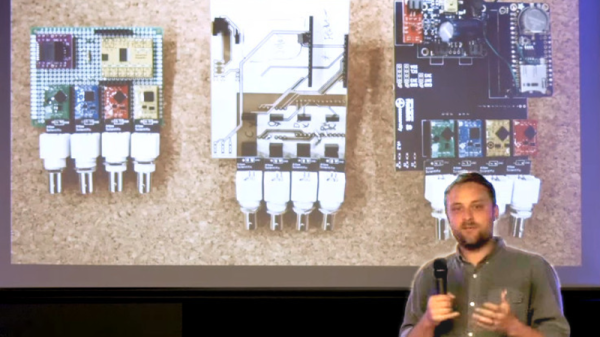
The hardware for this build is, of course, the HackRF, but this pseudo-doppler requires antenna switching. That means length-matched antennas, and switching antennas without interrupts or other CPU delays. This required an add-on board for the HackRF dubbed the Opera Cake. This board is effectively an eight-input antenna switcher using the state configurable timer found in the LPC43xx found on the HackRF.
The key technique for pseudo-doppler is basically switching between an array of antennas mounted in a circle. By switching through these antennas very, very quickly — on the order of hundreds of thousands of times per second — you can measure the Doppler shift of a transmitter.
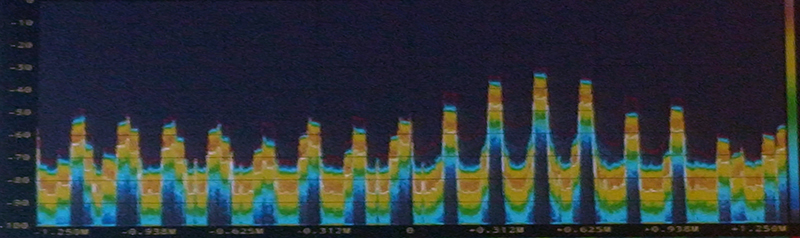
However, teasing out a distinct signal from a bunch of antennas virtually whizzing about isn’t exactly easy. If you look at what the HackRF an Opera Cake receive on a waterfall display, you’ll find a big peak around where you expect, and copies of that signal trailing off, separated by whatever your antenna switching frequency is. This was initially a problem for [Schuyler] and [Ossmann]’s experiments. Spinning the antennas at 20 kHz meant there was only 20 kHz difference in these copies, resulting in a mess that can’t be decoded. The solution was to virtually spin these antennas much faster, resulting in more separation, and a clean signal.
There are significant challenges when it comes to finding the direction of modern radio targets. Internet of Things things sometimes have very short packet duration, modulation interferes with antenna rotation, and packet detection must maintain the phase. That said, is this technique actually able to find the direction of IoT garbage devices? Yes, the demo on stage was simply finding the direction of one of the wireless microphones for the talk. It mostly worked, but the guys have some ideas for the future that would make this technique work a little better. They’re going to try phase demodulation instead of only frequency-based demodulation. They’re also going to try asymmetric antenna arrays and pseudorandom antenna switching. With any luck, this is going to become an easy and cheap way to do pseudo-doppler direction finding, all enabled by a few dollars in hardware and a laser-cut jig to hold a few antennas.
When we think of building research hardware, lab coats and pristine workbenches come to mind. Shah Selbe used to do something kind of like that when he was engineering satellite propulsion systems. But after putting twelve of them into space, he ditched the office gig and took his gear to some of the wildest places on earth. He’s an explorer and fellow with the National Geographic Society, and at the Hackaday Superconference he shared his experiences building research hardware that gathers data in incredibly remote places.
Shah makes a really good point about two very different trends in our world over the past several decades. While we’ve had unparalleled technological growth, we’ve also seen horrifying wildlife trends to the point that some scientists believe we’re currently in a sixth mass extinction event. But to know that for sure, and look for ways to prevent and reverse it, we need reliable data. This is a fascinating problem because the world is huge, and we simply can’t monitor everything.
Prepare yourself for the return of Hackaday Belgrade! Our premier European conference — Hackaday Belgrade — is on 26 May and we want to hear what you’ve been working on. The Call for Proposals is now open. We seek talks and workshops exploring the most interesting uses of technology and the culture that goes along with it. This includes design, prototyping, research, manufacturing, and the stories of people and progress that move hardware hacking forward.
We’ve booked Dom Omladine for the event because it was perfect for our previous Belgrade conference in 2016. The sold-out conference became a living organism of excitement when the Hackaday community from across Europe came together. A spectacular slate of speakers presented topics like designing computing clusters for use in University research programs, combining projection mapping with high powered lasers, building hardware for advertising campaigns, uncovering forgotten projector technology called Eidophor, fully embracing Open Hardware during product development, and so much more. All of this while hundreds in attendance joined forces for some of the best hardware badge hacking we’ve ever seen.
Hackaday Belgrade is the rare kind of opportunity that is worth reorganizing your life to attend. Want to guarantee yourself a ticket? They’re not available yet, but you can hack your way into the conference: submit a proposal! In addition to the adoration of the Hackaday community, accepted speakers will receive free admission. Everyone who submits a quality talk proposal will be given priority when tickets do go on sale. This event will sell out!
For updates, keep an eye on the conference page and pop into the chat on the project page by clicking “Join this project’s team”. Do you know someone who should be a speaker at this conference? Reach out to them personally, share this CFP on social media, or let us know in the comments below so we can make it happen.
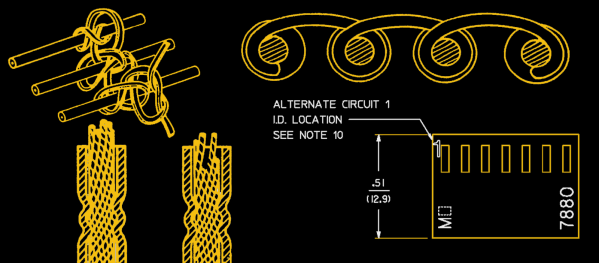
Wiring — as in plugging wires together and crimping connectors, not the Arduino IDE thingy — is an incredibly deep subject. We all know the lineman’s splice is the best way to solder two wires together, and NASA’s guide to cables and connectors is required reading around these parts. However, there’s a lot that can be said about connectors and cabling, and one of the best people to explain it all is Bradley Gawthrop. He spent the last ten years building pipe organs, and with that comes tens of thousands of relays, solenoids, switches, and valves. All of these parts are connected by thousands of miles of wire, and are arguably as complex as an old-school telephone exchange. If there’s someone you need to talk to about connecting hundreds of thousands of parts together, Bradley is your guy.
Bradley starts his Hackaday Superconference talk with a discussion of the modern prototyping process. We’re pretty far away from dozens of chips sitting around a breadboard with data and address lines these days, and now any sort of prototype is basically a development board with a constellation of modules studded around the perimeter. The best solution for connectors is right angle headers, not only for the reason that the wires stay flat, but also because right angle connectors allow you to probe each and every wire coming out of a board.
Of course, when it comes to wiring, it’s helpful to talk about the wire itself. Instead of having an entire warehouse of wire in every color, gauge, and insulation material hanging above his workshop, Bradley only needs a few options. Right now, he’s only dealing with three gauges of wire — small, medium, and large, or 24, 18, and 12 AWG. That’s one wire for small signals, one wire for a bit of current, and one wire for supply amounts of current. Not only does this cut down on workshop inventory, it also means Bradley only needs three sizes of crimpers and connectors. When it comes to strand count, solid core wire is highly underrated. Not only is it easier to strip and crimp, it can also support its own weight. That’s important, because it means connectors don’t have to bear the weight of the entire cable run.
If you’re looking for the minimal required toolset for running cables and crimping connectors, Bradley has a great little shopping list on his website. The best strippers he’s ever found come from Wiha, but they’ve been EOL’d by the manufacturer. Knipex makes some good strippers, though. You don’t need to spend big money on ferrule crimpers, and some cheapies from BangGood are good enough. Bradley has standardized on Molex SL and Molex KK interconnects, and wire can be sourced easily if you have Amazon Prime.
While the subject matter for Bradley’s talk sounds easy to overlook, connecting parts together in an assembly is a critical skill in itself. We’re glad Bradley could share his experience with us at the Hackaday Superconference.
Show of hands: how many of you have parked your car in the driveway, walked up to your house, and pressed your car’s key fob button thinking it would open the front door? We’ve probably all done it and felt a little dopey as a result, but when you think about it, it would be tremendously convenient, especially with grocery bags dangling off each arm and the mail clenched between your teeth. After all, we’re living in the future — shouldn’t your house be smart enough to know when you’re home?
Reverse engineer par excellence Samy Kamkar might think so, but given his recent experiences with cars smart enough to know when you’re standing outside them, he’d probably have some reservations. Samy dropped by the 2017 Hackaday Superconference in November to discuss the finer points of exploiting security flaws in passive car entry systems, and also sat down with our own Elliot Williams after his talk for a one-on-one interview. Samy has some interesting insights on vehicle cybersecurity, but the practical knowledge he’s gained while exploring the limits of these systems teach some powerful lessons about being a real-world reverse engineer.