How To Test A B-52 Against EMP: Project ATLAS-I

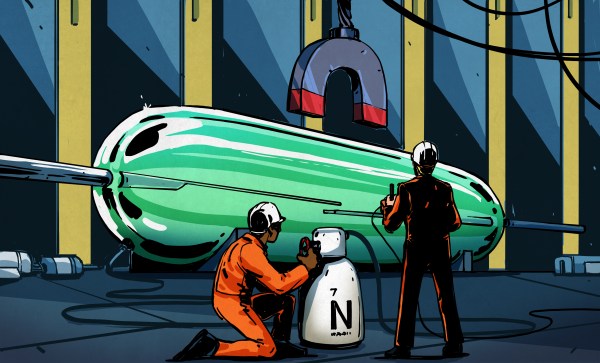
Audacious times generate audacious efforts, especially when national pride and security are perceived to be at stake. Such was the case in the 1950s and 1960s, with the Space Race that started with a Russian sphere whizzing around the planet and ended with Neil Armstrong’s footprint on the Moon. But at the same time, other efforts were underway to answer big questions of national import, such as determining how durable the United States’ strategic assets were, and whether they could withstand the known effects of electromagnetic pulse (EMP), a high-intensity burst of electromagnetic energy that could potentially disable a plane in flight. Finding out just what an EMP could do to a plane would take big engineering and a large forest’s worth of trees.

Continue reading “How To Test A B-52 Against EMP: Project ATLAS-I”

Linux Fu: Regular Expressions

If you consider yourself a good cook, you may or may not know how to make a souffle or baklava. But there are certain things you probably do know how to do that form the basis of many recipes. For example, you can probably boil water, crack an egg, and brown meat. With Linux or Unix systems, you can make the same observation. You might not know how to set up a Wayland server or write a kernel module. But there are certain core skills like file manipulation and editing that will serve you no matter what you do. One of the pervasive skills that often gives people trouble is regular expressions. Many programs use these as a way to specify search patterns, usually in text strings such as files.

If you aren’t comfortable with regular expressions, that’s easy to fix. They aren’t that hard to learn and there are some great tools to help you. Many tools use regular expressions and the core syntax is the same. The source of confusion is that the details beyond core syntax have variations.

Let’s look at the foundation you need to understand regular expression well.

Continue reading “Linux Fu: Regular Expressions”

The Pontoon Bridge Being Floated As An NYC Transit Fix

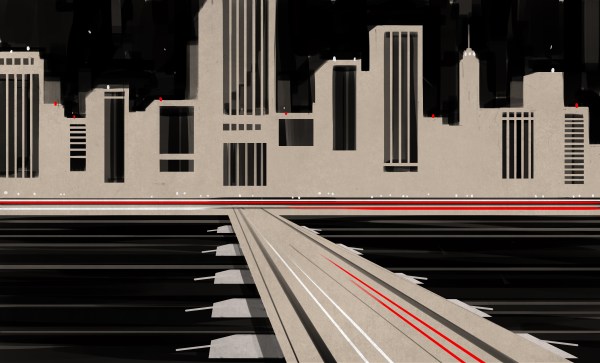
New York City’s L train carries about 400,000 passengers a day, linking Manhattan and Brooklyn and bringing passengers along 14th Street, under the East River, and through the neighborhoods of Williamsburg, Bushwick, Ridgewood, Brownsville, and Canarsie. About 225,000 of these passengers pass through the Canarsie Tunnel, a two-tube cast iron rail tunnel built below the East River between Manhattan and Brooklyn in 1924. Like many other New York City road and subway tunnels, the Canarsie Tunnel was badly damaged when Hurricane Sandy’s storm surge inundated the tubes with million of gallons of salt water. Six years later, the impending closure of the tunnel is motivating New Yorkers to develop their own ambitious infrastructure ideas.

Continue reading “The Pontoon Bridge Being Floated As An NYC Transit Fix”

Evolution Of The Worlds Oldest Computer Festival

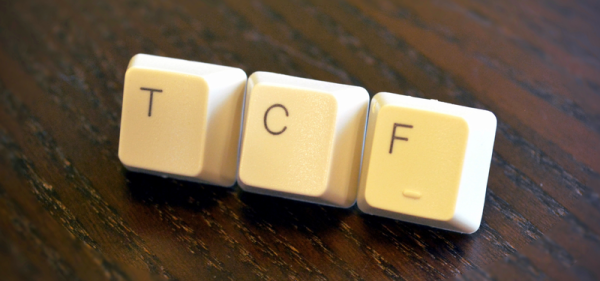
The Trenton Computer Festival (TCF) doesn’t have the name recognition of big technology conferences like DEF CON or HOPE. It’s not even as well known as smaller more localized conferences like DerbyCon, ShmooCon, or the Hackaday Superconference. In fact, there’s a good chance that most readers have never even heard of TCF. But despite not holding a place in the hacker lexicon, TCF has plenty to boast about. Its played host to technology luminaries from Bill Gates to Richard Stallman, and now in its 43rd year, holds the title as the longest continually running technology festival in the world.

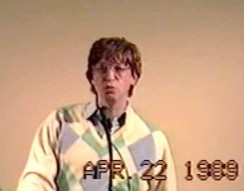
Bill Gates giving the keynote at TCF in 1989

When originally conceived in 1976, the show was devoted to the dawning age of the personal computer, but since then has evolved into a celebration of technology as a whole. When TCF kicks off on March 17th, there won’t be a media blitz or huge corporate sponsorship. There won’t be a simultaneous online stream of the event, and the only badges worn by speakers or attendees will be of the paper variety.

What you will find at TCF is a full schedule of talks given by people who are passionate about technology in its varied forms. These run the gamut from quantum computing to lock picking, from Arduino to Space Shuttle avionics.

At the heart of TCF is co-founder and current Chair Dr Allen Katz. I recently had the opportunity to speak with Dr Katz about the challenges of running a conference of this type, and the secret to keeping relevant in a wildly changing technology landscape.

Continue reading “Evolution Of The Worlds Oldest Computer Festival”

What’s Inside A Neonode Laser Sensor?

Every once in a while, you get your hands on a cool piece of hardware, and of course, it’s your first instinct to open it up and see how it works, right? Maybe see if it can be coaxed into doing just a little bit more than it says on the box? And so it was last Wednesday, when I was at the Embedded World trade fair, and stumbled on a cool touch display floating apparently in mid-air.

The display itself was a sort of focused Pepper’s Ghost illusion, reflected off of an expensive mirror made by Aska3D. I don’t know much more — I didn’t get to bring home one of the fancy glass plates — but it looked pretty good. But this display was interactive: you could touch the floating 2D projection as if it were actually there, and the software would respond. What was doing the touch response in mid-air? I’m a sucker for sensors, so I started asking questions and left with a small box of prototype Neonode zForce AIR sensor sticks to take apart.
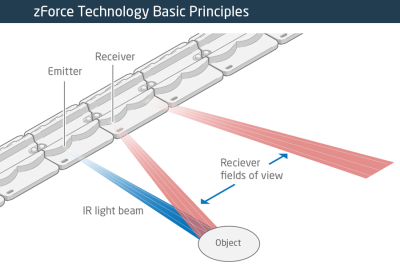
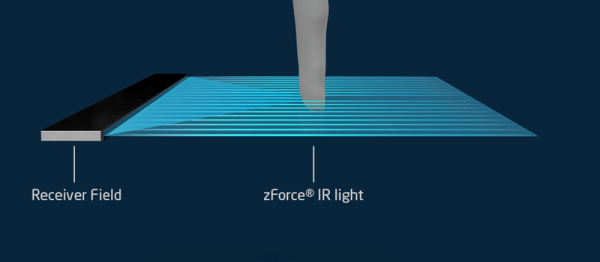
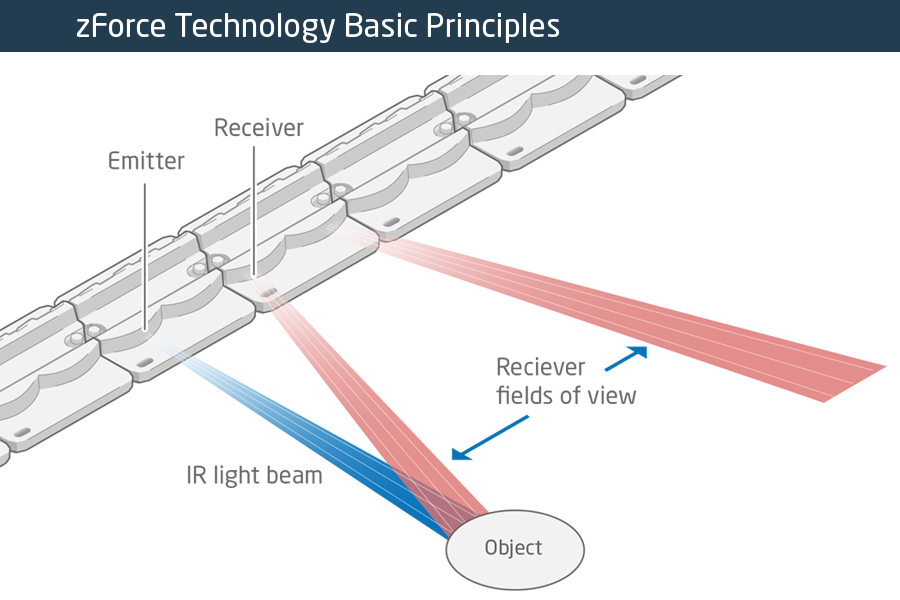
The zForce sensors are essentially an array of IR lasers and photodiodes with some lenses that limit their field of view. The IR light hits your finger and bounces back to the photodiodes on the bar. Because the photodiodes have a limited angle over which they respond, they can be used to triangulate the distance of the finger above the display. Scanning quickly among the IR lasers and noting which photodiodes receive a reflection can locate a few fingertips in a 2D space, which explained the interactive part of the floating display. With one of these sensors, you can add a 2D touch surface to anything. It’s like an invisible laser harp that can also sense distance.

The intended purpose is fingertip detection, and that’s what the firmware is good at, but it must also be the case that it could detect the shape of arbitrary (concave) objects within its range, and that was going to be my hack. I got 90% of the way there in one night, thanks to affordable tools and free software that every hardware hacker should have in their toolbox. So read on for the unfortunate destruction of nice hardware, a tour through some useful command-line hardware-hacking tools, and gratuitous creation of animations from sniffed SPI-like data pulled off of some test points.

Continue reading “What’s Inside A Neonode Laser Sensor?”

Mechanisms: The Reed Switch

Just about everywhere you go, there’s a reed switch nearby that’s quietly going about its work. Reed switches are so ubiquitous that you’re probably never more than a few feet away from one at any given time, especially at home or in the car. You might have them on your doors and windows as part of a burglar alarm system. They keep your washing machine from running when the lid is open, and they put your laptop to sleep when you close the lid. They know if the car has enough brake fluid and whether or not your seat belt is fastened.

Reed switches are interesting devices with a ton of domestic and industrial applications. We call them switches, but they’re also sensors. In fact, they only do the work of a switch while they can sense a magnetic field. They are capable of switching AC or DC at low and high voltages, but they don’t need electricity to work. Since they’re sealed in glass, they are impervious to dirt, dust, corrosion, temperature swings, and explosive environments. They’re cheap, they’re durable, and in low-current applications they can last for about a billion actuations.

Continue reading “Mechanisms: The Reed Switch”

Katherine Johnson: Computer To The Stars

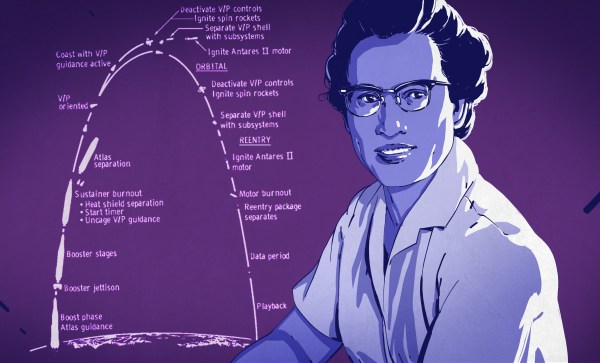
In 1962, John Glenn sat in his capsule waiting for his rocket engines to light-up and lift him to space. But first, he insisted that Katherine Johnson double-check the electronic computer’s trajectory calculations. While that’s the dramatic version of events given in the recent movie, Hidden Figures, the reality isn’t very far off. Glenn wasn’t sitting on the launchpad at the time, but during the weeks prior to launch, he did insist that Johnson double-check the computer’s calculations.

So who is this woman who played an important but largely unknown part of such a well-known historical event? During her long life, she was a wife, a mother, an African-American, a teacher, and a human computer, a term rarely used these days. Her calculations played a part in much of early spaceflight and in 2015, she was awarded the Presidential Medal of Freedom by President Obama. She also has a building named after her at the Langley Research Center in Hampton, Virginia.

Continue reading “Katherine Johnson: Computer To The Stars”