Our Reactions To The Treatment Of Robots

Most of us have seen employees of Boston Dynamics kicking their robots, and many of us instinctively react with horror. More recently I’ve watched my own robots being petted, applauded for their achievements, and yes, even kicked.

Why do people react the way they do when mechanical creations are treated as if they were people, pets, or worse? There are some very interesting things to learn about ourselves when considering the treatment of robots as subhuman. But it’s equally interesting to consider the ramifications of treating them as human.

The Boston Dynamics Syndrome

Shown here are two snapshots of Boston Dynamics robots taken from their videos about Spot and Atlas. Why do scenes like this create the empathic reactions they do? Two possible reasons come to mind. One is that the we anthropomorphize the human-shaped one, meaning we think of it as human. That’s easy to do since not only is it human-shaped but the video shows it carrying a box using human-like movements. The second snapshot perhaps evokes the strongest reactions in anyone who owns a dog, though its similarity to any four-legged animal will usually do.

Is it wrong for Boston Dynamics, or anyone else, to treat robots in this way? Being an electronic and mechanical wizard, you might have an emotional reaction and then catch yourself with the reminder that these machines aren’t conscious and don’t feel emotional pain. But it may be wrong for one very good reason.


Continue reading “Our Reactions To The Treatment Of Robots”

Retrotechtacular: Hacking Wartime Mail

I’m guessing you got quite a few e-mails today. But have you ever had a v-mail? That sounds like some new term for video e-mail, but it actually dates back to World War II. If you are in Europe, the term was Airgraph — not much more descriptive.

If you make a study of war, you’ll find one thing. Over the long term, the winning side is almost always the side that can keep their troops supplied. Many historians think World War II was not won by weapons but won by manufacturing capability. That might not be totally true, but supplies are critical to a combat force. Other factors like tactics, doctrine, training, and sheer will come into play as well.

On the other hand, morale on the front line and the home front is important, too. Few things boost morale as much as a positive letter from home. But there’s a problem.

While today’s warfighter might have access to a variety of options to communicate with those back home, in World War II, communications typically meant written letters. The problem is ships going from the United States to Europe needed to be full of materials and soldiers, not mailbags. With almost two million U.S. soldiers in the European Theater of Operations, handling mail from home was a major concern.

British Mail Hack

The British already figured out the mail problem in the 1930s. Eastman Kodak and Imperial Airways (which would later become British Airways) developed the Airgraph system to save weight on mail-carrying aircraft.  Airgraph allowed people to write soldiers on a special form. The form was microfilmed and sent to the field. On the receiving end, the microfilm was printed and delivered as regular mail.

Continue reading “Retrotechtacular: Hacking Wartime Mail”

Who Owns Arduino?

Who owns Arduino? We don’t mean metaphorically — we’d say that’s the community of users and developers who’ve all contributed to this amazing hardware/software ecosystem. We mean literally. Whose chips are on the table? Whose money talks? It looks like ARM could have a stake!

The Arduino vs Arduino saga “ended” just under a year ago with an out-of-court settlement that created a private holding company part-owned by both parties in the prior dispute over the trademark. And then, [Banzi] and the original founders bought out [Musto]’s shares and took over. That much is known fact.

The murky thing about privately held companies and out-of-court settlements is that all of the details remain private, so we can only guess from outside. We can speculate, however, that buying out half of the Arduino AG wasn’t cheap, and that even pooling all of their resources together, the original founders just didn’t have the scratch to buy [Musto] out. Or as the Arduino website puts it, “In order to make [t]his a reality, we needed a partner that would provide us with the resources to regain full ownership of Arduino as a company… and Arm graciously agreed to support us to complete the operation.” That, and the rest of the Arduino blog post, sure looks like ARM provided some funds to buy back Arduino.

We reached out to [Massimo Banzi] for clarification and he replied:

“Hi arm did not buy nor invest in arduino. The founders + Fabio Violante still own the company. As I wrote in the blog post we are still independent, open source and cross platform.”

We frankly can’t make sense of these conflicting statements, at least regarding whether ARM did or didn’t contribute monetary resources to the deal. ARM has no press release on the deal as we write this. Continue reading “Who Owns Arduino?”

A 3D Printer Alone Doesn’t Make A Hackspace

There was a time when hackspaces were few and far between — legendary environments that you’d read about online, where amazing projects were made by people who had come together to form communities of creative technology enthusiasts. Of course, they were always in places far afield, California, or Germany, never in provincial England where I call home. Eventually our movement spread its tentacles into the county towns, and several years later with a stint as a hackspace director behind me I sense that it is on the cusp of escaping its underground roots. Every month seems to bring news of yet another organisation wanting to open a makerspace of their own, be they universities, co-working spaces, enterprise centres, libraries, or even banks. It’s evident that our movement has attracted an aura of edginess when it comes to getting things done, and that these entities are anxious to secure a little piece of that for themselves.

So within a few miles of most hackspaces will be several places where you can find a 3D printer, maybe a vinyl cutter, a CAD workstation, and a soldering iron. There will be a fancy hipster coffee machine and some futuristic furniture, and probably some kind of enclosed meeting pod of dubious design. All of which can no doubt be viewed through a glass wall, so that people in suits can watch all that raw #innovation sizzling away.

Viewed from within the movement, it’s easy to see all this activity on the edges of the world of making as a threat. A struggling community organisation survives on its wits alone, it doesn’t have a multi-million pound (or dollar) university or investor behind it. Its tools are hard-won and patched up, and its coffee machine is a battered electric kettle and a jar of supermarket instant coffee. When it comes to gleaming innovation spaces, a group of assorted makers simply can’t compete. Surely the arrival of these spaces will tempt members away, and the hackspace will inevitably wither, and die.

It’s worth taking a step back at this point, and considering what makes a hackspace. Specifically, what makes a good hackspace.

Continue reading “A 3D Printer Alone Doesn’t Make A Hackspace”

The Art Of Blinky Business Cards

Business cards are stuck somewhere between antiquity and convenience. On one hand, we have very convenient paperless solutions for contact swapping including Bluetooth, NFC, and just saying, “Hey, put your number into my phone, please.” On the other hand, holding something from another person is a more personal and memorable exchange. I would liken this to the difference between an eBook and a paperback. One is supremely convenient while the other is tactile. There’s a reason business cards have survived longer than the Rolodex.

Protocols and culture surrounding the exchange of cards are meant to make yourself memorable and a card which is easy to associate with you can work long after you’ve given your card away. This may seem moot if you are assigned cards when you start a new job, but personal business cards are invaluable for meeting people outside of work and you are the one to decide how wild or creative to make them.

Continue reading “The Art Of Blinky Business Cards”

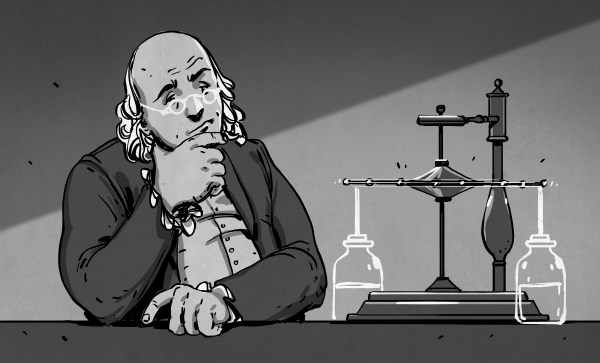
Ben Franklin’s Weak Motor And Other Forgotten Locomotion

Most of the electric motors we see these days are of the electromagnetic variety, and for good reason: they’re powerful. But there’s a type of motor that was invented before the electromagnetic one, and of which there are many variations. Those are motors that run on high voltage, and the attraction and repulsion of charge, commonly known as electrostatic motors.

Ben Franklin — whose electric experiments are most frequently associated with flying a kite in a thunderstorm — built and tested one such high-voltage motor. It wasn’t very powerful, but was good enough for him to envision using it as a rotisserie hack. Food is a powerful motivator.

What follows is a walk through the development of various types of these motors, from the earliest ion propelled ones to the induction motors which most have never heard of before, even an HV hacker such as yours truly.

Continue reading “Ben Franklin’s Weak Motor And Other Forgotten Locomotion”

Books You Should Read: Feynman’s Appendix To The Challenger Disaster Report

It isn’t really a book, but Richard Feynman’s Appendix to the Challenger Disaster Report is still definitely something you should read. It’s not particularly long, but it’s educational and relevant not just as an example of critical thinking in action, but as a reminder not to fool oneself; neither individually, nor on an organizational level. Sadly, while much was learned from the events leading to and surrounding the Challenger disaster, over thirty years later many of us can still find a lot of the same things to relate to in our own professional lives. There isn’t a single magic solution, because these problems are subtle and often masquerade as normal.

Feynman and the Challenger Disaster

Richard Feynman (1918-1988) was a Nobel Prize winning physicist and one of the best-known scientists of his time. In 1986 he somewhat reluctantly agreed to join the Rogers Commission, whose task was to investigate the Challenger disaster. The space shuttle Challenger had exploded a little more than a minute after launch, killing everyone on board. The commission’s job was to find out what had gone wrong and how it had happened, and figure out how to keep it from happening again.

Continue reading “Books You Should Read: Feynman’s Appendix To The Challenger Disaster Report”