The PDP-1: The Machine That Started Hacker Culture

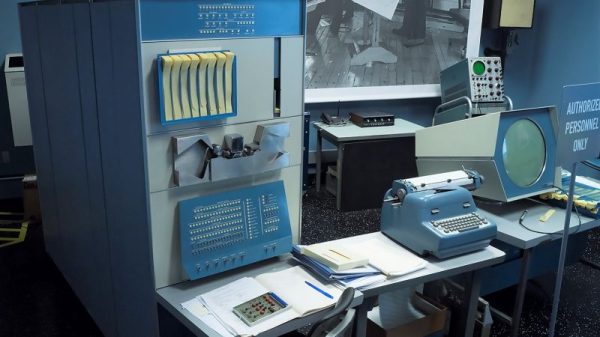
One of my bucket list destinations is the Computer History Museum in Mountain View, California — I know, I aim high. I’d be chagrined to realize that my life has spanned a fair fraction of the Information Age, but I think I’d get a kick out of seeing the old machines, some of which I’ve actually laid hands on. But the machines I’d most like to see are the ones that predate me, and the ones that contributed to the birth of the hacker culture in which I and a lot of Hackaday regulars came of age.

If you were to trace hacker culture back to its beginning, chances are pretty good that the machine you’d find at the root of it all is the Digital Equipment Corporation’s PDP-1. That’s a tall claim for a machine that was introduced in 1959 and only sold 53 units, compared to contemporary offerings from IBM that sold tens of thousands of units. And it’s true that the leading edge of the explosion of digital computing in the late 50s and early 60s was mainly occupied by “big iron” machines, and that mainframes did a lot to establish the foundations for all the advances that were to come.

Continue reading “The PDP-1: The Machine That Started Hacker Culture”
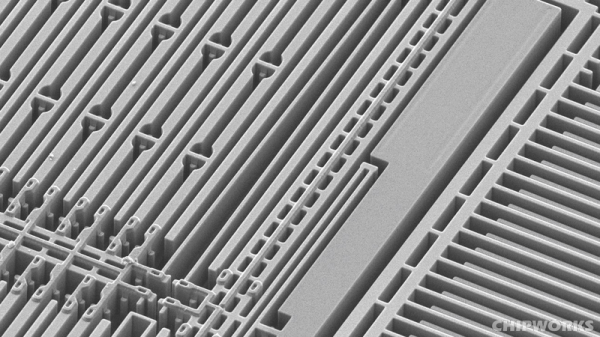
MEMS: The Biggest Word In Small

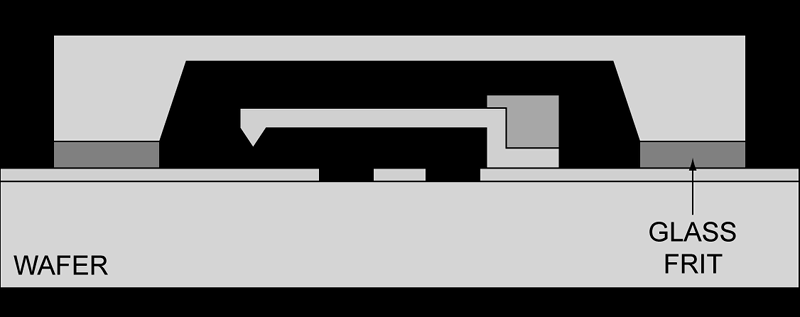
What’s tiny and on track to be worth $22 billion dollars by 2018? MEMS (Micro Electrical Mechanical Systems). That’s a catch-all phrase for microscopic devices that have moving parts. Usually, the component sizes range from 0.1 mm to 0.001 mm, which is tiny, indeed. There are some researchers working with even smaller components, sometimes referenced as NEMS (Nano Electrical Mechanical Systems).

Resonant Cantilever by [Pcflet01], CC BY-SA 3.0
MEMS have a wide range of applications including ink jet printers, accelerometers, gyroscopes, microphones, pressure sensors, displays, and more. Many of the sensors in a typical cell phone would not be possible without MEMS. There are many ways that MEMS devices are built, but just to get a flavor, consider the cantilever (see right), one of the most common MEMS constructions.

Continue reading “MEMS: The Biggest Word In Small”

Hacking An Inspection Microscope

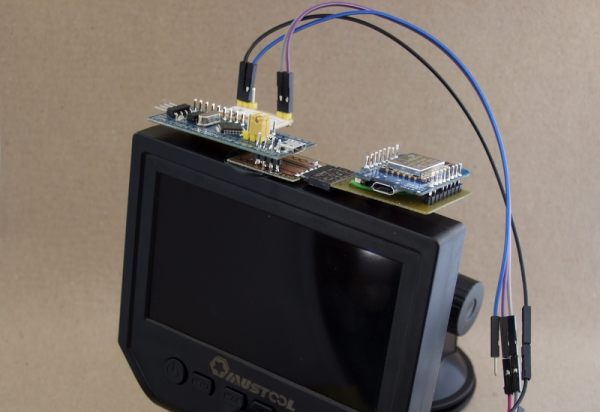
Sometimes I need to be able to take photographs of very small things, and the so-called macro mode on my point-and-shoot camera just won’t cut it. And it never hurts to have an inspection scope on hand for tiny soldering jobs, either, though I prefer a simple jeweler’s loupe in one eye for most tasks. So I sent just over $40 off to my close friend Alibaba, and a few weeks later was the proud owner of a halfway usable inspection scope that records stills or video to an SD card.

Unfortunately, it’s only halfway useable because of chintzy interface design and a wobbly mount. So I spent an afternoon, took the microscope apart, and got it under microcontroller control, complete with WiFi and a scripting language. Much better! Now I can make microscope time-lapses, but much more importantly I can take blur-free photos without touching the wiggly rig. It was a fun hack, so I thought I’d share. Read on!

Continue reading “Hacking An Inspection Microscope”

Catastrophic Forgetting: Learning’s Effect On Machine Minds

What if every time you learned something new, you forgot a little of what you knew before? That sort of overwriting doesn’t happen in the human brain, but it does in artificial neural networks. It’s appropriately called catastrophic forgetting. So why are neural networks so successful despite this? How does this affect the future of things like self-driving cars? Just what limit does this put on what neural networks will be able to do, and what’s being done about it?

The way a neural network stores knowledge is by setting the values of weights (the lines in between the neurons in the diagram). That’s what those lines literally are, just numbers assigned to pairs of neurons. They’re analogous to the axons in our brain, the long tendrils that reach out from one neuron to the dendrites of another neuron, where they meet at microscopic gaps called synapses. The value of the weight between two artificial neurons is roughly like the number of axons between biological neurons in the brain.

To understand the problem, and the solutions below, you need to know a little more detail.

Continue reading “Catastrophic Forgetting: Learning’s Effect On Machine Minds”

Go Small, Get Big: The Hack That Revolutionized Bioscience

Few people outside the field know just how big bioscience can get. The public tends to think of fields like physics and astronomy, with their huge particle accelerators and massive telescopes, as the natural expressions of big science. But for decades, biology has been getting bigger, especially in the pharmaceutical industry. Specialized labs built around the automation equipment that enables modern pharmaceutical research would dazzle even the most jaded CERN physicist, with fleets of robot arms moving labware around in an attempt to find the Next Big Drug.

I’ve written before on big biology and how to get more visibility for the field into STEM programs. But how exactly did biology get big? What enabled biology to grow beyond a rack of test tubes to the point where experiments with millions of test occasions are not only possible but practically required? Was it advances in robots, or better detection methodologies? Perhaps it was a breakthrough in genetic engineering?

Nope. Believe it or not, it was a small block of plastic with some holes drilled in it. This is the story of how the microtiter plate allowed bioscience experiments to be miniaturized to the point where hundreds or thousands of tests can be done at a time.

Continue reading “Go Small, Get Big: The Hack That Revolutionized Bioscience”

Amazing Motion-Capture Of Bendy Things

Have you, dear reader, ever needed to plot the position of a swimming pool noodle in 3D  and in real time? Of course you have, and today, you’re in luck! I’ve compiled together a solution that’s sure to give you the jumpstart on solving this “problem-you-never-knew-you-had.”

Ok, there’s a bit of a story behind this one. Back in my good-ol’ undergrad days, I got the chance to play with tethered underwater robots. I remember fumbling about thinking: “Hmm, with this robot tether, wouldn’t it be sweet to string up a set of IMUs down the length of the tether to estimate the robot’s location in 3-space?” A few years later, I cooked together this IMU Noodle project to play with some real hardware in the spirit of solving that problem. With a little quaternion math, a nifty IMU, and some custom PCBAs, this idea has gone from some idle brain-ramble into a real device. It’s an incredibly interesting example of using available hardware and a little ingenuity to build a system that is unique and dependable.

As for why? I first saw an IMU noodle pop up on these pages back in 2012 and I was baffled. I just had to build one! Now complete, I figured that there’s enough math and fun-loving electronics nuggets to merit a full article for this month’s after-hour adventures. Dear reader, let me tell you a wonderful story where math meets electronics and works up the courage to ask it out for brunch.

Continue reading “Amazing Motion-Capture Of Bendy Things”

Panelizing Boards The Easy Way

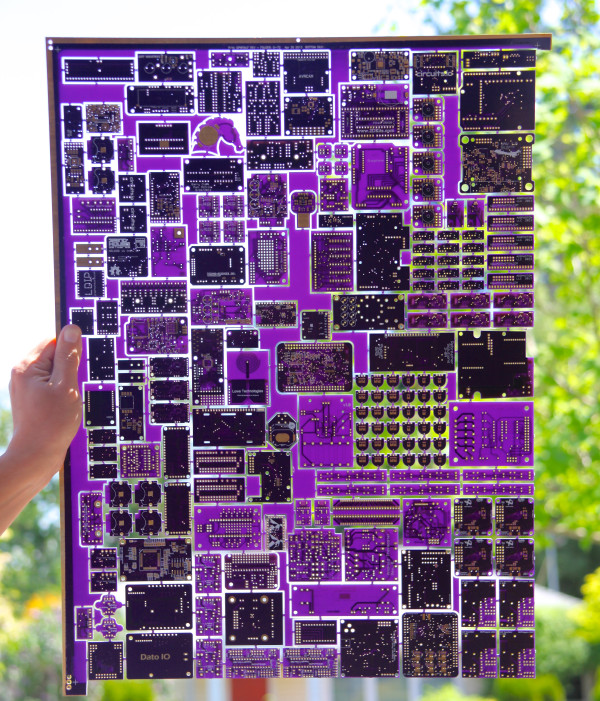
For reasons that will remain undisclosed until some time in the future, I recently had a need to panelize a few PCBs. Panelization is the art of taking PCB designs you already have, whether they’re KiCad board files, Eagle board files, or just Gerbers, and turning them into a single collection of PCBs that can be sent off to a fab house.

Now this is panel racing

If you’re still wondering what this means, take a look at the last board you got from OSH Park, Seeed, Itead, or Dirty PCBs. Around the perimeter of your board, you’ll find some rough spots. These are ‘mouse bites’ and tabs, places where the boards are strung together to form a gigantic rectangular panel sent off to a manufacturer. You can check out this great interview with [Laen] from OSH Park to get an idea of how this works, but the basic process is to take a bunch of Gerbers, add tabs and mouse bites, solve the knapsack problem, and send the completed panel off to a board house.

Panelizing boards is something most of us won’t have to do often. Really, you only want a panel of boards when you’re manufacturing something. For small-scale production and prototypes, bare boards will do just fine. Simply by virtue of the fact that panelizing boards is far less common than throwing some Gerbers at OSH Park or Seeed, there aren’t many (good) tutorials, and even fewer (good) tools to do so. This is how you panelize boards quickly and easily using Open Source tools.

Continue reading “Panelizing Boards The Easy Way”