Hackaday Podcast 014: Keeping Raspberry’s SD Card Alive, We Love MRRF, And How Hot Are Flip Chips?

Elliot Williams and Mike Szczys take a look at advances in photogrammetry (building 3D models out of many photographs from a regular camera), a delay pedal that’s both aesthetically and aurally pleasing, and the power of AI to identify garden slugs. Mike interviews Scotty Allen while walking the streets and stores of the Shenzhen Electronics markets. We delve into SD card problems with Raspberry Pi, putting industrial controls on your desk, building a Geiger counter for WiFi, and the sad truth about metal 3D printing.

Take a look at the links below if you want to follow along, and as always, tell us what you think about this episode in the comments!

Take a look at the links below if you want to follow along, and as always, tell us what you think about this episode in the comments!

Direct download (60 MB or so.)

Continue reading “Hackaday Podcast 014: Keeping Raspberry’s SD Card Alive, We Love MRRF, And How Hot Are Flip Chips?”

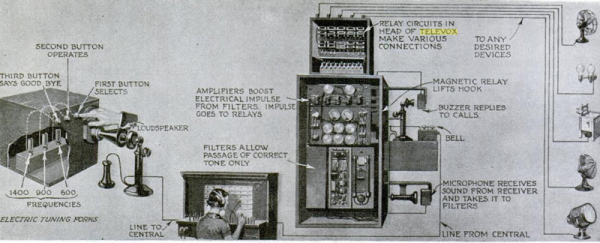
Televox: The Past’s Robot Of The Future

When I read old books, I like to look for predictions of the future. Since we are living in that future, it is fun to see how they did. Case in point: I have a copy of “The New Wonder Book of Knowledge”, an anthology from 1941. This was the kind of book you wanted before there was a Wikipedia to read in your spare time. There are articles about how coal is mined, how phonographs work, and the inner workings of a beehive. Not the kind of book you’d grab to look up something specific, but a great book to read if you just want to learn something interesting. In it there are a few articles about technology that seemed ready to take us to the future. One of those is the Televox — a robot from Westinghouse poised to usher in an age of home and industrial mechanical servants. Robots in 1941? Actually, Televox came into being in 1927.

If you were writing about the future in 2001, you might have pictured city sidewalks congested with commuters riding Segways. After all, in 2001, we were told that something was about to hit the market that would “change everything.” It had a known inventor, Dean Kamen, and a significant venture capitalist behind it. While it has found a few niche markets, it isn’t the billion dollar personal transportation juggernaut that was predicted.

But technology is like that. Sometimes things seem poised for greatness and disappear — bubble memory comes to mind. Sometimes things have a few years of success and get replaced by something better. Fax machines or floppy drives, for example. The Televox was a glimpse of what was to come, but not in any way that people imagined in 1941. Continue reading “Televox: The Past’s Robot Of The Future”

The $50 Ham: Checking Out The Local Repeater Scene

So far in this series, we’ve covered the absolute basics of getting on the air as a radio amateur – getting licensed, and getting a transceiver. Both have been very low-cost exercises, at least in terms of wallet impact. Passing the test is only a matter of spending the time to study and perhaps shelling out a nominal fee, and a handy-talkie transceiver for the 2-meter and 70-centimeter ham bands can be had for well under $50. If you’re playing along at home, you haven’t really invested much yet.

The total won’t go up much this week, if at all. This time we’re going to talk about what to actually do with your new privileges. The first step for most Technician-class amateur radio operators is checking out the local repeaters, most of which are set up exactly for the bands that Techs have access to. We’ll cover what exactly repeaters are, what they’re used for, and how to go about keying up for the first time to talk to your fellow hams.

Continue reading “The $50 Ham: Checking Out The Local Repeater Scene”

Blacksmithing For The Uninitiated: Let’s Talk About Anvils

When you grow up with something as the constant backdrop to your life, it’s easy to forget as an adult that not everyone else shares your instinctive knowledge of the subject. My dad is a blacksmith, he’s now retired, but as I was growing up his very active forge was in a workshop next to our house. This is the second part of a series based upon that experience, exploring blacksmithing for people who have maybe always fancied a go at the anvil but have little idea where to start.

The Most Obvious Blacksmithing Tool: The Anvil

Having considered the hearth in our previous outing, it’s time to turn our attention to what is the signature piece of blacksmithing equipment: the anvil. This has the function of providing a high-mass hardened working surface against which metal can be forged, and it has a distinctive shape with various parts for particular metalworking tasks. There are many minor and major variations of anvil design depending upon where in the world your anvil hails from, but since my experience comes from the English counties, the anvil I will be describing is the pattern you’ll find in the British Isles.

Continue reading “Blacksmithing For The Uninitiated: Let’s Talk About Anvils”

Transcending The Stack With The Right Network Protocol

The increase in network-connected devices the past years has been something of a dual-edged sword. While on one hand it’s really nice to have an easy and straight-forward method to have devices talk with each other, this also comes with a whole host of complications, mostly related to reliability and security.

With WiFi, integrating new devices into the network is much trickier than with Ethernet or CAN, and security (e.g. WPA and TLS) isn’t optional any more, because physical access to the network fabric can no longer be restricted. Add to this reliability issues due to interference from nearby competing WiFi networks and other sources of electromagnetic noise, and things get fairly complicated already before considering which top-layer communication protocol one should use. Continue reading “Transcending The Stack With The Right Network Protocol”

The 3D Printing Dream Is Still Alive At 2019’s Midwest RepRap Festival

3D Printers have been in the hands of hackers for well over ten years, but the dream is far from over and certainly not overslept. This year’s Midwest RepRap Festival is a testament to the still-growing excitement, and world where 3D printing is alive and kicking on the next level.

This past weekend, I took up my friend [Eric’s] advice to come down and participate firsthand, and I was simply blown away. Not only did we witness the largest number of attendees to date, MRRF 2019 spilled into not one but two conference halls at the Goshen Fairgrounds.

In what follows, I tell my tale of the times. Continue reading “The 3D Printing Dream Is Still Alive At 2019’s Midwest RepRap Festival”

Autodesk Fusion 360 Hack Chat

Join us Wednesday at noon Pacific time for the Autodesk Fusion 360 Hack Chat!

Most of us have a collection of tools that we use for the various mechanical, electronic, and manufacturing tasks we face daily. But if you were asked to name one tool that stretches across all these spaces, Autodesk Fusion 360 would certainly spring to mind. Everyone from casual designers of 3D-printed widgets to commercial CNC machine shops use it as an end to end design solution, and anyone who has used it over the last year or so knows that the feature set in Fusion is expanding rapidly.

Matt, who goes by technolomaniac on Hackaday.io, is Director of Product Development for EAGLE, Tinkercad, and Fusion 360 at Autodesk. He’ll drop by the Hack Chat this week to discuss your questions about:

  • All the Autodesk design software components, from EAGLE to Fusion and beyond
  • Future plans for an EAGLE-Fusion integration
  • Support for manufacturing, including additive, CNC, and even mold making
  • Will there ever be “one design tool to rule them all?”

You are, of course, encouraged to add your own questions to the discussion. You can do that by leaving a comment on the Autodesk Fusion 360 Hack Chat page and we’ll put that in the queue for the Hack Chat discussion.

join-hack-chatOur Hack Chats are live community events in the Hackaday.io Hack Chat group messaging. This week we’ll be sitting down on Wednesday, April 10, at noon, Pacific time. If time zones have got you down, we have a handy time zone converter.

Click that speech bubble to the right, and you’ll be taken directly to the Hack Chat group on Hackaday.io. You don’t have to wait until Wednesday; join whenever you want and you can see what the community is talking about.