The Art Of Vacuum Tube Fabrication

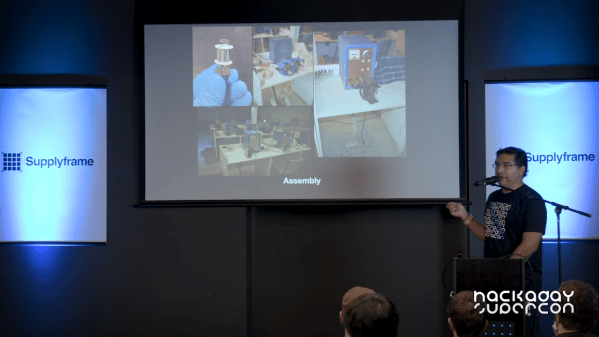
Vacuum tubes fueled a technological revolution. They made the amplification of signals a reality for transatlantic telephone cables (and transcontinental ones too), they performed logic for early computers, and they delivered that warm fuzzy sound for high fidelity audio. But they were labor intensive to produce, and fragile, so semiconductors came along and replaced tubes in almost every application. But of course tubes are still with us and some tube applications are still critical — you’ll find them used in high-power RF and there are even satellites that depend on klystrons. So there are still experts in tube fabrication around, and Charles Alexanian is one of them. His newly-published talk at the 2018 Hackaday Supercon (found below) is a whirlwind tour of what goes into building a vacuum tube.

The process of building your own vacuum tube isn’t hard, but it’s not a walk in the park. The difficulty comes in the sheer number of processes, and the tricks of the trade found at every step. Charles’ methaphor is that if you build one tube at a time each step is like learning to ride a bicycle again, but if you build many you get into the swing of it and things go a lot better. His talk is a brief overview of everything, but if you want to drill down he also wrote an excellent article that goes further in depth.
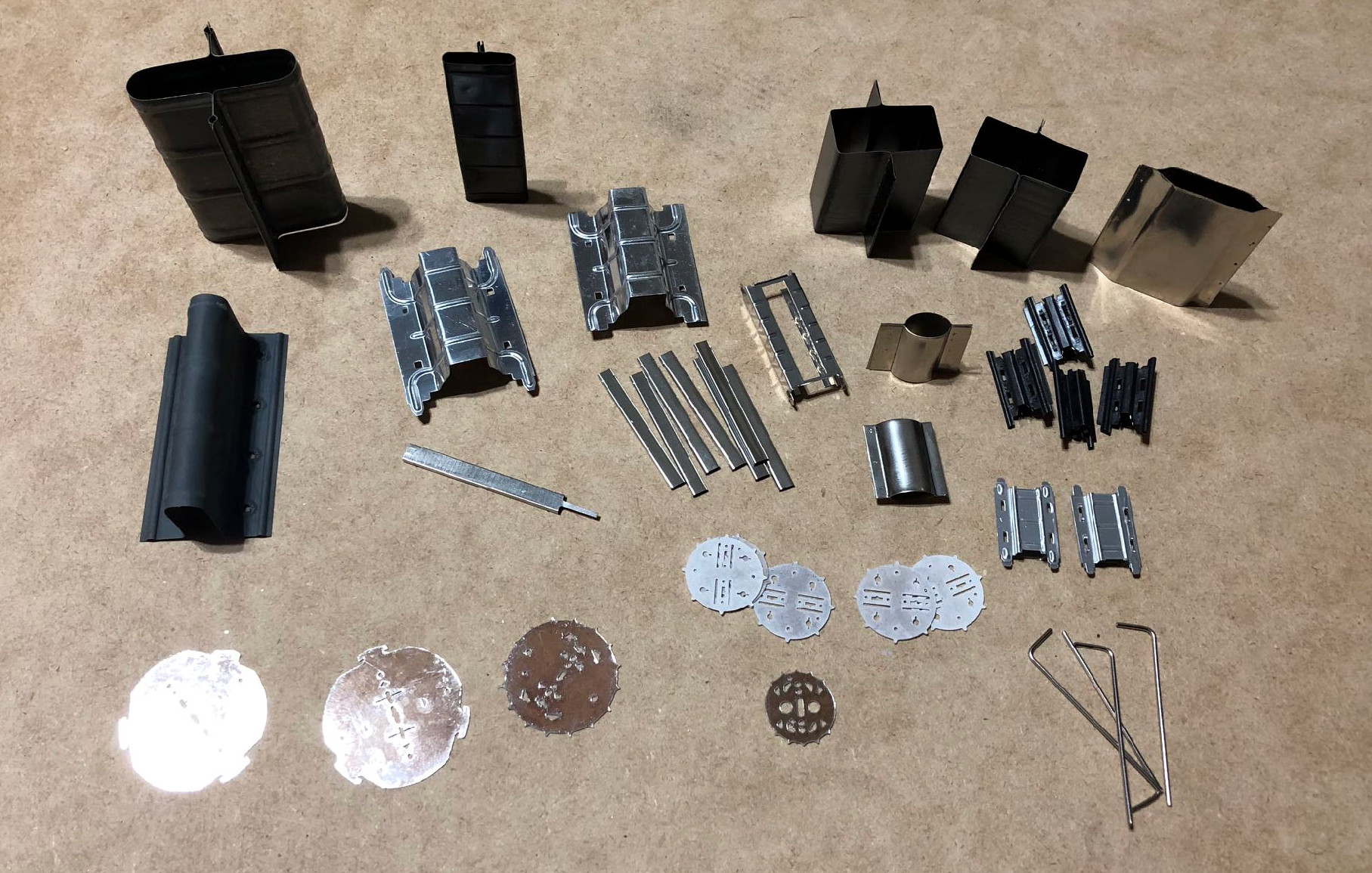
In the working components of each tube are the precision parts: the grid (or grids). For the tube to function well these must be accurately produced which can be done with photolithography, but Charles usually uses a winding process involving a lathe. After winding, the grid is stretched to straighten the nickel wire, then cut to length. Other components such as the plate are stamped using an arbor press and simple forms he fabricates for the purpose.

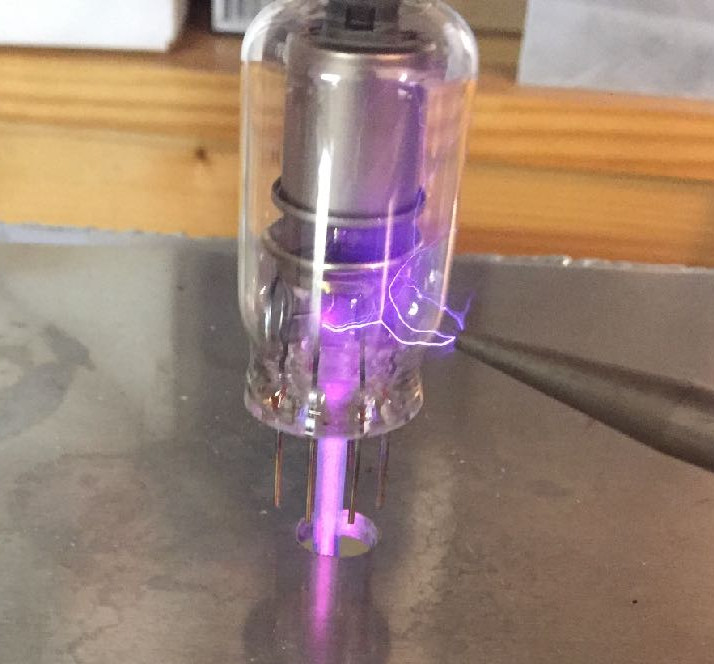
Tube being tested for leaks

Two glass components are used, the dome itself, and feedthrough stems that have a wire for each lead passing through a glass disc. The components are spot welded to the inside portion of the feedthrough stem, then the glass is fused together, again using a lathe. It heads over to a pumping station to evacuate the air from the tube, and is finally tested for leaks using a handheld Tesla coil (see, we knew those weren’t just toys).

Charles proposed his Supercon appearance as a chance to fabricate tubes on-site. We loved the idea, but the amount of gear needed is somewhat prohibitive (annealing ovens, vacuum cabinets, torches for sealing, and the need for 220v, plus space for it all). That’s too bad since we were really hoping to see the Jolly Wrencher in Nixie-tube form — incidentally, Charles says Nixes are simple to make compared to amplifiers and switches. He also mentions that the majority of your time is spent “washing” parts to remove impurities. Fair enough, that part sounds boring, but we hope to endure it at some point in the future because vacuum tube fabrication demos feel very much like a Hackaday event!

Continue reading “The Art Of Vacuum Tube Fabrication”

Printed It: Parametric Hex Key Holder

Desktop 3D printing is an incredible technology to be sure, but it’s not a cure-all. If you’re interested in making something in large numbers, or if production speed is a concern, 3D printing probably isn’t what you’re looking for. But on the flip side, if you want to make a few highly specialized or customized objects, desktop 3D printing represents an absolute revolution in capability for the individual hacker and maker.

In our ongoing mission to prove that desktop 3D printing isn’t just a novelty, we keep a close eye out for printable objects which play to the strengths of the technology. You won’t find any benchmarks or dust collectors here; everything featured in Printed It is a bona fide practical object. An ideal entry into this series is something that you wouldn’t need to print more than a few times, isn’t easily sourced or made via traditional means, and if possible, offers some form of customization which makes it more suitable to the individual’s needs than what’s commercially available.

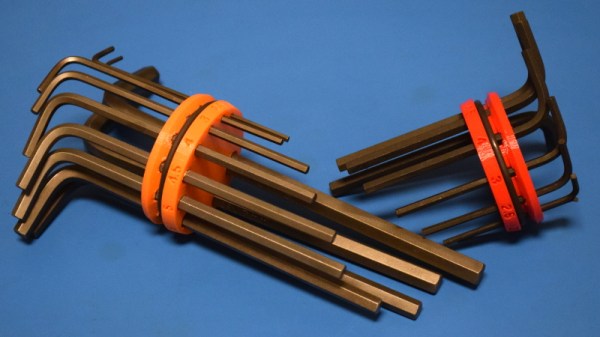
Not every object we feature hits all of these marks, but this parametric hex key holder designed by [Daniel Leitner] absolutely does. This object was created to address a problem that we imagine most Hackaday readers share: taming an ever-growing collection of hex keys. What’s more, this design is something of an open source success story. It’s an idea that passed through the hands of multiple community members, becoming more refined and functional as it went. Even if you don’t personally need to wrangle some unruly hex keys, this object is a fascinating look at how 3D printing and the community that has sprouted up around it is truly evolving the process of going from concept to execution.

Continue reading “Printed It: Parametric Hex Key Holder”

A Daring Search For Answers In Soyuz Mystery

If you happened to tune into NASA TV on December 11th, you’d have been treated to a sight perhaps best described as “unprecedented”: Russian cosmonauts roughly cutting away the thermal insulation of a docked Soyuz spacecraft with a knife and makeshift pair of shears. Working in a cloud of material ripped loose during the highly unusual procedure, cosmonauts Oleg Kononenko and Sergey Prokopyev were effectively carving out their own unique place in space history. Their mission was to investigate the external side of the suspicious hole in the Soyuz MS-09 capsule which caused a loss of air pressure on the International Space Station earlier in the year.

That astronauts don’t generally climb out the hatch and use a knife to hack away at the outside of their spacecraft probably goes without saying. Such an event has never happened before, and while nobody can predict the future, odds are it’s not something we’re likely to see again. Keep in mind that this wasn’t some test capsule or a derelict, but a vehicle slated to return three human occupants to Earth in a matter of days. Cutting open a spacecraft in which human lives will shortly be entrusted is not a risk taken likely, and shows how truly desperate the Russian space agency Roscosmos is to find out just who or what put a hole in the side of one of their spacecraft.

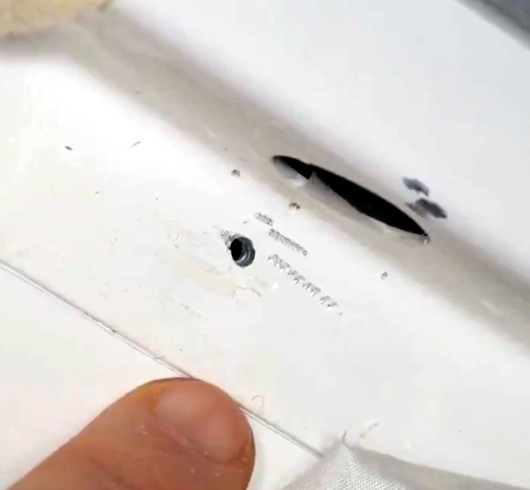
Close inspection from the inside of the spacecraft confirmed the hole wasn’t made by an impact with a micrometeorite or tiny piece of space junk as was originally assumed. It appears to have been made with a drill, which really only allows for two possible scenarios: intentional sabotage or a mistake and subsequent cover-up. In either event, a truly heinous crime has been committed and those responsible must be found. As luck would have it the slow leak of air pressure was detected early and the hole was patched before any damage was done, but what if it hadn’t?

Continue reading “A Daring Search For Answers In Soyuz Mystery”

Fail Of The Week: Hard Lessons In 3D-Printed Bushings For A Giant RC Car

Can you turn 47 pounds (21 kg) of PLA filament into a gigantic working 3D-printed RC car? No, no you can’t — at least not if you eschew proper bearings in favor of printed bushings.

That’s the hard lesson that [Joel Telling] learned with his scaled up version of the OpenRC F1 car, an RC car that can be mostly 3D-printed. The small version still has its share of non-printed parts, mainly screws and bearings. In his video series documenting the build of the upsized version, [Joel] elaborates on some of the reasons for going with printed bushings rather than bearings, which mainly boil down to hoping that the graphite lubricant powder he added would reduce friction enough to prevent the parts from welding themselves together.

The car came out looking great, and even managed to scoot about nicely for a few seconds before its predictably noisy and unhappy demise. But what was unexpected was the actual failure mode. The plastic-on-plastic running gear seemed to handle the rolling loads fine; it was the lateral force exerted on the axle by the tension of the drive belt that was too much for the printed bushing to bear.

As [Joel] rightly points out, it’s only a failure if you fail to learn something, so kudos to him for at least giving this a try. And all that PLA won’t go to waste, of course — everything else on the car worked fine, so adding one bearing should get it back on the road. He should check out our primer on bearings for a few tips on selecting the right one.

Continue reading “Fail Of The Week: Hard Lessons In 3D-Printed Bushings For A Giant RC Car”

Oh The Lessons You’ll Learn By Building A Robot Familiar

A familiar spirit, or just a familiar, is a creature rumored to help people in the practice of magic. The moniker is perfect for Archimedes, the robot owl built by Alex Glow, which wields the Amazon Google AIY kit to react when it detects faces. A series of very interesting design choices a what really gives the creature life. Not all of those choices were on purpose, which is the core of her talk at the 2018 Hackaday Superconference.

You can watch the video of her talk, along with an interview with Alex after the break.

Continue reading “Oh The Lessons You’ll Learn By Building A Robot Familiar”

Hackaday Links Column Banner

Hackaday Links: Christmas Eve Eve, 2018

The entirety of Silicon Valley is predicated on the ability to ‘move fast and break laws’. Have an idea for a scooter startup? No problem, just throw a bunch of scooters on the curb, littering and e-waste laws be damned. Earlier this year, Swarm Technologies launched four rogue satellites on an Indian rocket. All commercial satellite launches by US companies are regulated by the FCC, and Swarm just decided not to tell the FCC. This was the first unauthorized satellite launch ever. Now, Swarm has been fined $900k. Now that we know the cost of launching unauthorized satellites, so if you’ve got a plan for a satellite startup, the cost for an unauthorized launch is a bit more than $200k per satellite. Be sure to put that in your budget.

Santa Claws! Liberty Games would like to donate to a charity this holiday season, but you can’t just write a check. That’s not fun. Instead, they connected a claw machine to the Internet, and anyone can play it. Setting up a webcam was easy enough, but they also had to move the claw and press the button over the Internet. A Raspberry Pi came to the rescue.

Tomorrow is the 50th anniversary of Apollo 8, mankind’s first trip beyond Earth orbit. Now, using Lunar Reconnaissance Orbiter data, NASA has reconstructed the famous ‘Earthrise’ photo taken by the crew. It’s in 4K, and we’re getting a great diagram of what pictures were taken when, through which window.

It’s that time of year again, and the 176th Air Defense Squadron is on high alert. This squadron, based out of Joint Base Elmendorf-Richardson in Anchorage, Alaska has the AWACS in the air, on patrol, just waiting for the inevitable. You can take a look at their progress here, and please be sure to keep our service members in your thoughts this holiday season.

Show off your sculpture skills with small bits of wire! Get the blowtorch out because copper work hardens! [Roger] can’t enter the Circuit Sculpture contest, but he did manage to give a body to one of the Tindie heads.

Radio Gets Ridiculous

There were plenty of great talks at this year’s Supercon, but we really liked the title of Dominic Spill’s talk: Ridiculous Radios. Let’s face it, it is one thing to make a radio or a computer or a drone the way you are supposed to. It is another thing altogether to make one out of things you shouldn’t be using. That’s [Dominic’s] approach. In a quick 30 minutes, he shows you two receivers and two transmitters. What makes them ridiculous? Consider one of the receivers. It is a software defined radio (SDR). How many bits should an SDR have? How about one bit? Ridiculous? Then you are getting the idea.

Dominic is pretty adept at taking a normal microcontroller and bending it to do strange RF things and the results are really entertaining. The breadboard SDR, for example, is a microcontroller with three components: an antenna, a diode, and a resistor. That’s it. If you missed the talk at Supercon, you can see the newly published video below, along with more highlights from Dominic’s talk.

Continue reading “Radio Gets Ridiculous”