Tearing Into Delta Sigma ADC’s

It’s not surprising that Analog to Digital Converters (ADC’s) now employ several techniques to accomplish higher speeds and resolutions than their simpler counterparts. Enter the Delta-Sigma (Δ∑) ADC which combines a couple of techniques including oversampling, noise shaping and digital filtering. That’s not to say that you need several chips to accomplish this, these days single chip Delta-Sigma ADCs and very small and available for a few dollars. Sometimes they are called Sigma-Delta (∑Δ) just to confuse things, a measure I applaud as there aren’t enough sources of confusion in the engineering world already.

I’m making this a two-parter. I will be talking about some theory and show the builds that demonstrate Delta-Sigma properties and when you might want to use them.

Continue reading “Tearing Into Delta Sigma ADC’s”

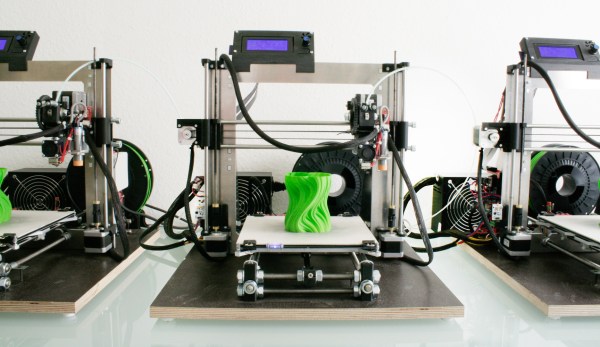
Build A 3D Printer Workhorse, Not An Amazing Disappointment Machine

3D printers have become incredibly cheap, you can get a fully workable unit for $200 – even without throwing your money down a crowdfunded abyss. Looking at the folks who still buy kits or even build their own 3D printer from scratch, investing far more than those $200 and so many hours of work into a machine you can buy for cheap, the question “Why the heck would you do that?” may justifiably arise.

The answer is simple: DIY 3D printers done right are rugged workhorses. They work every single time, they never break, and even if: they are an inexhaustible source of spare parts for themselves. They have exactly the quality and functionality you build them to have. No clutter and nothing’s missing. However, the term DIY 3D printer, in its current commonly accepted use, actually means: the first and the last 3D printer someone ever built, which often ends in the amazing disappointment machine.

This post is dedicated to unlocking the full potential in all of these builds, and to turning almost any combination of threaded rods and plywood into a workshop-grade piece of equipment.

Continue reading “Build A 3D Printer Workhorse, Not An Amazing Disappointment Machine”

The Future Of Eagle CAD

Last week, Autodesk announced their purchase of CadSoft Eagle, one of the most popular software packages for electronic design automation and PCB layout.

Eagle has been around for nearly thirty years, and has evolved to become the standard PCB design package for electronic hobbyists, students, and engineering firms lead by someone who learned PCB design with Eagle. The reason for this is simple: it’s good enough for most simple designs, and there is a free version of Eagle. The only comparable Open Source alternative is KiCad, which doesn’t have nearly as many dedicated followers as Eagle.  Eagle, for better or worse, is a standard, and Open Source companies from  Sparkfun to Adafruit use it religiously and have created high-quality libraries of parts and multiple tutorials

I had the chance to talk with [Matt Berggren], former Hackaday overlord who is currently serving as the Director of Autodesk Circuits. He is the person ultimately responsible for all of Autodesk’s electronic design products, from Tinkercad, 123D, Ecad.io, and project Wire, the engine behind Voxel8, Autodesk’s 3D printer that also prints electronics. [Matt] is now the master of Eagle, and ultimately will decide what will change, what stays the same, and the development path for Eagle.

Continue reading “The Future Of Eagle CAD”

Retrotechtacular: How Solidarity Hacked Polish TV

In the 1980s, Poland was under the grip of martial law as the Communist government of General Wojciech Jaruzelski attempted to repress the independent Solidarity trade union. In Western Europe our TV screens featured as much coverage of the events as could be gleaned through the Iron Curtain, but Polish state TV remained oblivious and restricted itself to wholesome Communist fare.

In September 1985, TV viewers in the city of Toruń sat down to watch an action adventure film and were treated to an unexpected bonus: the screen had a brief overlay with the messages “Solidarity Toruń: Boycotting the election is our duty,” and “Solidarity Toruń: Enough price hikes, lies, repression”. Sadly for the perpetrators, they were caught by the authorities after their second transmission a few days later when they repeated the performance over the evening news bulletin, and they were jailed for four months.

The transmission had been made by a group of dissident radio astronomers and scientists who had successfully developed a video transmitter that could synchronise itself with the official broadcast to produce an overlay that would be visible on every set within its limited transmission radius. This was a significant achievement using 1980s technology in a state in which electronic components were hard to come by. Our description comes via [Maciej Cegłowski], who was able to track down one of the people involved in building the transmitter and received an in-depth description of it.

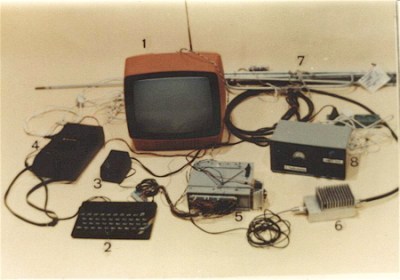
Transmission equipment seized by the Polish police.

The synchronisation came courtesy of the international effort at the time on Very Long Baseline Interferometry, in which multiple radio telescopes across the world are combined to achieve the effect of a single much larger instrument. Before GPS made available a constant timing signal the different groups participating in the experiment had used the sync pulses of TV transmitters to stay in time, establishing a network that spanned the political divide of the Iron Curtain. This expertise allowed them to create their transmitter capable of overlaying the official broadcasts. The police file on the event shows some of their equipment, including a Sinclair ZX Spectrum home computer from the West that was presumably used to generate the graphics.

There is no surviving recording of the overlay transmission, however a reconstruction has been put on YouTube that you can see below the break, complete with very period Communist TV footage.

Continue reading “Retrotechtacular: How Solidarity Hacked Polish TV”

Retrotechtacular: DC To DC Conversion By Vibrator

Electricity comes in two basic forms: Alternating Current (AC) and Direct Current (DC). DC is handy to use and is easy to analyze. However, AC has some useful properties too. In particular, AC current can operate a transformer which can step it up or down easily. Power is conserved, of course (well, actually, you get less power because of losses in the transformer).

You can’t do that trick with pure DC. You can reduce a voltage, although that typically wastes power in heat (for example, a voltage divider or linear regulator). You can’t readily increase a DC voltage unless you convert it into some sort of AC first.

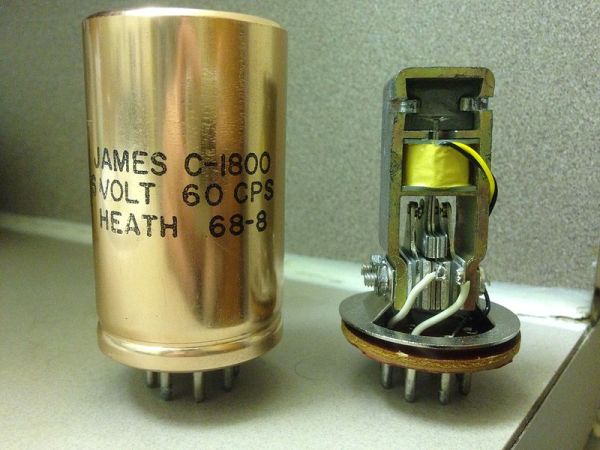
This was a particularly bad problem in the era of tubes–especially tubes in car radios. The car’s voltage was probably 12V but the tube’s plates might take hundreds of volts. What do you do? Some old car radios used what is called a dynamotor. This is just a motor and a generator in one box. You could spin the motor with 12V and have the generator produce a different voltage (even a DC voltage).

Continue reading “Retrotechtacular: DC To DC Conversion By Vibrator”

Hackaday Links: July 3, 2016

This week, Popular Mechanics published cutaway diagrams of ships that will be seen in Star Trek: Beyond, released later this month. This is your cue for spoilers for the remainder of this paragraph. The USS Franklin looks suspiciously like – and was likely built after – the NX-01, the titular ship of Star Trek: Enterprise. The Abrams-verse Franklin was the first Warp 4 ship, yet the prime universe NX-01 was the first Warp 5 ship, with previous ships having trouble reaching Warp 2. We must now consider the Abrams-verse Trek is not a parallel universe to prime-universe Trek and should therefore be considered a completely separate canon (yes, even the destruction of Vulcan. If you see the new Star Trek movie, the NX-01 launched in 2151, and your suggested viewing beforehand is ST:ENT, S02E24, First Flight.

The Mechaduino is a Hackaday Prize entry that turns steppers into closed-loop servos. It’s a phenomenal idea, and now it’s a Kickstarter.

Walk into a dollar store, and you’ll find stupid solar powered electronic flower pots. They’re bits of plastic that shake a plastic flower back and forth when placed in the sun. They’re selling millions, and I have no idea why. [Scott] put a jolly wrencher on one of these flower pots. Really, this is just an exercise in 3D printing, but [Scott] printed the jolly wrencher. We don’t see a lot of that, due to how difficult it is to render the wrencher in OpenSCAD.

In just a few hours, Juno will perform an insertion burn around Jupiter. Does this mean pretty pictures? Not quite yet. This is the closest a spacecraft has ever gotten to Jupiter, and over thirty or forty orbits, Juno will fly between Jupiter’s massive radiation belts. Here’s the NASA trailer.

This video recently caught the Internet’s attention. It’s squares and circles that when put next to a mirror look like circles and squares. Yes, it’s weird. People have 3D printers, so of course these ambiguous objects were quickly reverse engineered and printed. Here’s how they work

It looks like Brexit has caught up to Mouser. Here’s their country select dialog for eu.mouser.com. Thanks [Tom] for the screencap.

Hacklet 114 – Python Powered Projects

Python is one of today’s most popular programming languages.  It quite literally put the “Pi” in Raspberry Pi. Python’s history stretches back to the late 1980’s, when it was first written by  Guido van Rossum. [Rossum] created Python as a hobby project over the 1989 Christmas holiday. He wanted a language that would appeal to Unix/C hackers. I’d say he was pretty successful in that endeavor. Hackers embraced Python, making it a top choice in their projects. This week’s Hacklet focuses on some of the best Python-powered projects on Hackaday.io.
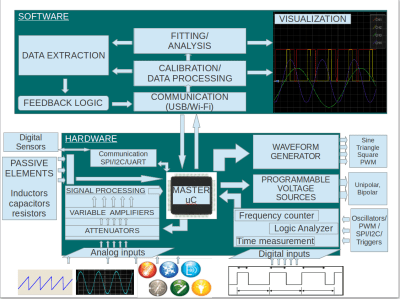
pytoolWe start with [Jithin] and Python Powered Scientific Instrumentation tool, his entry in the 2015 Hackaday Prize. [Jithin] has created an “electronics lab in a box” style tool that can compete with commercial products with price tags in the thousands. Python Powered Scientific Instrumentation tool uses simple microcontroller powered hardware to create programmable gain amplifiers, waveform generators, LCR meters, CC sources and more. The microcontroller handles all the real-time operations. Data processing happens on a connected PC running Python scripts. Popular Python libraries like Scipy make signal processing and waveform displays easy.
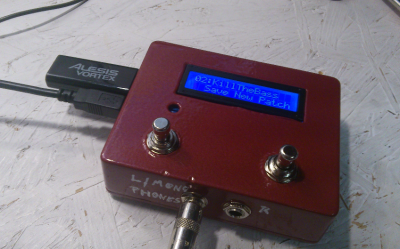
 

pymusicNext up is [Bill Peterson] with jamPi. [Bill] loves his music keyboard, but hates having to lug around a laptop, audio interface, and all the associated cables. He needed a device which would be as flexible as a PC-based synthesizer, but as simple and compact as a MIDI sound module. JamPi does all this and more. [Bill] is using fluidsynth to generate sound. The control and interface software is handled in Python with the help of the fluidsynth.py module. All this functionality is wrapped up in a simple box with a 2 line character LCD. Now [Bill] is ready to jam anytime, anywhere.
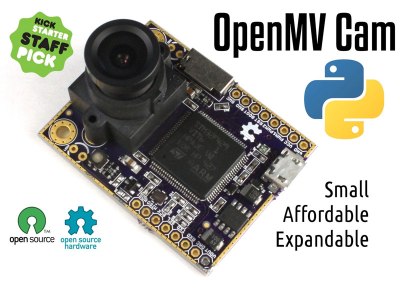
openmv-featureNext is [i.abdalkader] with OpenMV, his entry in the 2014 Hackaday Prize. [i.abdalkader’s] goal was to create “the Arduino of machine vision”. He’s well on his way to accomplishing that. In 2015, OpenMV had a successful Kickstarter campaign. After a few manufacturing glitches, customers are now receiving their devices. OpenMV is a low-cost Python-powered machine vision device. An ARM microcontroller coupled to a simple image sensor makes up the core of the device. The camera is programmed in MicroPython, with the help of many image processing libraries created by the OpenMV team. [i.abdalkader] even created his own IDE using Glade and PyGTK.
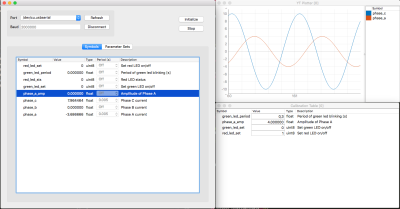
pyfaceFinally we have [osannolik] with Calibration and Measurement Tool. Have you ever want to display a few debug parameters from your embedded project, but didn’t have the display real estate (or any display at all)? What about changing a parameter without pulling out your JTAG setup and firing up your debugger? [Osannolik] has created a simple Python powered PC-based front end which can be used as a Swiss army knife for developing embedded systems. Variables can be displayed in real-time, parameters changed. Even graphs are available thanks to pyqtgraph.

If you want more Python-powered goodness, check out our new Python-powered project list! Did I miss your project? Don’t be shy, just drop me a message on Hackaday.io. That’s it for this week’s Hacklet. As always, see you next week. Same hack time, same hack channel, bringing you the best of Hackaday.io!