You may have seen the Ruideng range of programmable power supply modules from China: small and relatively inexpensive switch-mode buck converters, with microprocessor control and a front panel featuring a large colour OLED screen. Given 30 volts or so they can supply any lower voltage with the extra bonus of current limiting. They’ve been so successful over the several years they’ve been available that they’ve even spawned their own Chinese clones, and countless hacker projects, for instance on the DPS300X and DPS500X models.
Late last year a new module came from Ruideng, the Riden-branded RD6006 combines the basic idea of the previous modules with an extremely flexible front panel with full keypad and rotary encoder, creating something like the front panel to a decent bench power supply but without the accompanying power supply. I ordered one, waited for it to clear customs, took it to my bench, and reviewed it. Continue reading “Review: The Riden RD6006W DC Power Supply Module”→
COVID-19 can seem like a paper tiger, when looking at bare mortality rates. The far greater problem is the increase in fatalities as health systems are stretched to the limit. With thousands of patients presenting all at once, hospitals quickly run out of beds and resources and suddenly, normally survivable conditions become life threatening. One Italian hospital found themselves in such a position, running out of valves for a critical respirator device needed to save their patients. Supplies were running out – but additive manufacturing was able to save the day.
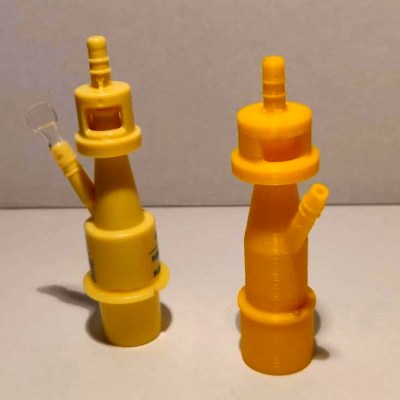
The original part, left, with its 3D-printed replacement.
While the article uses the term “reanimation device”, it’s clear we’re talking about respirators here, necessary to keep patients alive during respiratory distress. The valve in question is a plastic part, one which likely needs to be changed over when the device is used with each individual patient to provide a sterile flow of air. After the alarm was raised by Nunzia Vallini, a local journalist, a ring around of the 3D printing community led to a machine being sent down to the hospital and the parts being reproduced. Once proven to work, things were stepped up, with another company stepping in to produce the parts in quantity with a high-quality laser fusion printer.
People rightly marvel at modern surgical techniques that let surgeons leverage the power of robotics to repair the smallest structures in the human body through wounds that can be closed with a couple of stitches. Such techniques can even be applied remotely, linking surgeon and robot through a telesurgery link. It can be risky, but it’s often a patient’s only option.
NASA has arrived at a similar inflection point, except that their patient is the Mars InSight lander, and the surgical suite is currently about 58 million kilometers away. The lander’s self-digging “mole” probe needs a little help getting started, so they’re planning a high-stakes rescue attempt that would make the most seasoned telesurgeon blanch: they want to use the lander’s robotic arm to press down on the mole to help it get back on track.
In addition to driving home the need for Steadicam or Optical Image Stabilization, this eighty-year-old video illustrates some elegant solutions the automotive industry developed in their suspension systems. Specifically, this Chevrolet video from 1938 is aimed at an audience that values science and therefore the reel boils down the problem at hand using models that will remind you of physics class.
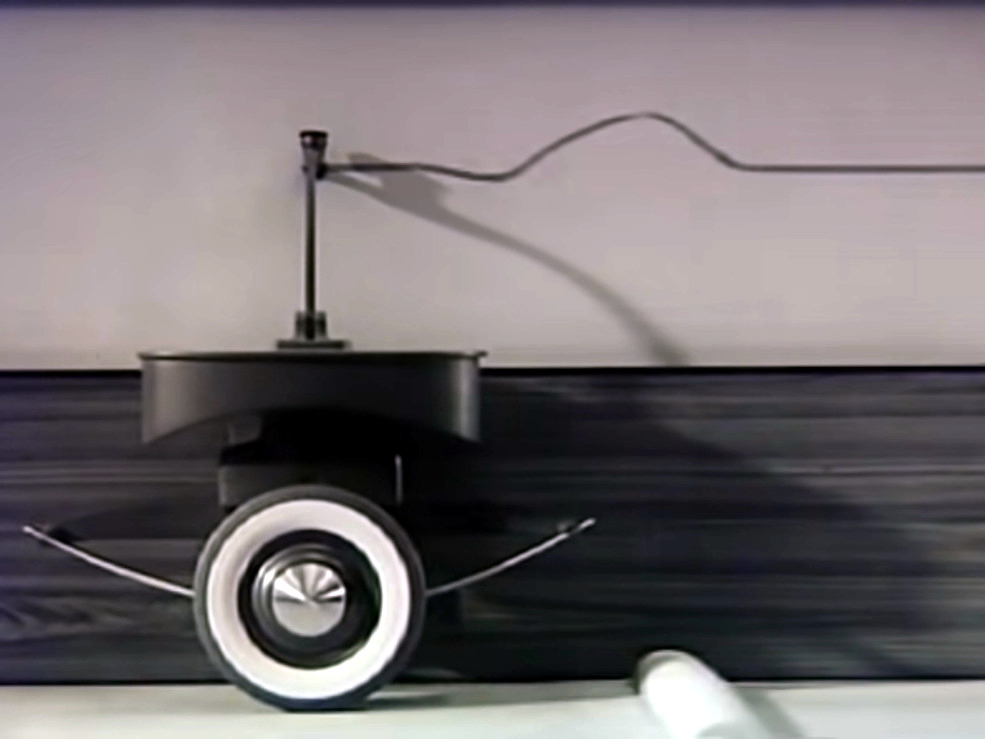
Model of a wheel with a leaf spring records the effect of a bump on a piece of paper above
The problem is uneven ground — the “waves in the Earth’s surface” — be it the terrain in an open field, a dirt road, or even a paved parkway. Any vehicle traveling those surfaces will face the challenge of not only cushioning for rough terrain, but accounting for the way a suspension system itself reacts to avoid oscillation and other negative effects. In the video this is boiled down to a 2-dimensional waveform drawn by a model which begins with a single tire and evolves to include a four wheeled vehicle with different suspension systems in the front and the rear.
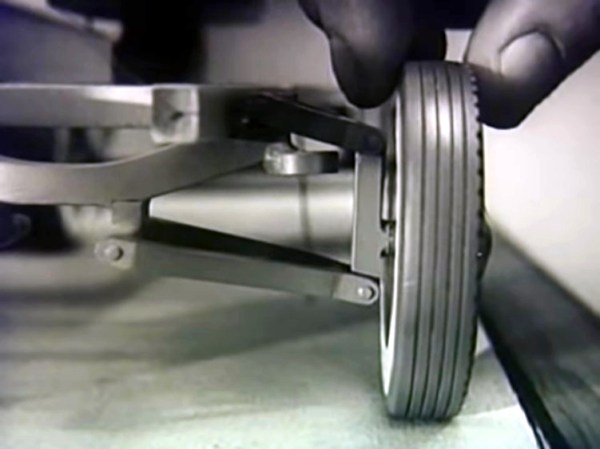
Perhaps the most illuminating part of the video is the explanation of how the car’s front suspension actually works. The wheels need to be able to steer the vehicle, while the suspension must also allow the tire to remain perpendicular to the roadway. This is shown in the image at the top of this article. Each wheel has a swing arm that allows for steering and for vertical movement of the wheel. A coil spring is used in place of the leaf springs shown in the initial model.
You probably know what’s coming next. The springs are capable of storing and releasing energy, and left to their own devices, they’ll dissipate the energy of a bump by oscillating. This is exactly what we don’t want. The solution is to add shock absorbers which limit how the springs perform. The waveforms drawn by the model encountering bumps are now tightly constrained to the baseline of flat ground.
This is the type of advertising we can wholeheartedly get behind. Product engineers of the world, please try to convince your marketing colleagues to show us the insides, tell us why the choices were made, and share the testing that helps users understand both how the thing works and why it was built that way. The last eighty years have brought myriad layers of complexity to most of the products that surround us, but human nature hasn’t changed; people are still quite curious to see the scientific principles in action all around us.
Make sure you don’t bomb out of the video before the very end. A true bit of showmanship, the desktop model of a car is recreated in a full-sized Chevy, complete with “sky-writing smoke” to draw the line. I don’t think it’s a true analog, but it’s certainly the kind of kitsch I always look for in a great Retrotechtacular subject.
When it comes to creating a handling monster, the aim is to create a car that sticks to the road like glue, and is controllable when it does break loose. Having a car that handles predictably at the limit is a big help when you’re pushing hard on track, particularly for an inexperienced driver. And, whether you’re hitting the canyons on the weekend or trying to slash your laptimes, it’s always nice to have more grip. Through selecting the right parts and getting the set up right, it’s possible to hone your car’s cornering ability to make it a rewarding experience to drive fast and hard. Continue reading “How To Get Into Cars: Handling Mods”→
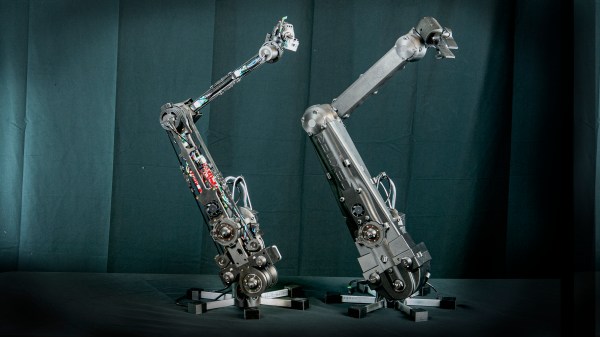
You may remember that the combination of Dexter’s makeup and capabilities are what let it stand out among robotics projects. The fully-articulated robot arm can be motion trained; it records how you move the arm and can play back with high precision rather than needing to be taught with code. The high-precision is thanks to a clever encoder makeup that leverages the power of FPGAs to amplify the granularity of its optical encodes. And it embraces advanced manufacturing to combine 3D printed and glue-up parts with mass produced gears, belts, bearings, and motors.
Of the many well-known names in science, few have been as reluctant to stick to one particular field as Freeman John Dyson. Born in the UK in 1923, he showed a great interest in mathematics and related fields even as a child. By the time he was 15 he had won a scholarship at Trinity College, in Cambridge, where he studied mathematics. Though the war forced him to work at the Air Force’s Operational Research Section (ORS), afterwards he would return to Trinity to get his BA in mathematics.
His subsequent career saw him teaching at universities in the UK and US, before eventually ending up at Cornell University, where he joined the Institute for Advanced Study at the invitation of its head, J. Robert Oppenheimer. Here he would meet up with such people as Richard Feynman with whom he would work on quantum electrodynamics.
Beyond mathematics and physics, Dyson would also express great interest in space exploration — with Dyson spheres being well-known — and genetics, both in the context of the first formation of life and in genetic manipulation to improve plants to deal with issues today. He also worked on the famous Project Orion, which used nuclear bombs for propulsion.
In this article we’ll take a look at these and other parts of Mr. Dyson’s legacy, as well as the influence of his works today.