Rovers To The Rescue: Robot Missions Tackles Trash

Everyone knows plastic trash is a problem with junk filling up landfills and scattering beaches. It’s worse because rather than dissolving completely, plastic breaks down into smaller chunks of plastic, small enough to be ingested by birds and fish, loading them up with indigestible gutfill. Natural disasters compound the trash problem; debris from Japan’s 2011 tsunami washed ashore on Vancouver Island in the months that followed.

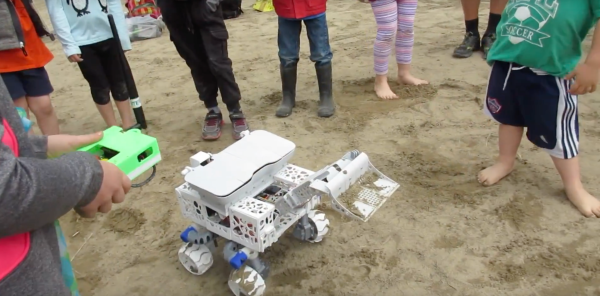
Erin Kennedy was walking along Toronto Island beach and noticed the line of plastic trash that extended as far as the eye could see. As an open source robot builder, her first inclination was to use robots to clean up the mess. A large number of small robots following automated routines might be able to clear a beach faster and more efficiently than a person walking around with a stick and a trash bag.

Erin founded Robot Missions to explore this possibility, with the goal of uniting open-source “makers” — along with their knowledge of technology — with environmentalists who have a clearer understanding of what needs to be done to protect the Earth. It was a finalist in the Citizen Science category for the 2016 Hackaday Prize, and would fit very nicely in this year’s Wheels, Wings, and Walkers challenge which closes entries in a week.

Join me after the break for a look at where Robot Missions came from, and what Erin has in store for the future of the program.

Continue reading “Rovers To The Rescue: Robot Missions Tackles Trash”

Automate The Freight: The Robotic Garbage Man

When I started the Automate the Freight series, my argument was that long before the vaunted day when we’ll be able to kick back and read the news or play a video game while our fully autonomous car whisks us to work, economic forces will dictate that automation will have already penetrated the supply chain. There’s much more money to be saved by carriers like FedEx and UPS cutting humans out of the loop while delivering parcels to homes and businesses than there is for car companies to make by peddling the comfort and convenience of driverless commuting.

But the other end of the supply chain is ripe for automation, too. For every smile-adorned Amazon package delivered, a whole bunch of waste needs to be toted away. Bag after bag of garbage needs to go somewhere else, and at least in the USA, municipalities are usually on the hook for the often nasty job, sometimes maintaining fleets of purpose-built trucks and employing squads of workers to make weekly pickups, or perhaps farming the work out to local contractors.

Either way you slice it, the costs for trash removal fall on the taxpayers, and as cities and towns look for ways to stretch those levies even further, there’s little doubt that automation of the waste stream will start to become more and more attractive. But what will it take to fully automate the waste removal process? And how long before the “garbage man” becomes the “garbage ‘bot”?

Continue reading “Automate The Freight: The Robotic Garbage Man”

A Beverage Cooler That Comes To You!

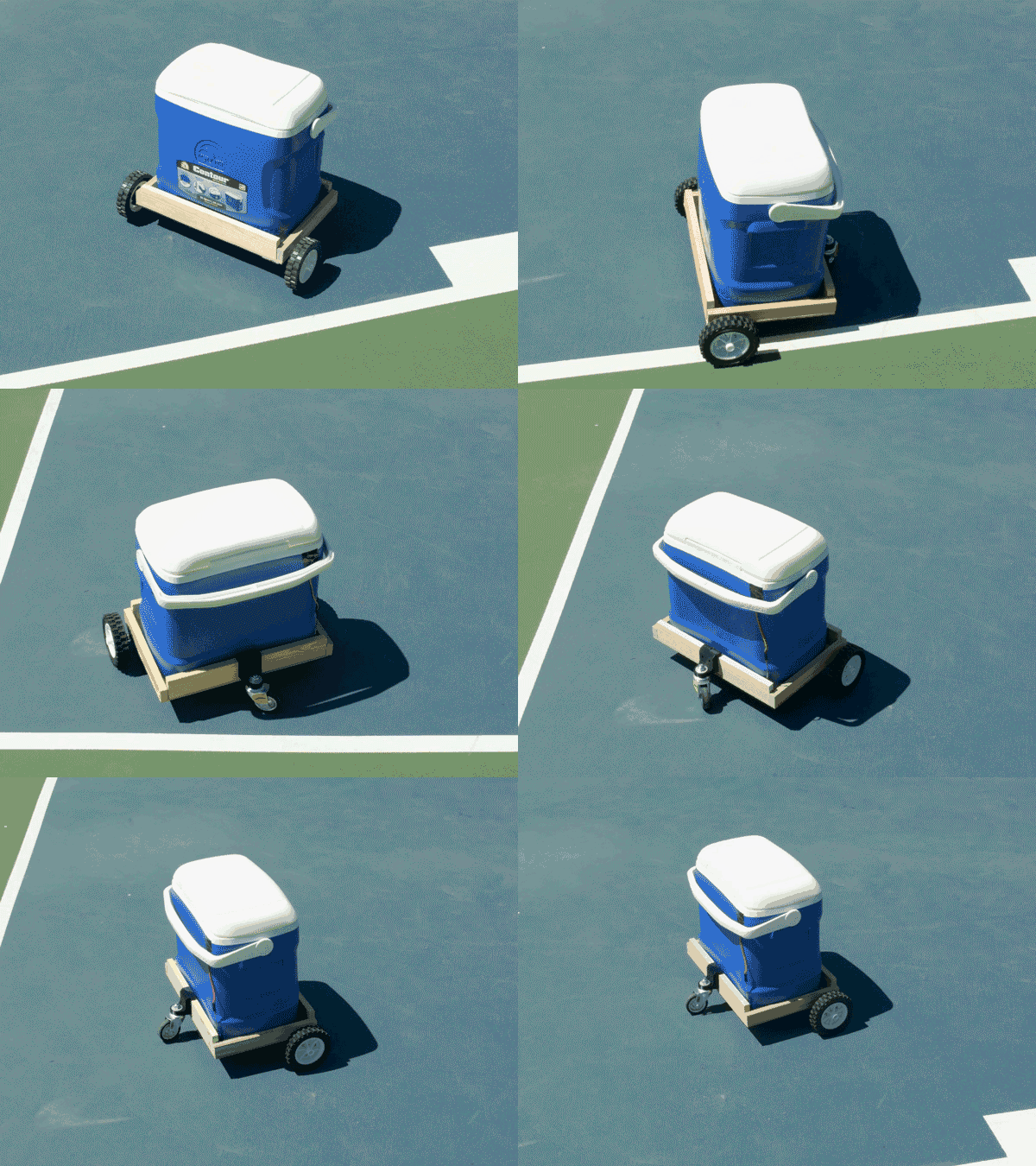
Feel like taking a long walk, but can’t be bothered with carrying your drinks? Have no fear, this  “Follow Me” Cooler Bot is here!

Really just a mobile platform with a cooler on top, the robot connects to smartphone via Bluetooth, following it using GPS. Making the platform involves a little woodworking skill, and an aluminium hub with a 3D-printed hub adapter connects the motors to a pair 6″ rubber wheels with a swivel caster mounted at the rear. A pocket in the platform’s base houses the electronics.

The Arduino Uno — via an L298n motor driver — controls two 12V DC, brushed and geared motors mounted with 3D printed brackets, while a Parallax PAM-7Q GPS Module in conjunction with an HMC 5883L compass help the robot keep its bearing. A duo of batteries power the motors and the electronics separately to prevent  any malfunctions.

Continue reading “A Beverage Cooler That Comes To You!”

Ambitious Hackerboat Project Still Aiming High

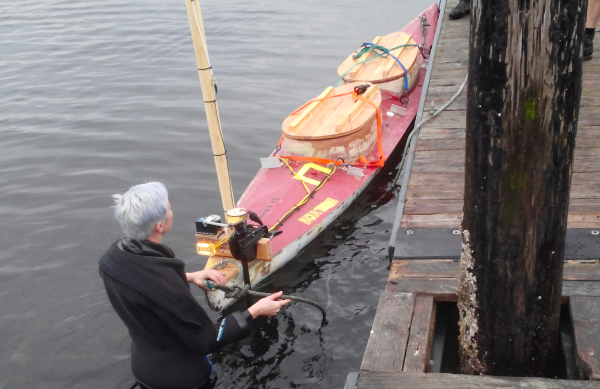
Last year we wrote about Hackerbot Labs’ autonomous boat, which project members hope to someday circumnavigate the globe. Now called Project Ladon, progress continues apace with a recent ocean test of their modified 18’ kayak, the TSV Disputed Right of Way. The kayak’s internal spaces contain a pair of lead-acid truck batteries controlled by a home-brewed control system that uses relays to control the craft’s trolling motor, with a Beaglebone and Arduino Mega under the hood.

The test was not exactly a success, with the boat actually avoiding the waypoints rather than sticking to them. Fortunately the team was aboard a chase boat so they were able to keep tabs on the craft. Unlike a quadcopter, which just falls down, a watercraft that borks may never be seen again.

Entered into the 2016 Hackaday Prize, the project has continued to gather steam, with presentations at both Toorcamp and Maker Faire Bay Area. In addition, they’re maintaining their Hackaday.io project site as well as a Patreon page.

Check out a couple of videos after the break! The test video is 360-degrees so you can drag around the POV.

Continue reading “Ambitious Hackerboat Project Still Aiming High”

Submersible Robots Hunt Lice With Lasers

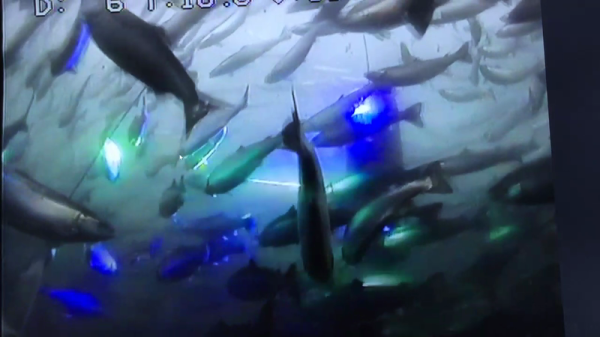
De-lousing is a trying agricultural process. It becomes a major problem in pens which contain the hundreds of thousands of salmon farmed by Norwegians — the world’s largest salmon exporter — an environment which allows the parasite to flourish. To tackle the problem, the Stingray, developed by [Stingray Marine Solutions],  is an autonomous drone capable of destroying the lice with a laser in the order of tens of thousands per day.

Introduced in Norway back in 2014 — and some areas in Scotland in 2016 — the Stingray floats in the salmon pen, alert and waiting. If the lice-recognition software (never thought you’d hear that term, huh?) detects a parasite for more than two frames in the video feed, it immediately annihilates it with a 530 nanometre-wide, 100 millisecond laser pulse from up to two metres away. Don’t worry — the salmon’s scales are reflective enough to leave it unharmed, while the pest is fried to a crisp.  In action, it’s reminiscent of a point-defense laser on a spaceship.

Continue reading “Submersible Robots Hunt Lice With Lasers”

Turbine-driven Robot To Navigate Inside Space Station

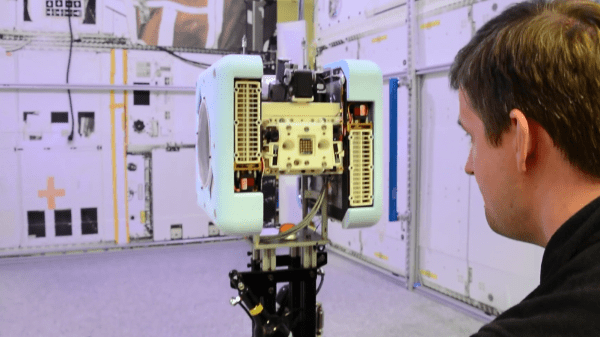
It may look more like a Companion Cube than R2-D2, but the ISS is getting an astromech droid of sorts.

According to [Trey Smith] of the NASA Ames Research Center, Astrobee is an autonomous robot that will be able to maneuver inside the ISS in three dimensions using vectored thrust from a pair of turbines. The floating droid will navigate visually, using a camera to pick out landmarks aboard the station, including docking ports that let it interface with power and data. A simple arm allows Astrobee to grab onto any of the hand rails inside the ISS to provide a stable point for viewing astronaut activities or helping out with the science.

As cool as Astrobee is, we’re intrigued by how the team at Ames is testing it. The droid is mounted on a stand that floats over an enormous and perfectly flat granite slab using low-friction CO₂ gas bearings, giving it freedom to move in two dimensions. We can’t help but wonder why they didn’t suspend the Astrobee from a gantry using a counterweight to add that third dimension in. Maybe that’s next.

From the sound of it, Astrobee is slated to be flight ready by the end of 2017, so we’ll be watching to see how it does. But if they find themselves with a little free time in the schedule, perhaps adding a few 3D-printed cosmetics would allow them to enter the Hackaday Sci-Fi Contest.

Canary Island Team Wins World Robotic Sailing 2016

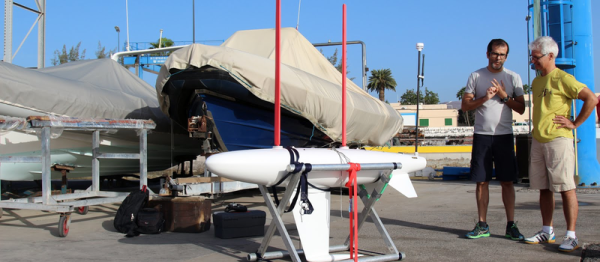
If you’re like us, you had no idea that there even was a World Robotic Sailing Championship. But we’re glad that we do now! And congratulations to the team of A-Tirma G2, the winning boat. (Link in Spanish, difficult to translate — if you can figure out how, post in the comments?)

The Championship has apparently been going on for nine years now, and moves to a different location around the world each year. The contests for 2016 (PDF) are by no means trivial. Besides a simple there-and-back regatta, the robot boats have to hold position, scan a prescribed area, and avoid a big obstacle and return quickly back to their lane. All of this with wind power, of course.

The winning boat used solid sails, which act essentially as vertical wings, and was designed for rough weather. This paid off in the area-scanning test; the winds were so strong that the organizers considered calling it off, but team A-Tirma’s boat navigated flawlessly, giving them enough points to win the event even though camera malfunction kept them from completing the obstacle avoidance.

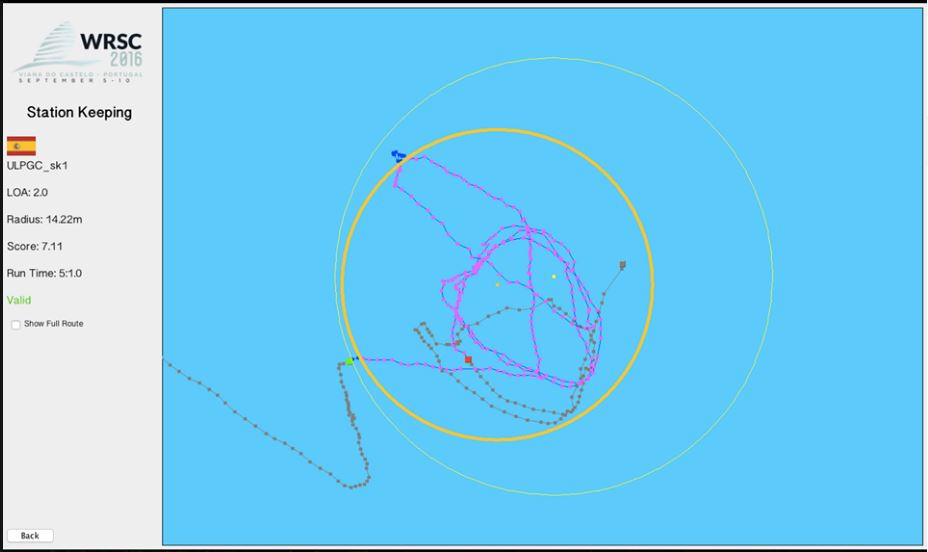
stationkeepingtrackingUnless you’ve sailed, it’s hard to appreciate the difficulty of these challenges to an autonomous vehicle. It’s incredibly hard to plan far ahead because the boat’s motive power source, the wind, isn’t constant. But the boat has, relatively speaking, a lot of inertia and no brakes, so the robot has to plan fairly far in advance. That any of the 2-4 meter long boats could stay inside a circle of 20 meters is impressive. Oh, and did we mention that A-Tirma did all of this calculating and reacting on solar power?

Because the wind is so fickle, drone sailboats are much less popular than drone motorboats — at least using the Hackaday Blogpost Metric ™. The hackerboat project is trying out sails, but they’re still mostly working on powered propulsion. We do have an entry in the 2016 Hackaday Prize, but it’s looking like the development process is in the doldrums. Still, sailing is the best way to go in the end, because windpower is essentially free on the open ocean, which means less work for the solar panels.

As far as role-models go, you’ve basically got the entrants in the World Robotic Sailing Championships. So kudos to the A-Tirma team, and thanks [Nikito] for the tip!