Aluminum No Match For 3D Printed Press Brake Dies

If you’re looking for a get-rich-quick scheme, you can scratch “Doing small-scale manufacturing of ultralight aircraft” off your list right now. Turns out there’s no money in it. At least, not enough money that you can outsource production of all the parts. Not even enough to setup a huge shop full of customized machining tools when you realize you have to make the stuff yourself. No, this sounds like one of those “labors of love” we always hear so much about.

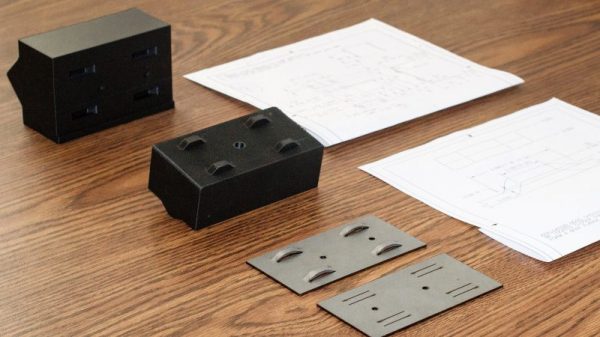
So how does one do in-house manufacturing of aircraft with a bare minimum of tools? Well, since you’re reading this on Hackaday you can probably guess that you’ve got to come up with something a bit unorthodox. When [Brian Carpenter] of Rainbow Aviation needed a very specific die to bend a component for their aircraft, he decided to try designing and 3D printing one himself.

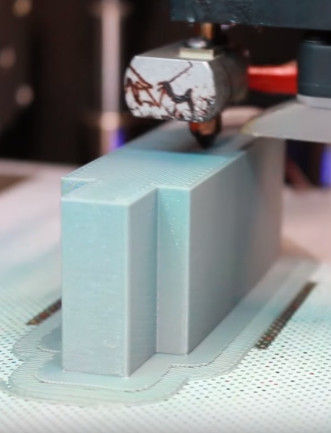
Printing a die on the Zortrax M200

He reasoned that since he had made quick and dirty dies out of wood in the past, that a 3D printed one should work for at least a few bends before falling apart. He even planned to use JB Weld to fill in the parts of the printed die which he assumed would start cracking and breaking off after he put it through a few cycles. But even after bending hundreds of parts, wear on the dies appears to be nearly non-existent. As an added bonus, the printed plastic dies don’t mar the aluminum pieces they are bending like the steel dies do.

So what’s the secret to printing a die that can bend hundreds of pieces of aluminum on a 20 ton brake without wearing down? As it turns out…not a whole lot. [Brian] attributes the success of this experiment to designing the die with sufficiently accurate tolerances and having so high of an infill that it may as well be solid plastic.

In fact, the 3D printed die worked out so well that they’ve now expanded the idea to a cheap Harbor Freight brake. Before this tool was going more or less unused as it didn’t have features they needed for the production of their parts, namely a radius die or backstop. But by 3D printing these components [Brian] was able to put the tool back to work.

We’ve previously covered the art and science of bending sheet metal, as well as a homebuilt brake that let’s you do it on a budget even Rainbow Aviation would scoff at. So what are you waiting for? Go build an airplane.

Thanks to [Oahupilot] for the tip.

Continue reading “Aluminum No Match For 3D Printed Press Brake Dies”

Bolt-Together Belt Grinder For The No-Weld Shop

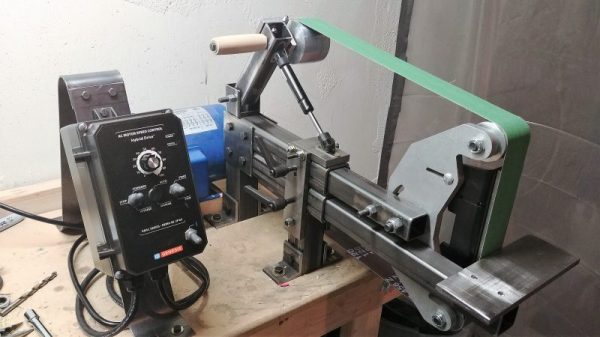
Belt grinding offers a lot of advantages for the metalworker, and since belt grinders are pretty simple machines, shop-built tools are not an uncommon project. A bolt-together belt grinder makes this tool even more accessible to the home gamer.

With no access to a welder but with a basic milling machine and an ample scrap bin at his disposal,  [IJustLikeMakingThings] had to get creative and modify some of the welding-required belt grinder designs he found online to be bolt-up builds.  The key to a cool running belt grinder is for the belt to be as long as possible, and the 2″x72″ belt seems to be the sweet spot, at least here in the States. Machined drive and idler wheels with the crown needed for proper belt tracking were sourced online, as was the D-bracket for holding the two guide wheels. But the rest of the parts were fabricated with simple tools and bolted together. [IJustLikeMakingThings] provides a lot of detail in his write-up, and it shouldn’t be too hard to build a belt grinder just like this one.

Looking for other belt grinder plans to compare notes? Here’s a grinder with an even simpler design, but with welding required.

Sharpening Drills Bits The Hard Way

Drill bits are so cheap that when one is too chowdered up to keep working, we generally just toss it out. So you might expect a video on sharpening drill bits to be somewhat irrelevant, but [This Old Tony] makes it work.

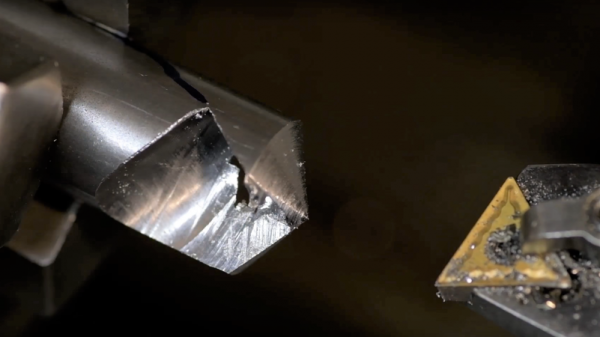
The reason this video is worth watching is not just that you get to learn how to sharpen your bits, although that’s an essential metalworker’s skill. Where [This Old Tony]’s video shines is by explaining why a drill bit is shaped the way it is, which he does by fabricating a rudimentary twist drill bit from scratch. Seeing how the flutes and the web are formed and how all the different angles interact to cut material and transport the swarf away is fascinating. And as a bonus, knowing what the angles do allows you to customize a grind for a special job.

[This Old Tony] may be just a guy messing around in his shop, but he’s got a wealth of machine shop knowledge and we always look forward to seeing what he’s working on, whether it’s a homemade fly cutter or a full-blown CNC machine.

Continue reading “Sharpening Drills Bits The Hard Way”

Fail Of The Week: Sand Casting Copper

There’s trouble in the Kingdom of Random – the smithies of the realm are having trouble sand-casting copper. And while [King Grant] might not be directly asking for help, we think the Hackaday community might have plenty to say about his efforts.

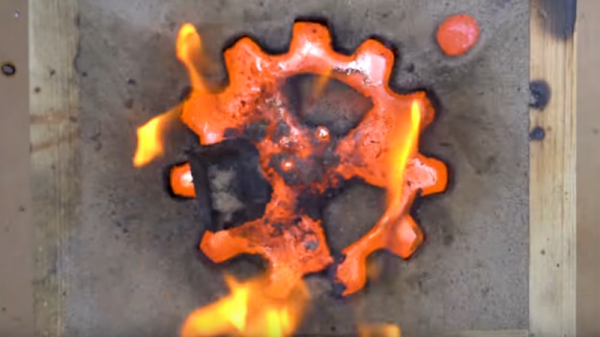
We’ve all seen plenty of sand casting efforts before, including attempts to make otherwise unobtainable engine parts. And “lost foam” casting, where a model of the part is constructed of polystyrene foam that flashes off when the molten metal is poured, is a relatively new twist on the technique that’s been used to good effect on a recent Gingery lathe build. But most backyard foundries work in aluminum, which is apparently much easier to work with than the copper that [Grant Thompson] is working with. Ironically, his first pour worked the best — not perfect, but at least the islands defining the spokes of his decorative piece didn’t break off and float away as they did in every pour shown in the video below. That leads us to think that the greensand is too dry by the second video. Or perhaps the density of copper just makes it more likely for the sand to float. Maybe a cope and drag mold is in order to keep the islands in place and direct the flow of the copper better.

We know there’s a lot of expertise out there, so sound off in the comments about what you think is going on with these pours.

Continue reading “Fail Of The Week: Sand Casting Copper”

Chess Set From Car Parts

Chess has been around for an awfully long time, automobiles less so. However, there’s no reason the two can’t be combined, like in this chess set fashioned from automotive components.

The project was made as a gift, and is the sort of thing that’s quite accessible for an interested maker to attempt at home. Parts used to build the set include valves, valve springs, spark plugs, castellated nuts and pipe fittings. As the parts don’t actually need to be in good working condition, a haul like this could likely easily be had for less than $50 from the local pull-it-yourself wrecking yard — or free if you know a mechanic with some expired engines lying around.

The metalworking side of things involves trimming down and welding together the parts, before polishing them up and applying a coat of paint to create the white and black, or in this case, gold and black pieces.

Overall, it’s a fun weekend project that could be tackled in any number of ways depending on your creativity and taste. For a different take, check out this 3D laser cut chess set.

Custom Workstation Makes Plasma Cutting A Breeze

A plasma cutter is probably top of every metalworker’s short list of dream tools. From freehand curves to long straight cuts, nothing beats a plasma cutter for getting the creative juices flowing. Unfortunately, there’s also the jet of superheated metal blasting through the workpiece to deal with, which is the reason behind this shop-built plasma cutting workstation.

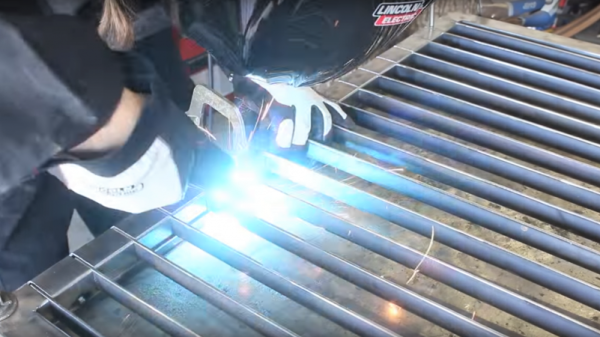
[Regalzack] looks like he had a couple of design goals in mind for his table. A solid work surface isn’t a great idea for plasma cutting, so he designed the top as a grid of replaceable steel slats. Underneath is a hopper to collect the slag, both for neatness and for fire safety. The table top and hopper live on a custom-built wheeled steel frame, and the lower shelf provides plenty of room for his Lincoln 375 plasma rig. With hooks for cables and a sturdy ground clamp tab, the whole thing is a nicely self-contained workstation. The video below shows the build and some of the fabrication techniques [Regalzack] used; we were especially taken by the clever way he cut the slots for the table slats.

Plasma is versatile stuff – you can use it to make music, cook a burger, or decorate wood. And it’s not too shabby for notching metal tubing either.

Continue reading “Custom Workstation Makes Plasma Cutting A Breeze”

The Mother Of All Belt Grinders

It seems like everyone is building belt grinders these days. You might think [Jeremy Schmidt] is just hoping on the bandwagon, but you’d be wrong. He took a full two years to design the perfect belt grinder for his needs. Now he’s built his perfect beast, and we must say, it’s quite impressive!

[Jeremy] had seen grinders which can tilt, but most of them tilt the entire machine, including the table. He designed his machine with an independent table. This means the belt can be placed at any angle, while the table remains flat. He’s achieved some really interesting finishes with a course grind on a 45-degree angle to the workpiece.

No build is without its problems. In [Jeremy’s] case it was building the box which acts as a receiver for the machine and the tables. Regular square tube stock wasn’t quite rigid enough, so bar stock was the way to go. The first attempt at building the box resulted in a warped tube, due to the stresses of welding. [Jeremy] was more careful the second time, moving from section to section of the four welds. This kept the heat from building up, and the box stayed straight.

The final result is an incredibly rigid machine which definitely will withstand anything that [Jeremy] can throw at it.

If you want to see more belt grinders at work, check out [Bob]’s treadmill belt grinder, or [Mike’s] conversion.

Continue reading “The Mother Of All Belt Grinders”