Sniffing Bluetooth Devices With A Raspberry Pi

Hackaday was at HOPE last weekend, and that means we got the goods from what is possibly the best security conference on the east coast. Some of us, however, were trapped in the vendor area being accosted by people wearing an improbable amount of Mr. Robot merch asking, ‘so what is Hackaday?’. We’ve all seen The Merchants Of Cool, but that doesn’t mean everyone was a vapid expression of modern marketing. Some people even brought some of their projects to show off. [Jeff] of reelyActive stopped by the booth and showed off what his team has been working on. It’s a software platform that turns all your wireless mice, Fitbits, and phones into a smart sensor platform using off the shelf hardware and a connection to the Internet.

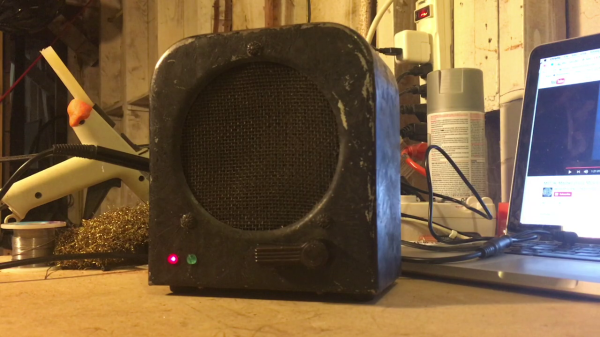
[Jeff]’s demo unit (shown above) is simply a Raspberry Pi 3 with WiFi and Bluetooth, and an SD card loaded up with reelyActive’s software. Connect the Pi to the Internet, and you have a smart space that listens for local Bluetooth devices and relays the identity and MAC address of all Bluetooth devices in range up to the Internet.

The ability to set up a hub and detect Bluetooth devices solves the problem Bluetooth beacons solves — identifying when people enter a space, leave a space, and with a little bit of logic where people are located in a space — simply by using what they’re already wearing. Judging from what [Jeff] showed with his portable reelyActive hub (a Pi and a battery pack) a lot of people at HOPE are wearing Fitbits, wireless headphones, and leaving the Bluetooth on the phone on all the time. That’s a great way to tell where people are, providing a bridge between the physical world and the digital.

This NES Emulator Build Lets You Use Cartridges To Play Games

You may not remember this, but Nintendo hardware used to be a pretty big deal. The original Game Boy and NES both had remarkable industrial design that, like the Apple II and IBM Thinkpad, weren’t quite appreciated until many years after production ended. But, like many of you, [daftmike] had nostalgia-fueled memories of the NES experience still safely locked away.

Memories like lifting the cartridge door, blowing on the cartridge, and the feel of the cartridge clicking into place. So, understandably, reliving those experiences was a key part of [daftmike’s] Raspberry Pi-based NES build, though at 40% of the original size. He didn’t just want to experience the games of his youth, he wanted to experience the whole NES just as he had as a child.

20160727_181746

Now, like any respectable hacker, [daftmike] didn’t let gaps in his knowledge stop him. This project was a learning experience. He had to teach himself a lot about 3D design and modeling, using Linux, and programming. But, the end result was surely worth the work; the attention to detail shows in features like the USB placement, the power and reset buttons, and of course the game cartridges which work with the magic of NFC and still include the insert and toggle action of the original cartridge carriage.

If you have a 3D printer and Raspberry Pi available, you could build a similar NES emulator yourself. But if you don’t have a 3D printer, but do have an original NES lying around, you could pull of the Raspberry Pi in a NES case hack. Whichever you do, the NES’s beauty deserves to be displayed in your home.

Continue reading “This NES Emulator Build Lets You Use Cartridges To Play Games”

Squirrel Café To Predict The Weather From Customer Data

Physicist and squirrel gastronomer [Carsten Dannat] is trying to correlate two critical social economical factors: how many summer days do we have left, and when will we run out of nuts. His research project, the Squirrel Café, invites squirrels to grab some free nuts and collects interesting bits of customer data in return.

Continue reading “Squirrel Café To Predict The Weather From Customer Data”

DIY Smart Home Device Means No More Fumbling In The Dark

Smart home tech is on the rise, but cost or lack of specific functionality may give pause to prospective buyers. [Whiskey Tango Hotel] opted to design their own system using a Raspberry Pi and Bluetooth device connectivity. Combining two ubiquitous technologies provides a reliable proximity activation of handy functions upon one’s arrival home.

Electrical Wiring Diagram

The primary function is to turn on a strip of LEDs when [Whiskey Tango Hotel] gets home to avoid fumbling for the lights in the dark, and to turn them off after a set time. The Raspberry Pi and Bluetooth dongle detect when a specified discoverable Bluetooth device comes within range — in this case, an iPad — after some time away. This toggles the Pi’s GP10 outputs and connected switching relay while also logging the actions to the terminal and Google Drive via IFTTT.

Continue reading “DIY Smart Home Device Means No More Fumbling In The Dark”

Hackaday Prize Entry: A Cheap Robotic Microscope

The microscope is one of the most useful instruments for the biological sciences, but they are expensive. Lucky for us, a factory in China can turn out webcams and plastic lenses and sell them for pennies. That’s the idea behind Flypi – a cheap microscope for scientific experiments and diagnostics that’s based on the ever-popular Raspberry Pi.

Flypi is designed to be a simple scientific tool and educational device. With that comes the challenges of being very cheap and very capable. It’s based around a Raspberry Pi and the Pi camera, with the relevant software for taking snapshots, recording movies, and controlling a few different modules that extend the capabilities of this machine. These modules include a Peltier element to heat or cool the sample, a temperature sensor, RGB LED, LED ring, LED matrix, and a special blue LED for activating fluorescent molecules in a sample.

The brains behind the Flypi, [Andre Chagas], designed the Flypi to be cheap. He’s certainly managed that with a frame that is mostly 3D printed, and some surprisingly inexpensive electronics. Already the Flypi is doing real science, including tracking bugs wandering around a petri dish and fluorescence microscopy of a zebrafish’s heart. Not bad for a relatively simple tool, and a great entry for the Hackaday Prize.

Hackaday Links: July 24, 2016

Right now HOPE is dying down, and most of the Hackaday crew will be filtering out of NYC. It was a great weekend. The first weekend in August will be even better. We’re going to DEF CON, we’ll have people at VCF West, and a contingent at EMF Camp. If you’re going to EMF Camp, drop a line here. There will be Hackaday peeps wandering around a field in England, so if you see someone flying the Hackaday or Tindie flag, stop and say hi.

Raspberry Pi’s stuffed into things? Not all of them are terrible. The Apple Extended keyboard is possibly the best keyboard Apple ever produced. It’s mechanical (Alps), the layout is almost completely modern, and they’re actually cheap for something that compares well to a Model M. There’s also enough space inside the plastic to fit a Pi and still have enough room left over for holes for the Ethernet and USB ports. [ezrahilyer] plopped a Pi in this old keyboard, and the results look great. Thanks [Burkistana] for sending this one in.

We’ve been chronicling [Arsenijs] Raspberry Pi project for months now, but this is big news. The Raspberry Pi project has cracked 10k views on Hackaday.io, and is well on track to be the most popular project of all time, on any platform. Congrats, [Arsenijs]; it couldn’t happen to a better project.

A few months ago, [Sébastien] released SLAcer.js, a slicer for resin printers that works in the browser. You can’t test a slicer without a printer, so for the last few months, [Sébastien] has been building his own resin printer. He’s looking for beta testers. If you have experience with resin printers, this could be a very cool (and very cheap) build.

Anyone going to DEF CON? For reasons unknown to me, I’m arriving in Vegas at nine in the morning on Wednesday. This means I have a day to kill in Vegas. I was thinking about a Hackaday meetup at the grave of James T. Kirk on Veridian III. It’s about an hour north of Vegas in the Valley of Fire State Park. Yes, driving out to the middle of the desert in August is a great idea. If anyone likes this idea, leave a note in the comments and I’ll organize something.

Hackaday Prize Entry: An Internet Of Things Microscope

For their entry into the Citizen Scientist portion of the Hackaday Prize, the folks at Arch Reactor, the St. Louis hackerspace, are building a microscope. Not just any microscope – this one is low-cost, digital, and has a surprisingly high magnification and pretty good optics. It’s the Internet of Things Microscope, and like all good apparatus for Citizen Scientist, it’s a remarkable tool for classrooms and developing countries.

When you think of ‘classroom microscope’, you’re probably thinking about a pile of old optics sitting in the back of a storage closet. These microscopes are purely optical, without the ability to take digital pictures. The glass is good, but you’re not going to get a scanning stage when you’re dealing with 30-year-old gear made for a classroom full of sticky-handed eighth graders.

The Internet of Things Microscope includes a scanning stage that moves across the specimen on the X and Y axes, stitching digital images together to create a very large image. That’s a killer feature for a cheap digital microscope, and the folks at Arch Reactor are doing this with a few cheap stepper motors and stepper motor drivers.

The rest of the electronics are built around a Raspberry Pi, Raspberry Pi camera (which recently got a nice resolution upgrade), and a some microscope eyepieces and objectives. Everything else is 3D printed, making this a very cheap and very accessible microscope that has some killer features.