This Robot Swims, Skates, And Crawls

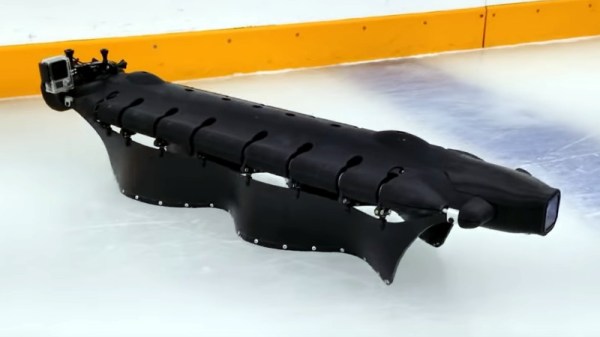
You often hear that art imitates life, but sometimes technology does too. Pliant Energy Systems’ Velox robot resembles an underwater creature more than it does a robot because it uses undulating fins to propel itself, as you can see in the video below.

The video shows the beast skating, but also swimming, and walking. It really does look more like a lifeform than a device. According to the company, the robot has excellent static thrust/watt and is resistant to becoming entangled in plants and other debris.

Continue reading “This Robot Swims, Skates, And Crawls” →

Welcome Our New Insect Overlords With Arduino-Powered Ant Bot

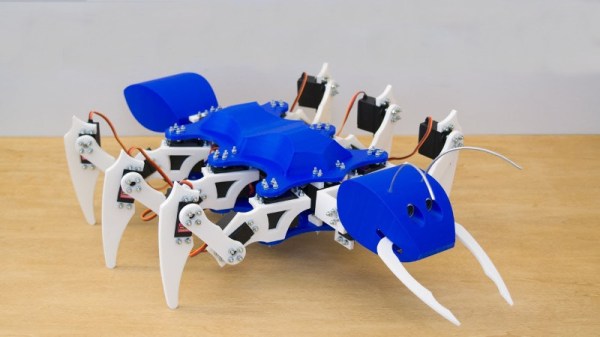
Walking robots come in many forms, and each presents their own unique challenges. Bipedal style locomotion is considered particularly difficult to do well, however designs with more legs offer certain advantages. Hexapods offer the possibility of keeping several legs on the ground while others move, providing a useful degree of stability. [How To Mechatronics] developed this ant robot, which is an excellent example of the form.

The hexapod has as the name suggests, six legs, each of which consist of 3 joints. This necessitates 3 servos per leg, for 18 servos total just for locomotion. Further servos are then used to control the abdomen, head, and mandibles. This gives the robot strong ant credentials, above and beyond being simply a 3D printed lookalike.

Brains come courtesy of an Arduino Mega, chosen for its ability to control a large number of servos. A custom PCB is printed as a shield to ease the connection of all the necessary hardware. An HC-05 Bluetooth module is used for communication with an Android app, which controls the ant. The piece de resistance is the ultrasonic sensors in the head, which allow the ant to automatically defend itself against predators that get too close.

It’s an involved build, requiring plenty of 3D printing and over 200 fasteners. Fundamentally though, it’s a fully working and tested hexapod build with full plans available for download, ready to toil in your underground sugar caves.

If your hexapod tastes skew more anime than insectoid, check out this Ghost in the Shell build. Video after the break.

[Thanks to Baldpower for the tip!]

Continue reading “Welcome Our New Insect Overlords With Arduino-Powered Ant Bot” →

Cyborg, Or Leafy Sensor Array?

Some plants react quickly enough for our senses to notice, such as a Venus flytrap or mimosa pudica. Most of the time, we need time-lapse photography at a minimum to notice while more exotic sensors can measure things like microscopic pores opening and closing. As with any sensor reading, those measurements can be turned into action through a little trick we call automation. [Harpreet Sareen] and [Pattie Maes] at MIT brought these two ideas together in a way which we haven’t seen before where a plant has taken the driver’s seat in a project called Elowan. Details are sparse but the concept is easy enough to grasp.

We are not sure if this qualifies as a full-fledged cyborg or if this is a case of a robot using biological sensors. Maybe it all depends on which angle you present this mixture of plant and machine. Perhaps it is truly is the symbiotic relationship that the project claims it to be. The robot would not receive any instructions without the plant and the plant would receive sub-optimal light without the robot. What other ways could plants be integrated into robotics to make it a bona fide cyborg?

Continue reading “Cyborg, Or Leafy Sensor Array?” →

Soft Rotating Pneumatic Actuators

When we think of pneumatic actuators, we typically consider the standard varieties of pneumatic cylinder, capable of linear motion. These can be referred to as “hard” actuators, made of rigid components and capable of great accuracy and force delivery. However, “soft” actuators have their own complementary abilities – such as being able to handle more delicate tasks and being less likely to injure human operators when used in collaborative operations. The Whitesides Research Group at Harvard University has undertaken significant research in this field, and released a paper covering a novel type of soft pneumatic actuator.

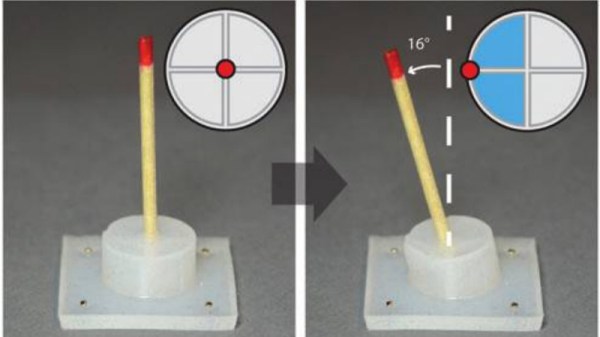
The actuator consists of a series of soft, flexible sealed chambers which surround a wooden dowel in the center. By applying vacuum to these various chambers, the dowel in the center can be pulled into up to eight different positions. It’s a unique concept, and one we can imagine could have applications in various material processing scenarios.

The actuator was built by moulding elastomers around 3D printed components, so this is a build that could theoretically be tackled by the DIYer. The paper goes into great detail to quantify the performance of the actuator, and workshops several potential applications. Testing is done on a fluid delivery and stirring system, and a tethered robotic walker was built. The team uses the term cVAMS – cyclical vacuum actuated machine – to describe the actuator technology.

The world of soft robotics is a hot bed of development, and we look forward to further work in this field. It’s not just Harvard, either – we’ve seen interesting work from Yale and from the Hackaday community too!


Crawling PCB ‘Bot Is Flexible Where It Counts

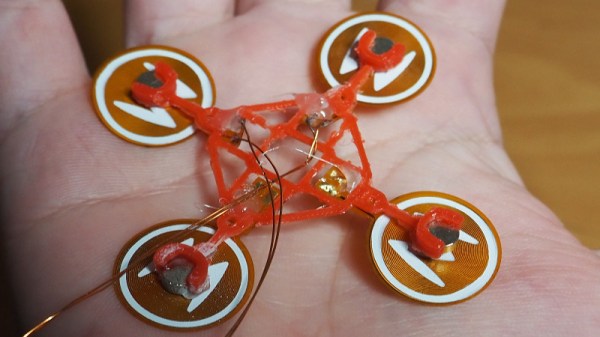
20 years ago, PCB production was expensive and required a multitude of phone calls and emails to a fab with significant minimum order restrictions. Now, it’s cheap and accessible online, which in addition to curtailing the home etching market has created significant new possibilities for home projects. Now that flexible PCBs are also readily available, it’s possible to experiment with some cool concepts – and that’s precisely what [Carl] has been doing.

The aim is to build a walking robot that uses actuators made from flexible PCBs. The flexible PCB is printed with a coil, capable of generating a small magnetic field. This then interacts with a strong permanent magnet, causing the flexible PCB to move when energised.

Initial attempts with four actuators mounted to a 3D printed frame were unsuccessful, but [Carl] has persevered. With a focus on weight saving, the MK II prototype has shown some promise, gently twitching its way across a desk in testing. Future steps will involve building an untethered version. This will replace the 3D printed chassis with a standard fibreglass PCB acting as both control board and the main chassis to minimise weight, similar to PCB quadcopter designs we’ve seen in the past.

We can’t wait to see the next revision, and if you’ve been working on your own walking robots, make sure you let us know.

Wonderful Sculptural Circuits Hide Interactive Synthesizers

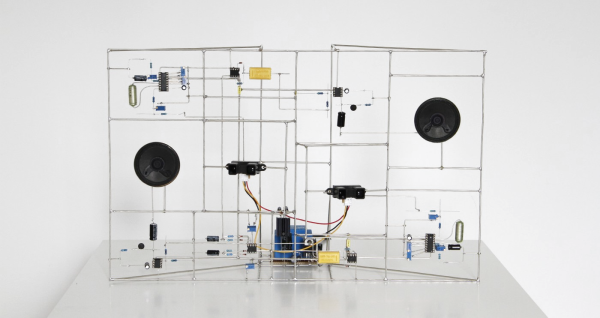
When it rains, it pours (wonderful electronic sculpture!). The last time we posted about freeform circuit sculptures there were a few eye-catching comments mentioning other fine examples of the craft. One such artist is [Eirik Brandal], who has a large selection of electronic sculptures. Frankly, we’re in love.

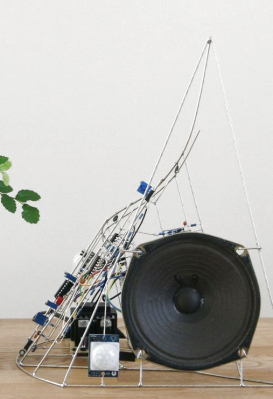
A common theme of [Eirik]’s work is that each piece is a functional synthesizer or a component piece of a larger one. For instance, when installed the ihscale series uses PIR sensors to react together to motion in different quadrants of a room. And the es #17 – #19 pieces use ESP8266’s to feed the output of their individual signal generators into each other to generate one connected sound.

Even when a single sculpture is part of a series there is still striking variety in [Eirik]’s work. Some pieces are neat and rectilinear and obviously functional, while others almost looks like a jumble of components. Whatever the style we’ve really enjoyed pouring through the pages of [Eirik]’s portfolio. Most pieces have demo videos, so give them a listen!

If you missed the last set of sculptural circuits we covered this month, head on over and take a look at the flywire circuits of Mohit Bhoite.

Thanks [james] for the tip!

I’m Sorry, Alexander, I’m Afraid I Can’t Do That

Getting people to space is extremely difficult, and while getting robots to space is still pretty challenging, it’s much easier. For that reason, robots and probes have been helping us explore the solar system for decades. Now, though, a robot assistant is on board the ISS to work with the astronauts, and rather than something impersonal like a robot arm, this one has a face, can navigate throughout the ship, and can respond to voice inputs.

The robot is known as CIMON, the Crew Interactive Mobile Companion. Built by Airbus, this interactive helper will fly with German astronaut Alexander Gerst to test the concept of robotic helpers such as this one. It is able to freely move about the cabin and can learn about the space it is in without being specifically programmed for it. It processes voice inputs similarly to a smart phone, but still processes requests on Earth via the IBM Watson AI. This means that it’s not exactly untethered, and future implementations of this technology might need to be more self-contained for missions outside of low Earth orbit.

While the designers have listened to the warnings of 2001 and not given it complete control of the space station, they also learned that it’s helpful to create an interactive robot that isn’t something as off-putting as a single creepy red-eye. This robot can display an interactive face on the screen, as well as use the same screen to show schematics, procedure steps, or anything else the astronauts need. If creepy design is more your style though, you can still have HAL watching you in your house.

Thanks to [Marian] for the tip!

Continue reading “I’m Sorry, Alexander, I’m Afraid I Can’t Do That” →