Wooing A Lady Into Persisting With Persistence… Of Vision

As the story goes, years ago [Matt Evans] was wooing the beautiful and talented [Jen]. There were many suitors vying for her hand; he would have to set himself apart. The trouble was, how to convince her that persisting in the relationship was the best and only course? What did he have to offer? Of course many of us know the answer; having wooed our own significant others with the same thing. Incredible and unrepentant nerdiness.

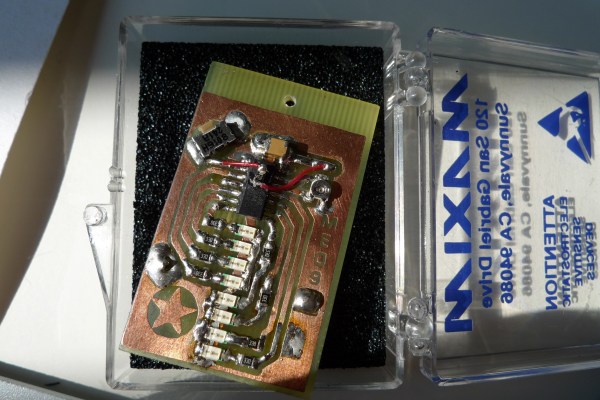
So! He toiled late into the night, his eyes burning with love and from the fumes of solder smoke. For her he would put his wizardry to work. At the wave of a hand would write songs of adoration in the air with nothing but light. The runes of power, all typed out in the proper order, would be held by a ATiny. A CR2032 coin cell provided the magic pixies which would march to its commands, delivering their spark to the LEDs in the right order.

He etched the board, wrote the code, and soldered the components. He encased it in his finest box of crystal clear plastic and black static foam, a gift of the samples department of the Maxim corporation.

Presumably the full moon was high in the air when he presented the box. He took it out and waved it with a flair. Poetry floated there in front of her eyes. It read, “Jen is cool!”. A few years later, they were married.


Vintage 16mm Film Editor Is Now Retro Arcade

When [Douglas Welcome] found a disposed Kalart Craig 16 mm Projecto-Editor on the curb, he knew it was destined for retro-greatness. This vintage looking device was once used to view and cut 16 mm film strips, and still in mint condition, it was just too cool to pass up. With help of a similarly historic Raspberry Pi 1 Model B, and a little LCD screen, [Douglas] now turned the little box into an awesome retro arcade game console

Continue reading “Vintage 16mm Film Editor Is Now Retro Arcade”

Bicycle Seismograph Measures The Streets

Riding the streets of the Netherlands on a bicycle is a silky-smooth experience compared to doing the same on those of Germany. So says [Kati Hyyppä], who made the move with her trusty Dutch bike. The experience led her to record the uneven cobblestones and broken asphalt of the German roads on a home-made seismograph, a paper chart recorder driven by the bike’s motion and recorded upon by a pen free to vibrate as it passed over any bumps.

The resulting instrument is a wooden frame with a ballpoint pen mounted in a sliding holder weighted with some washers and kept under some tension with elastic bands. The paper roll is driven from the motion of the bike by the drive from a mechanical speedometer feeding a set of FischerTechnik gears, and the whole unit is suspended from the crossbar.

You can see it in action in the video below the break, and if you would like to build one yourself she has put the project up on Instructables as well as posting the description linked above.

Continue reading “Bicycle Seismograph Measures The Streets”

Run A RepRap On An ESP8266

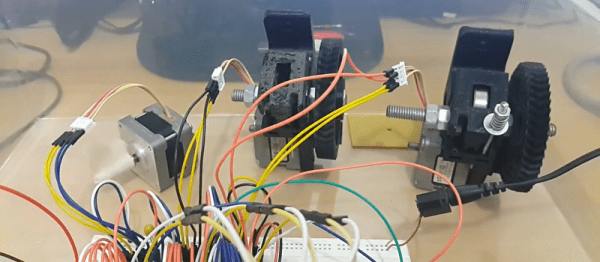
What can’t the little $5 WiFi module do? Now that [lhartmann] has got an ESP8266 controlling the motors of a 3D printer, that’s one more item to check off the list.

What’s coolest about this project is the way that [lhartmann] does it. The tiny ESP8266 has nowhere near the required number of GPIO pins, the primary SPI is connected to the onboard flash memory, and the secondary SPI is poorly documented and almost nobody uses it. So, [lhartmann] chose to use the I2S outputs.

I2S is most often an audio protocol, so this might at first seem like a strange choice. Although I2S sounds like I2C, it’s really essentially an SPI protocol with a fourth wire that alternates to designate the right or left channel. It’s actually just perfect for sending 16×2 bits of data at high data rates.

[lhartmann] takes these 32 bits and feeds them into four shift registers, producing 32 outputs from just the four I2S data lines. That’s more than enough signals to run the stepper motors. And since it updates at 192 kHz sample rate, it’s plenty fast enough to drive them.

The other side benefit of this technique is that it can work on single-board computers with just a little bit of software. Programming very complicated stepper movements then becomes just a matter of generating the right “audio” file and playing it out. [lhartmann] demonstrated this earlier with an Orange Pi. That’s pretty cool, too.

The code for turning the ESP8266 and a short handful of 74HC595s into a 3D printer controller are up on GitHub, so go check it out.

Thanks [CNLohr] for the tip!

A Helmet To Make Daft Punk Jealous

If you’ve been paying even a little bit of attention to popular music over the past couple of decades, then you’re surely aware of the electronic music duo Daft Punk. Of course, their success isn’t just a result of their music – a big part of it is also their iconic costumes and persona. What makes those costumes iconic is the robot helmets that the musicians wear. What initially began as a desire to hide their faces ended up becoming their most distinctive trait.

The helmets that the duo wears have changed over the years, but an homage helmet created by [Mike Michelena] puts them all to shame. It maintains the aesthetic elements of Daft Punk’s helmets, while improving on the tech aspects in every way. 210 RGB LEDs, a microprocessor, and 14 amp hours worth of battery give it complete customizability and 5 hours of use.

Continue reading “A Helmet To Make Daft Punk Jealous”

What Is There To Know About Resistors?

Resistor: A passive chunk of material that resists the flow of electrical current. A terminal is connected to each end you’re done. What could be simpler?

It turns out it’s not so simple at all. Temperature, capacitance, inductance and other factors all play a part in making the resistor a rather complex component after all. Even its uses in circuits are many, but here we’ll just focus on the different types of fixed-value resistors, how they’re made, and what makes them desirable for different applications.

Let’s start with a simple one, and one of the oldest.

Continue reading “What Is There To Know About Resistors?”