Extrusion For The Pottery Shop

Extrusion is a process for forming materials by forcing them through an opening, which can allow for complex shapes. Aluminum extrusion beams are what most of us are probably thinking of, but plenty of other things are made from extruded material like pipe, heat sinks, and even macaroni. Extrusion can also be used for modelling clay to create uniform sections of rounded clay as a starter material for producing other pottery, and [Justins Makery] has built a custom extruder to do just that.

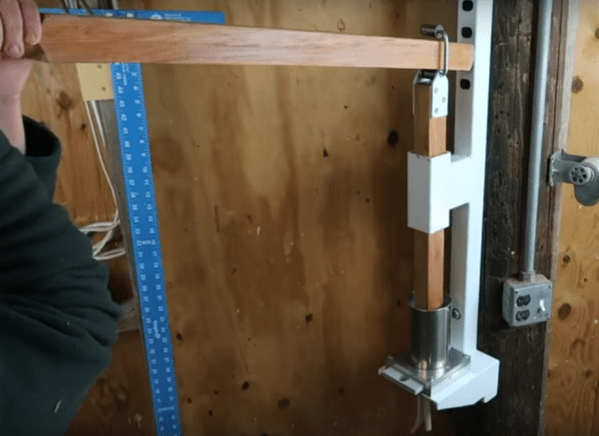
The build starts with welding together a metal frame to hold the press, and uses a wooden wagon handle to drive the extruder. The handle can be moved up or down the frame to increase the range of motion thanks to a custom bearing and slots cut into the frame’s post. The piston mechanism itself is built out of aluminum plate with a cylinder loosely fitted to it to allow for easy cleaning, and the top of the piston uses a loose-fitting plastic cap cut out of an old cutting board.

With everything in pace, the extruder can make cylinders of clay of any desired thickness thanks to swappable dies. While it doesn’t produce the end result of the workshop directly, it definitely helps to provide the potter with clay of uniform dimensions used for building other pieces of pottery, much like how aluminum extrusions are used to build all kinds of other things as well.


Continue reading “Extrusion For The Pottery Shop”

High-Speed Sled Adds Bicycle Suspension

While you might have bought the best pair of skis in the 90s or 00s, as parts on boots and bindings start to fail and safety standards for ski equipment improve, even the highest-quality skis more than 15 or 20 years old will eventually become unsafe or otherwise obsolete. There are plenty of things that can be done with a pair of old skis, but if you already have a shot ski and an Adirondack chair made of old skis, you can put another pair to use building one of the fastest sleds we’ve ever seen.

[Josh Charles], the creator of this project, took inspiration from his father, who screwed an old pair of skis to the bottom of an traditional runner sled when he was a kid. This dramatically increased the speed of the sled, but eliminated its ability to steer. For this build [Josh] built a completely custom frame rather than re-use an existing sled, which allowed him to not only build a more effective steering mechanism for the skis, but also to use bicycle suspension components to give this sled better control at high speeds.

This build is part of a series that [Josh] did a few years ago, and you can find additional videos about it documenting his design process and his initial prototypes and testing. The amount of work he put into this build is evident when it’s seen finally traversing some roads that had been closed for winter; he easily gets the sled up in the 30 mph range several times. If you’re looking to go uphill in the snow, though, take a look at this powered snowboard instead.

Continue reading “High-Speed Sled Adds Bicycle Suspension”

Developing An Open Source Bike Computer

While bicycles appear to have standardized around a relatively common shape and size, parts for these bikes are another story entirely. It seems as though most reputable bike manufacturers are currently racing against each other to see who can include the most planned obsolescence and force their customers to upgrade even when their old bikes might otherwise be perfectly fine. Luckily, the magic of open source components could solve some of this issue, and this open-source bike computer is something you’ll never have to worry about being forced to upgrade.

The build is based around a Raspberry Pi Zero in order to keep it compact, and it uses a small 2.7 inch LCD screen to display some common information about the current bike ride, including location, speed, and power input from the pedals. It also includes some I2C sensors including pressure and temperature as well as an accelerometer. The system can also be configured to display a map of the current ride as well thanks to the GPS equipment housed inside. It keeps a log in a .fit file format as well so that all rides can be archived.

When compared against a commercial offering it seems to hold up pretty well, and we especially like that it’s not behind a walled garden like other products which could, at any point, decide to charge for map upgrades (or not offer them at all). It’s a little more work to set up, of course, but worth it in the end. It might also be a good idea to pair it with other open source bicycle components as well.

Thanks to [Richard] for the tip!

All Aboard The Garbage Express

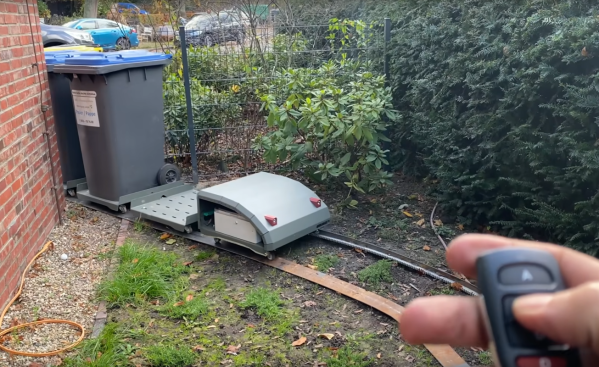
Cog railways are a somewhat unusual way of train locomotion, typically only installed when a train needs to climb steep terrain. Any grade above about 10% needs the extra traction since the friction between the wheels and rails won’t be enough to push the train forward or keep it from falling backwards. Even without a steep hill to climb, sometimes a cog railway is necessary for traction as [Max Maker] discovered while building a train for his garbage cans.

The build started out as a way to avoid having to wheel his seven waste bins to the curb every month. Originally he built a more standard railway with a simple motor to drive the train, but he quickly realized that there wasn’t enough grip even when using plastic wheels, even though this track follows fairly flat terrain. Since the rail is built out of steel he quickly welded up a rack-and-pinion system to one of the rails. The build goes through many iterations before he finally settles on a design that solves the problem, and it includes several other features as well such as remote control and a spring-loaded automatic charger for the train at its station in the back yard.

While we always appreciate the eccentricity of those who would automate a relatively simple task that only happens once a month, [Max Maker] hopes to build this into a commercial product aimed at the elderly or disabled who would really benefit from a reliable, semi-automatic system that takes their trash bins to the curb for them. And, if your system only involves a single trash can, there are other ways of automating the task of taking the garbage to the curb.

Continue reading “All Aboard The Garbage Express”

Snow Plowing By Bicycle

There are few challenges more difficult or dangerous than trying to get around the majority of North American cities by bicycle. Not only is the bicycle infrastructure woefully inadequate for safe travel (if it exists at all), but it’s often not maintained to any reasonable standard, either. This goes double in colder areas, where bike paths can essentially become abandoned in the winter after a snowfall. [Phil] found himself in this situation recently after a snowfall in western Canada and decided to DIY his own bike-powered snowplow to help keep his bike paths cleared.

The plow is built around an electric-assisted cargo bicycle, which is almost as rare in North America as bicycle infrastructure itself, but is uniquely suited to snowplow duty. It has a long wheelbase and a large front cargo area that can be weighed down if needed to ensure the plow makes good contact with the ground. The plow itself is built out of sections of plastic 55-gallon drums, which have been cut into two scooping sections and attached to the bike with a wooden 2×4 frame. The plow can be raised or lowered with a ratchet strap mechanism, and the plastic scoop skips over bumps in the path with relative ease.

With this relatively simple mechanism attached to his bike, [Phil] can make sure the trails that he frequents around Vancouver are more suitable for bike travel in the winter. Riding a bicycle through the winter, even in the coldest of climates, is not that difficult with the right support and investment in infrastructure, and this build is the best DIY solution we’ve seen to bicycle infrastructure support outside of adopting something like this remote-controlled snowblower to the job.

Continue reading “Snow Plowing By Bicycle”

Pi-Cast Adds ATX Signalling To KVM

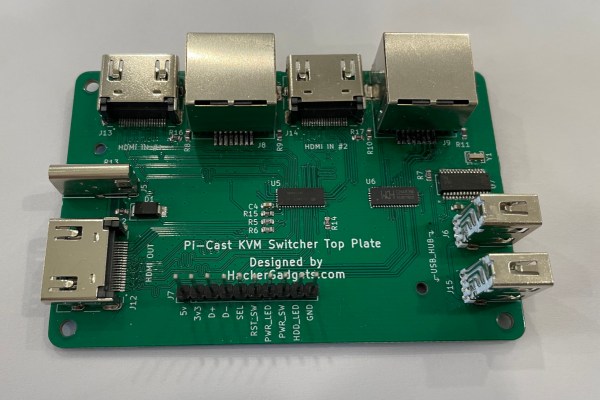
A KVM is a great tool for administering a number of different computers without cluttering one’s desk with extra peripherals, or for having to re-connect the keyboard, video, and mouse to each new machine as needed. For local administration this can save a ton of time and headache. For remote administration, though, a virtual KVM is needed, and although these solutions are pricey it’s possible to build one around a Raspberry Pi for a fraction of the cost. This one adds even more functionality by also switching the ATX signals from the motherboard and simplifying cable management to boot. Continue reading “Pi-Cast Adds ATX Signalling To KVM”

Shopping Cart Does The Tedious Work For You

Thanks to modern microcontrollers, basic home automation tasks such as turning lights on and off, opening blinds, and various other simple tasks have become common DIY projects. But with the advent of artificial intelligence and machine learning the amount of tasks that can be offloaded to computers has skyrocketed. This shopping cart that automates away the checkout lines at grocery stores certainly fits into this category.

The project was inspired by the cashierless Amazon stores where customers simply walk into a store, grab what they want, and leave. This is made possible by the fact that computers monitor their purchases and charge them automatically, but creator [kutluhan_aktar] wanted to explore a way of doing this without a fleet of sensors and cameras all over a store. By mounting the hardware to a shopping cart instead, the sensors travel with the shopper and monitor what’s placed in the cart instead of what’s taken from a shelf. It’s built around the OpenMV Cam H7, a microcontroller paired with a camera specifically designed for these types of tasks, and the custom circuitry inside the case also includes WiFi connectivity to make sure the shopping cart can report its findings properly.

[kutluhan_aktar] also built the entire software stack from the ground up and trained the model on a set of common products as a proof-of-concept. The idea was to allow smaller stores to operate more efficiently without needing a full suite of Amazon hardware and software backing it up, and this prototype seems to work pretty well to that end. If you want to develop a machine vision project on your own with more common hardware, take a look at this project which uses the Raspberry Pi instead.