
VGA Output On A Freescale

Even though VGA is an outdated and becoming somewhat deprecated, getting this video output running on non-standard hardware is a rite of passage for some hackers. [Andrew] is the latest to take up the challenge. He got VGA output on a Freescale i.MX233 and also got some experience diving into the Linux kernel while he was at it.

The Freescale i.MX233 is a single-board computer that is well-documented and easy to wire up to other things without specialized hardware. It has video output in the form of PAL/NTSC but this wasn’t quite enough for [Andrew]. After obtaining the kernel sources, all that’s needed is to patch the kernel, build the kernel, and build a custom DAC to interface the GPIO pins to the VGA connector.

The first thing that [Andrew] did was load up the Hackaday home page, which he notes took quite a while since the i.MX233 only runs at 454 MHz with just 64 MB of RAM. While our retro page may have loaded a little faster, this is still an impressive build and a great first step to exploring more of the Linux kernel. The Freescale i.MX233 is a popular chip for diving into Linux on single-board computers, and there’s a lot going on in that community. There are some extreme VGA hacks out there as well if that’s more your style.
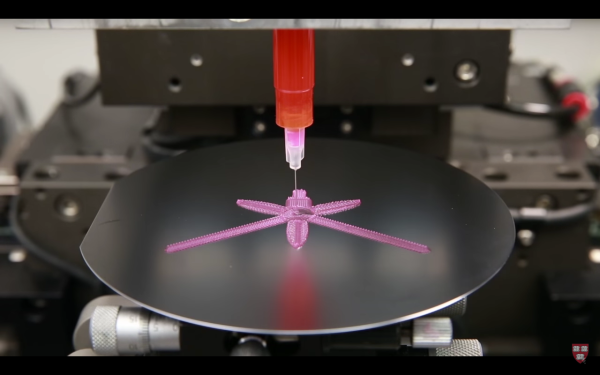

Take Your 3D Printing To The Next Dimension

In what is being hailed as the next great advancement in 3D printing, scientists have been able to get a 3D printed shape to change form when it is exposed to water, bringing 3D printing squarely into the realm of the fourth dimension. Although the only examples we’ve seen so far are with relatively flat prints (which arguably subtracts one “D” from the claim) the new procedure is one which is groundbreaking for the technology.

The process uses cellulose fibers which, when aligned in a particular way and exposed to water, swell in order to change shape. This is similar to how a bimetallic strip in a thermostat works, but they really took their inspiration from biological processes in plants that allow them to change shape according to environmental conditions. It’s hard to tell if this new method of printing will forever alter the landscape of 3D printing but, for now, it’s an interesting endeavor that will be worth watching. The video after the break shows a fast-motion print using the technique, followed by a demo of the print submersed in water.

We often see new technological advancements that use biology as a springboard for new ideas, and this one is no different. There have been building structures inspired by pinecones and this Processing hack inspired by squid. Biology is all around us, and any of it could be used for inspiration for your next project!

Continue reading “Take Your 3D Printing To The Next Dimension”

High Energy Gardening Means Nuking Plants

We live in a world transformed by our ability to manipulate the nucleus of atoms. Nuclear power plants provide abundant energy without polluting the air, yet on the other hand thousands of nuclear warheads sit in multiple countries ready to annihilate everything, even if it’s not on purpose. There are an uncountable number of other ways that humanity’s dive into nuclear chemistry has impacted the lives of people across the world, from medical imaging equipment to smoke detectors and even, surprisingly, to some of the food that we eat.

After World War 2, there was a push to find peaceful uses for atomic energy. After all, dropping two nuclear weapons on a civilian population isn’t great PR and there’s still a debate on whether or not their use was justified. Either way, however, the search was on to find other uses for atomic energy besides bombs. While most scientists turned their attention to creating a viable nuclear power station (the first of which would only come online in 1954, almost ten years after the end of World War 2), a few scientists turned their attention to something much less obvious: plants.

Continue reading “High Energy Gardening Means Nuking Plants”

The Newest Graphing Calculator Game

Certainly everyone remembers passing time in a boring high school class playing games on a graphing calculator. Whether it was a Mario-esque game, Tetris, or BlockDude, there are plenty of games out there for pretty much all of the graphing calculators that exist. [Christopher], [Tim], and their colleagues from Cemetech took their calculator game a little bit farther than we did, and built something that’ll almost surely disrupt whatever class you’re attempting to pay attention in: They built a graphing calculator whac-a-mole game.

This game isn’t the standard whac-a-mole game, though, and it isn’t played on the calculator’s screen. Instead of phyiscal “moles” the game uses LEDs and light sensors enclosed in a box to emulate the function of the moles. In order to whack a mole, the player only needs to interrupt the light beam which can be done with any physical object. The team made extensive use of the ArTICL library which allows graphing calculators to interface with microcontrollers like the MSP432 that they used, and drove the whole thing with a classic TI-84.

This project is a fun way to show what can be done with a graphing calculator and embedded electronics, and it was a big hit at this past year’s World Maker Faire. Calculators are versatile in other ways as well. We’ve seen them built with open hardware and free software, And we’ve even seen them get their own Wi-Fi.

Continue reading “The Newest Graphing Calculator Game”

There Is No Spoon; Automatic Self Stirring Mug

Sometimes it’s helpful to realize the truth that there is no spoon. At least, not with [Ronaldo]’s automatic self-stirring mug. At first it was just a small propeller in the bottom of the mug that turned on by pushing a button in the handle, but this wasn’t as feature-rich as [Ronaldo] hoped it could be, so he decided to see just how deep the automatic beverage-mixing rabbit hole goes.

The first thing to do was to get a microcontroller installed to handle the operation of the motor. The ATtiny13a was perfect for the job since it’s only using one output pin to control the motor, and can be configured to only draw 0.5 microamps in power-saving mode. This ensures a long life for the two AAA batteries that power the microcontroller and the motor.

As far as operation goes, the motor operates in different modes depending on how many times the button in the handle is pushed. It can be on continuously or it can operate at pre-determined intervals for a certain amount of time, making sure to keep the beverage thoroughly mixed for as long as the power lasts. Be sure to check out the video below for a detailed explanation of all of the operating modes. We could certainly see some other possible uses for more interesting beverages as well.

Continue reading “There Is No Spoon; Automatic Self Stirring Mug”

The Stork Looks Different Than We Thought

What the Internet of Things really needs is more things, and the more ridiculous the better. At least, that’s the opinion of [Eric] who has created a tongue-in-cheek gadget to add to the growing list of connected devices. It’s a Bluetooth-enabled pregnancy test that automatically releases the results to the world. Feeling lucky?

The theory of operation is fairly straightforward. A Bluetooth low-energy module is integrated into the end of a digital pregnancy test. These tests have a set of photo detectors to read the chemical strip after the test is conducted. If the test is positive, the module sends a signal to a Raspberry Pi which tweets the results out for the world to see. It also has an option to send a text message to your mom right away!

[Eric]’s project to live-tweet a pregnancy test also resulted in a detailed teardown of a digital pregnancy test, so if you need any technical specifications for pregnancy tests (for whatever reason) his project site has a wealth of information. He does note that his device can be used on other similar devices with directly driven LCD screens, too. The fun doesn’t end there, though! Once the pregnancy is a little further along you’ll be able to get the baby on Twitter, too.

Continue reading “The Stork Looks Different Than We Thought”

Truck-Sized Star Destroyer Takes Flight

While some of you may have been to see the new Star Wars movie, you might be sad that everything happened a long time ago in a galaxy far away. But there’s a group of RC enthusiasts called [Flite Test] who are trying to bring at least a little bit of that fantasy into real life. They’ve created a truck-sized Star Destroyer that actually flies. It looks kind of terrifying, too.

While it’s not as big as a “real” Star Destroyer, it’s certainly one of the biggest we’ve ever seen in real life. Built out of foam, this monstrosity is 15 feet long and powered by two huge electric motors and a large lithium polymer battery. Of course they didn’t start out by building this huge flying spaceship; they created a smaller model as proof-of-concept and flew that one around for a while to make sure everything was shipshape. While it’s exciting to see the small model in flight, it’s another thing to see the 15-foot version swooping around.

We’re sad to report that the Star Destroyer did meet a similar fate as the one that Rey was scavenging at the beginning of the movie (spoilers: it crashed), we hope that the RC team rebuilds it so it’s space worthy again. Maybe they can even add a real-life ion drive or a few lasers to make it even more real.

Continue reading “Truck-Sized Star Destroyer Takes Flight”