magnetic toggle swtches

Modified Toggle Switches Grace Hyper-Detailed Cockpit Simulator Panels

In the world of the cockpit simulator hobby, no detail is too small to obsess over. Getting the look and feel of each and every cockpit control just right is important, and often means shelling out for cockpit-accurate parts. But not always, as these DIY magnetically captured toggle switches show.

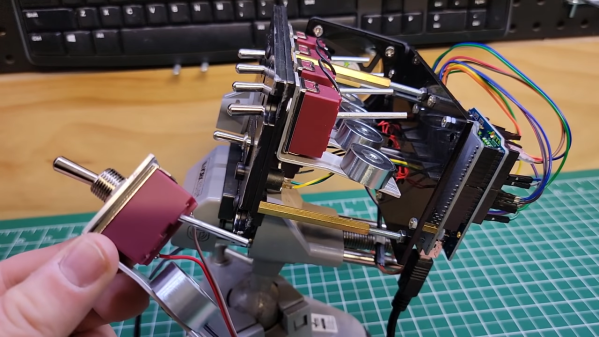
Chances are good you’ve seen [The Warthog Project]’s fantastically detailed A-10 Thunderbolt II cockpit simulator before; we’ve featured it recently, and videos from the ongoing build pop up regularly in our feeds. The sim addresses the tiniest of details, including the use of special toggle switches that lock into place automatically using electromagnets. They’re commercially available, but only for those with very deep pockets — depending on the supplier, up to several thousand dollars per unit!

The homebrew substitute is mercifully cheap and easy to build, though — a momentary DPST toggle switch is partially gutted, with a length of nail substituted for one of its poles. The nail sticks out of the back of the switch, where a bracket holds a small electromagnet. When energized, the electromagnet holds the nail firmly when the switch is toggled on; the simulated pilot can still manually toggle the switch off, or it can be released automatically by de-energizing the coil. Each switch cost less than $20 to make, including the MOSFETs needed to drive the coils and the Arduino to provide the logic. The panels they adorn look fantastic, and the switches add a level of functional detail that’s just right for the whole build.

Continue reading “Modified Toggle Switches Grace Hyper-Detailed Cockpit Simulator Panels”

Ethernet Cable Turned Into Antenna To Exploit Air-Gapped Computers

Good news, everyone! Security researcher [Mordechai Guri] has given us yet another reason to look askance at our computers and wonder who might be sniffing in our private doings.

This time, your suspicious gaze will settle on the lowly Ethernet cable, which he has used to exfiltrate data across an air gap. The exploit requires almost nothing in the way of fancy hardware — he used both an RTL-SDR dongle and a HackRF to receive the exfiltrated data, and didn’t exactly splurge on the receiving antenna, which was just a random chunk of wire. The attack, dubbed “LANtenna”, does require some software running on the target machine, which modulates the desired data and transmits it over the Ethernet cable using one of two methods: by toggling the speed of the network connection, or by sending raw UDP packets. Either way, an RF signal is radiated by the Ethernet cable, which was easily received and decoded over a distance of at least two meters. The bit rate is low — only a few bits per second — but that may be all a malicious actor needs to achieve their goal.

To be sure, this exploit is quite contrived, and fairly optimized for demonstration purposes. But it’s a pretty effective demonstration, but along with the previously demonstrated hard drive activity lights, power supply fans, and even networked security cameras, it adds another seemingly innocuous element to the list of potential vectors for side-channel attacks.

[via The Register]

Big homemade lathe

Heavy Metal Lathe Build Doesn’t Spare The Steel

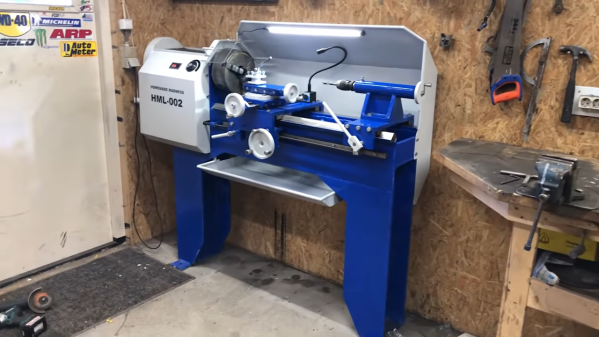
It’s common wisdom that the lathe is the essential machine tool, and the only one that can make copies of itself. While we won’t argue the primacy of the lathe in the machine shop, this scratch-built, heavy-duty lathe gives the lie to the latter argument — almost.

We’re used to seeing homebrew lathes, of course, and we’ve featured more than a few of them before. But two things make [Jornt]’s build stand out: how few specialized tools were needed to build it, and the sheer size and bulk of the finished product. Where most homebrew lathes tend to be the bench top variety and feature cast aluminum parts, [Jornt] went with steel for his build, and a lot of it. The base and bed of the machine are welded from scrap steel I-beams, and the ways are made from angle iron that has been ground flat with a clever jig to hold an angle grinder. The angle grinder plays a prominent role in the build, as do simple tools like a hand drill, files, and a welder — and yes, the unfinished lathe itself, which was used to bore out the bearing blocks for the headstock.

The completed lathe, powered by a treadmill motor in a way that [Jeremy Fielding] would no doubt endorse, comes in at a beefy 450 kg. It honestly looks like something you could buy from a catalog, and has most of the features of commercial machines. One thing we’d love to see on this lathe is the electronic lead screw that [James Clough] developed for his off-the-shelf lathe.

Continue reading “Heavy Metal Lathe Build Doesn’t Spare The Steel”

Wearable soft robot grippers

Soft Robotics Hack Chat

Join us on Wednesday, October 27 at noon Pacific for the Soft Robotics Hack Chat with Ali Shtarbanov!

By this point in technological history, we’ve all been pretty well trained in how to think about robots. Designs vary wildly, but to achieve their goals, most robots have one thing in common: they’re rigid. Whether it’s a robot arm slinging a spot welder on an assembly line or a robot dog on patrol, they’re largely made of stiff, strong, materials that, more often than not, are powered by electric motors of some sort.

But just because that’s the general design palette for robotics doesn’t mean there aren’t other ways. Robots, especially those that are intended to be used in close association with humans, can often benefit from being a little more flexible. And that’s where the field of soft robotics shines. Rather than a skeleton of machined aluminum and powerful electric actuators, these robots tend more toward silicone rubber construction with pneumatic activation. Some soft robots are even compliant and safe enough to be wearable, giving humans the ability to do things they never could before, or perhaps restoring functions that have been lost to the ravages of entropy.

Soft robotics is a fascinating field with the potential to really revolutionize things like wearables and collaborative robotics. To help us understand a little more about what’s going on in this space, we’re pleased to welcome Ali Shtarbanov to the Hack Chat. Ali is a Ph.D. student at MIT’s famed Media Lab, where he studies Human-Computer Interaction. He’s particularly interested in making soft robotics as fast and easy to prototype as traditional robotics have become, and to this end, he invented FlowIO, an open-source platform for pneumatic control. We’ll use this as a jumping-off point to discuss the whole field of soft robotics, especially where it is now and where Ali sees it going in the future.

join-hack-chatOur Hack Chats are live community events in the Hackaday.io Hack Chat group messaging. This week we’ll be sitting down on Wednesday, October 27 at 12:00 PM Pacific time. If time zones have you tied up, we have a handy time zone converter.

spinning thread extruder

Spinning Threads Put The Bite On Filament In This Novel Extruder Design

When it comes to innovation in FDM 3D printing, there doesn’t seem to be much room left to move the needle. Pretty much everything about filament printing has been reduced to practice, with more or less every assembly available off the shelf. Even the business end — the extruder — is so optimized that there’s not much room left for innovation.

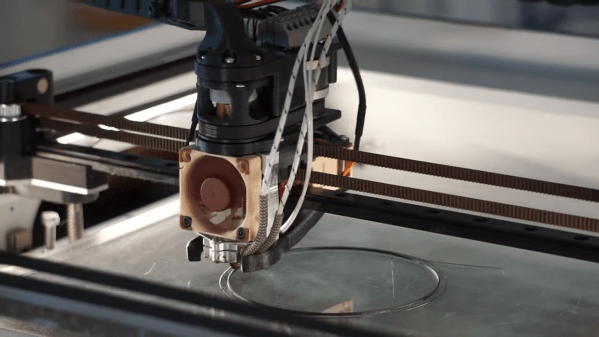
Or is there? The way [David Leitner] sees it, there is, which is why he built this rolling-screw extruder (if you can get to the Thingiverse link, [David] cross-posted on reddit, too). Standard extruders work on the pinch-roller principle, where the relatively soft filament is fed past a spring-loaded gear attached to a stepper motor. The stepper rotates the gear, which either advances the filament into or retracts it from the hot end. [David]’s design instead uses a trio of threaded rods mounted between two rings. The rods are at an angle relative to the central axis of the rings, forming a passage that’s just the right size for the filament to fit in. When the rings spin, the threads on the rods engage with the filament, gripping it around its whole circumference and advancing or retracting it depending on which way it’s spinning. The video below shows it working; we have to admit it’s pretty mesmerizing to watch.

[David] himself admits there’s not much advantage to it, perhaps other than a lower tendency to skip since the force is spread over the entire surface of the filament rather than just a small pinch point. Regardless, we like the kind of thinking that leads to something like this, and we’ll bet there are probably unseen benefits to it. And maybe the extruder actually is a place for innovation after all; witness this modular nozzle swapping system.

Continue reading “Spinning Threads Put The Bite On Filament In This Novel Extruder Design”

Making Your Projects Move: Jeremy Fielding To Deliver Remoticon Keynote

We’re really excited to announce that Jeremy Fielding will give a keynote address at Hackaday Remoticon in November! Get your free ticket now!

The projects we in this community choose to tackle often take a lot to see to completion. Parts, tools, expertise, time; all are critical to getting projects from concept to reality. But how deep your parts bin is or how well-equipped your shop may be matters not a whit unless you’ve got the one thing that makes it all go: passion. Passion is what keeps a project rolling ahead paste the inevitable roadblocks and diversions; it’s what keeps us going back to the bench to try something new when we think we’ve tried it all.

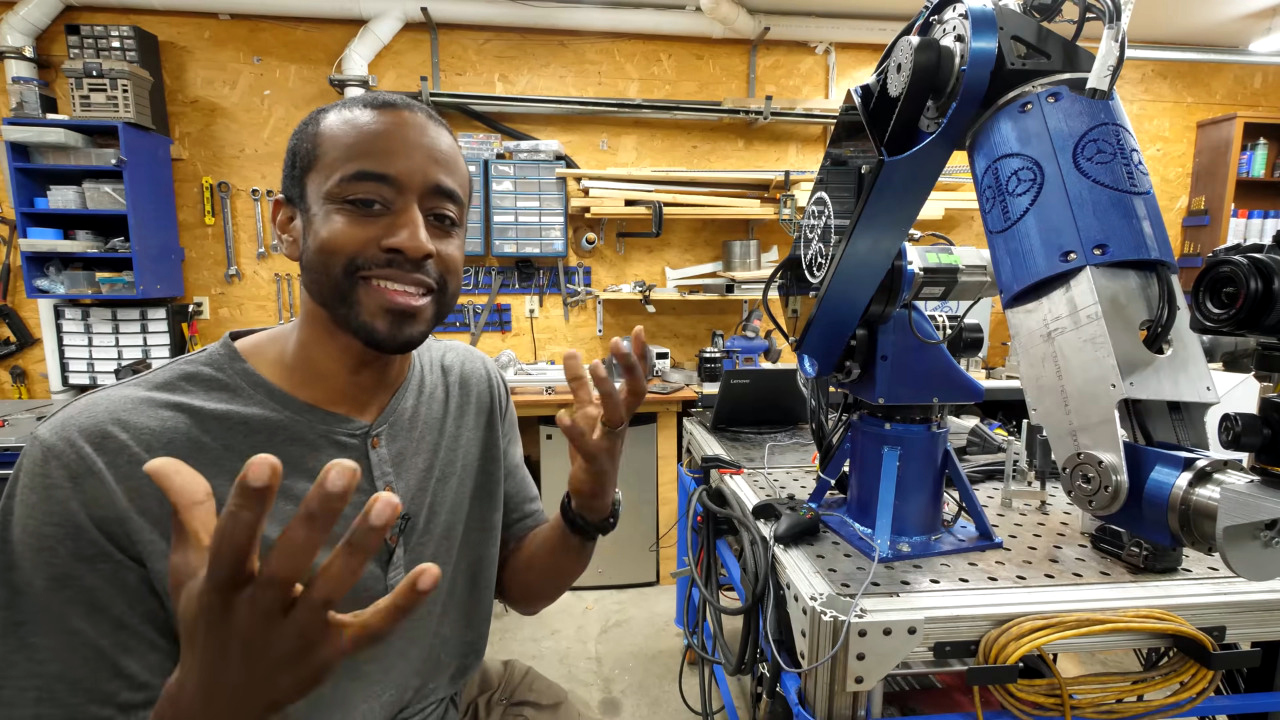
Jeremy Fielding showing off his robot arm back in April

The passion to understand, to create, to innovate, is something that Jeremy Fielding clearly has. Anyone who has watched even a few of his YouTube videos knows how much he loves to make things move. His current project is a seven-axis industrial robot arm, and it’s a seriously impressive build that could easily be mistaken for a commercial product. What’s perhaps most impressive about this is that many of the skills needed to pull it off, like welding aluminum and machining, are skills that Jeremy has been teaching himself on the fly. Talk about passion!

For his keynote, Jeremy is going to focus on building hardware that moves. Most of us are reasonably good at putting together projects that flash a few lights or perhaps move a few small steppers or servos. But scaling that up, as Jeremy has done for his robot arm as well as other projects, introduces new challenges: what type of electric motor do I choose? How do I figure out the trade-offs between torque and speed? Do I even want to use electric motors — maybe pneumatics will be better? What are my control options? These questions can be just as daunting to the old hands as they are to beginners, and Jeremy is going to focus on how to handle these and other mechatronic challenges that crop up in our projects.

Aside from the (literal) nuts and bolts of mechanical engineering, there’s another place where Jeremy’s passion shines through: his passion for communicating what he has learned. His presentation style and enthusiasm are infectious, and we’re sure that’s going to come across in his keynote. Jeremy fancies himself a “contraption engineer,” which is both an apt and engaging way to look at what he does. Fellow contraption builders take note — you’re going to want to make sure you don’t miss this one!

Call for Proposals is Still Open!

We’re still on the hunt for great talks about hardware creation, so the Call for Proposals has been extended to October 20. And remember, get your tickets early — knowing how many people to expect really helps us with infrastructure planning so we can give everyone a quality experience.

Electric Vehicles, The Gasoline Problem, And Synthetic Fuels

When you’re standing at the gas station filling up your car, watching those digits on the pump flip by can be a sobering experience. Fuel prices, especially the price of gasoline, have always been keenly watched, so it’s hard to imagine a time when gasoline was a low-value waste product. But kerosene, sold mainly for lighting, was once king of the petroleum industry, at least before the automobile came along, to the extent that the gasoline produced while refining kerosene was simply dumped into streams to get rid of it.

The modern mind perhaps shudders at the thought of an environmental crime of that magnitude, and we can’t imagine how anyone would think that was a good solution to the problem. And yet we now face much the same problem, as the increasing electrification of the world’s fleet of motor vehicles pushes down gasoline demand. To understand why this is a problem, we’ll start off by taking a look at how crude oil is formed, and how decreasing demand for gasoline may actually cause problems that we should think about before we get too far down the road.

Continue reading “Electric Vehicles, The Gasoline Problem, And Synthetic Fuels”