Minimum Viable Quad Build Shows What Starting From Nothing Can Accomplish

While it’s great to be experienced and have a ton of specialist knowledge needed to solve a problem, there’s something liberating about coming at things from a position of ignorance. Starting at ground zero can lead you down the path less traveled, and reveal solutions that might otherwise not have presented themselves. And, if [Robin Debreuil]’s exploration of the “minimum viable quadcopter” is any example, some pretty fun failure modes too.

The minimum viable product concept is nothing new of course, being a core concept in Lean methodologies and a common practice in many different industries. The idea of building an MVP is to get something working and in the hands of users, who will then give you feedback on everything wrong with it, plus, if you’re lucky, what you got right. That feedback informs the next design, which leads to more feedback and a whole iterative process that should design the perfect widget.

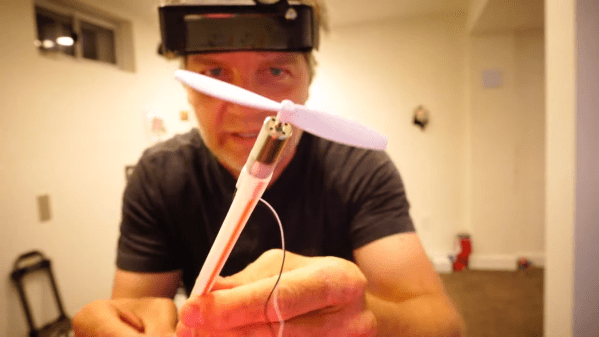
In [Robin]’s case, he wanted to build a quadcopter, but didn’t know where to start. So his first version was as simple as possible: a motor with a propellor and a small LiPo battery. No chassis, no control electronics — nothing. And it worked just about as well as expected. But fixing that problem led to different designs, the process of which was fascinating — we especially liked the quad with opposing motors controlled by mercury tilt switches to sense attitude changes.

In the end, [Robin] took a more conventional tack and used a microcontroller and BetaFlight to get his popsicle stick and hot glue UAV airborne. But the decision to start with a minimum viable design and iterate from there was a powerful learning experience in tune with [Robin]’s off-beat and low-key outlook, which we’ve seen before with his use of bismuth for desoldering and his scratch-off PCBs.

Continue reading “Minimum Viable Quad Build Shows What Starting From Nothing Can Accomplish”

Homebrew ROM Reader Saves Data From A Vintage Minicomputer

Have you ever heard of a Centurion minicomputer? If not, don’t feel bad — we hadn’t either, until [David Lovett] stumbled upon a semi-complete version of the 1980-ish mini in all its wood-trimmed, dust-encased glory. And what does a hacker do with such an acquisition but attempt to get it going again?

Of course, getting a machine from the Reagan administration running is not without its risks, including the chance of losing whatever is on the machine’s many ROM chips forever. When finding a commercial ROM reader supporting the various chips proved difficult, [David] decided to build his own. The work was eased considerably by the fact that he had managed to read one chip in a commercial reader, giving him a baseline to compare his circuit against. The hardware is straightforward — a 12-bit counter built from a trio of cascaded 74LS161s to step through addresses, plus an Arduino Nano to provide clock pulses and to read the data out to the serial port.

The circuit gave the same results as the known good read, meaning results would be valid for the rest of the chips. The breadboard setup made supporting multiple ROM pinouts easy, even for the chips that take -9 volts. What exactly the data on the ROMs mean, if anything, remains a mystery, but at least it’s backed up now.

Before anyone notes the obvious, yes, [David] could have used a 555 to clock the reader — perhaps even this one. We’d actually have loved that, but we get it — sometimes you just need to throw an Arduino at a job and be done with it.

Continue reading “Homebrew ROM Reader Saves Data From A Vintage Minicomputer”

Vintage Displays Hack Chat With Fran Blanche

Join us on Wednesday, August 11 at noon Pacific for the Vintage Displays Hack Chat with Fran Blanche!

In terms of ease of integration and density of the information that can be shown, it’s hard to argue with the fact that modern displays like LCD panels are anything but superior to the character-based displays of yore. Throw one into a project, add a little code from a few off-the-shelf libraries to drive it, and you’re on to the next job.

Efficient, yes, but what does this approach do for the engineer’s soul? What design itch does it scratch; what aesthetic does it celebrate? Nostalgic questions, true, and not every project lends itself to exploring old display technologies. But some still do, thankfully, and when the occasion calls for it, we’re glad that there are those out there who are still actively involved in the retro display community, making sure that what was once state-of-the-art technology is still able to be added to modern projects.

There’s no doubt that Fran Blanche is one of those passing the torch of vintage displays down to the next generation. You’ll certainly know Fran from her popular Fran Lab channel on YouTube, where in addition to about a million other interests, she has explored some really cool vintage displays: the Nimo cathode-ray tube, super-bright incandescent seven-segment displays, the delightfully strange “Bina-View”, and many, many more. Fran will stop by the Hack Chat to talk about all these retro displays, what she’s learned from collecting them, and how they shaped the displays we take so much for granted these days. Oh, and perhaps we’ll also talk about her upcoming ride on “G-Force 1” as well.

join-hack-chatOur Hack Chats are live community events in the Hackaday.io Hack Chat group messaging. This week we’ll be sitting down on Wednesday, August 11 at 12:00 PM Pacific time. If time zones have you tied up, we have a handy time zone converter.

Permanent Artificial Hearts: Long-Sought Replacements May Not Be Far Away

The number of artificial prosthetic replacement parts available for the human body is really quite impressive. From prosthetic eyes to artificial hips and knees, there are very few parts of the human body that can’t be swapped out with something that works at least as well as the original, especially given that the OEM part was probably in pretty tough shape in the first place.

But the heart has always been a weak spot in humans, in part because of the fact that it never gets to rest, and in part because all things considered, we modern humans don’t take really good care of it. And when the heart breaks down past the point where medicine or surgery can help, we’re left with far fewer alternatives than someone with a bum knee would face. The fact is that the best we can currently hope for is a mechanical heart that lets a patient live long enough to find a donor heart. But even then, tragedy must necessarily attend, and someone young and healthy must die so that someone else may live.

A permanent implantable artificial heart has long been a goal of medicine, and if recent developments in materials science and electrical engineering have anything to say about it, such a device may soon become a reality. Heart replacements may someday be as simple as hip replacements, but getting to that point requires understanding the history of mechanical hearts, and why it’s not just as simple as building a pump.

Continue reading “Permanent Artificial Hearts: Long-Sought Replacements May Not Be Far Away”

Apollo DSKY Display Glows Again

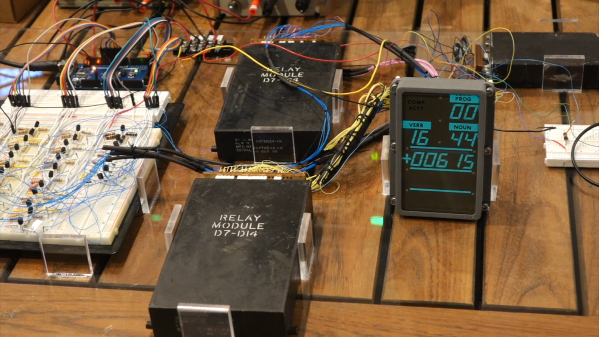
We love seeing old technology brought back to life, especially when it’s done in the context of how the device was originally intended to be used. And double points when it’s space gear, like what [Curious Marc] and his usual merry band of cohorts did when they managed to light up a couple of real Apollo DSKY displays.

The “Display and Keyboard” formed the human interface to the Apollo Guidance Computer, the purpose-built machine that allowed Apollo missions to fly to the Moon, land safely, and return to Earth. Complete DSKYs are hard to come by, but a lucky collector named [Marcel] was able to score a pair of the electroluminescent panels, one a prototype and one a flight-qualified spare. He turned them over to AGC guru [Carl Claunch], who worked out all the details of getting the display working again —  a non-trivial task with a device that needs 250 volts at 800 Hertz.

The first third of the video below mostly concerns the backstory of the DSKY displays and the historical aspects of the artifacts; skip to around the 12:30 mark to get into the technical details, including the surprising use of relays to drive the segments of the display. It makes sense once you realize that mid-60s transistors weren’t up to the task, and it must have made the Apollo spacecraft a wonderfully clicky place. We were also intrigued by the clever way the total relay count was kept to a minimum, by realizing that not every combination of segments was valid for each seven-segment display.

The video has a couple of cameos, like [Ben Krasnow], no slouch himself when it comes to electroluminescent displays and DSKY replicas. We also get a glimpse of well-known component slicer and MOnSter 6502-tamer [TubeTime] too. Continue reading “Apollo DSKY Display Glows Again”

Hackaday Links Column Banner

Hackaday Links: August 1, 2021

Amateur radio operators have a saying: When all else fails, there’s ham radio. And that’s true, at least to an extent — knock out the power, tear down the phone lines, and burn up all the satellites in orbit, and there will still be hams talking about politics on 40 meters. The point is, as long as the laws of physics don’t change, hams will figure out a way to send and receive messages. In honor of that fact, the police in the city of Pune in Maharashtra, India, make it a point to exchange messages with their headquarter using Morse code once a week. The idea is to maintain a backup system, in case they can’t get a message through any other way. It’s a good idea, especially since they rotate all their radio operators through the Sunday morning ritual. We can’t imagine that most emergency services dispatchers would be thrilled about learning Morse, though.

Just because you’re a billionaire with a space company doesn’t mean you’re an astronaut. At least that’s the view of the US Federal Aviation Administration, which issued guidelines pretty much while Jeff Bezos and his merry band of cohorts were floating about above the 100-km high Kármán line in a Blue Origin “New Shepard” rocket. The FAA guidelines make it clear that those making the trip need to have actually done something to qualify as an astronaut, by “demonstrated activities during flight that were essential to public safety, or contributed to human space flight safety.” That’s good news to the “Old Shepard”, who clearly was in control of “Freedom 7” during the Mercury program. But the Bezos brothers, teenager Oliver Daemen, and Wally Funk, one of the “Mercury 13” group of women who trained to be NASA astronauts but never got to fly, were really just along for the ride, as the entire flight was automated. It doesn’t take away from the fact that they’ve been to space and you haven’t, of course, but they can’t officially call themselves astronauts. This goes to show that even billionaires can just be ballast too.

Good news, everyone — if you had anything that was being transported aboard the Ever Given, your stuff is almost there. The Suez Canal-occluding container ship finally made it to its original destination in Rotterdam, approximately four months later than originally predicted.  After plugging up the vital waterway for six days last March, the ship along with her cargo and her crew were detained in Egypt’s Great Bitter Lake, perhaps the coolest sounding body of water in the world next to the Dead Sea. Legal squabbling ensued at that point, all the while rendering whatever was in the 20,000-odd containers aboard the ship pretty much pointless. We’d imagine that even with continuous power, whatever was in the refrigerated containers must be pretty nasty by now, so there’s probably a lot of logistics and clean-up left to sort out.

I have to admit that I have a weird love of explosive bolts. I don’t know what it is, but the idea of fasteners engineered to fail in a predictable way under the influence of pyrotechnic charges just tickles something in me. I mean, I even wrote a whole article on the subject once. So when I came across this video explaining how the Space Shuttles were held to the launch pad, I really had to watch it. Surprisingly, the most interesting part of this story was not the explosive aspect, but the engineering problem of supporting the massive vehicle on the launch pad. For as graceful as the Shuttles seemed once they got into orbit, they really were ungainly beasts, especially strapped to the external fuel tank and booster. The scale of the eight frangible nuts used to secure the boosters to the pad is just jaw-dropping. We also liked the idea that NASA decided to catch the debris from the explosions in a container filled with sand.

Retrotechtacular: Understanding Protein Synthesis Through Interpretive Dance

With the principles of molecular biology very much in the zeitgeist these days, we thought it would be handy to provide some sort of visual aid to help our readers understand the complex molecular machines at work deep within each cell of the body. And despite appearances, this film using interpretive dance to explain protein synthesis will teach you everything you need to know.

Now, there are those who go on and on about the weirdness of the 1960s, but as this 1971 film from Stanford shows, the 60s were just a warm-up act for the really weird stuff. The film is a study in contrasts, with the setup being provided by the decidedly un-groovy Paul Berg, a professor of biochemistry who would share the 1980 Nobel Prize in Medicine for his contributions to nucleic acid research. His short sleeves and skinny tie stand in stark contrast to the writhing mass of students capering about on a grassy field, acting out the various macromolecules involved in protein synthesis. Two groups form the subunits of the ribosome, a chain of ballon-headed students act as the messenger RNA (mRNA) that codes for a protein, and little groups standing in for the transfer RNA (tRNA) molecules that carry the amino acids float in and out of the process.

The level of detail, at least as it was understood in 1971, is impressively complete, with soloists representing things like T-factor and the energy-carrying molecule GTP. And while we especially like the puff of smoke representing GTP’s energy transfer, we strongly suspect a lot of other smoke went into this production.

Kitsch aside, and with apologies to Lewis Carroll and his Jabberwock, you’ll be hard-pressed to find a modern animation that captures the process better. True, a more traditional animation might make the mechanistic aspects of translation clearer, but the mimsy gyre and gimble of this dance really emphasize the role random Brownian motion plays in macromolecular processes. And you’ll never see the term “tRNA” and not be able to think of this film.

Continue reading “Retrotechtacular: Understanding Protein Synthesis Through Interpretive Dance”