CNC Router Frame Repurposed For Colorful String Art Bot

Pandemic lockdowns have been brutal, but they’ve had the side-effect of spurring creativity and undertaking projects that are involved enough and complex enough to keep from going stir crazy. This CNC string art robot is a great example of what’s possible with a little imagination and a lot of time. (Video, embedded below.)

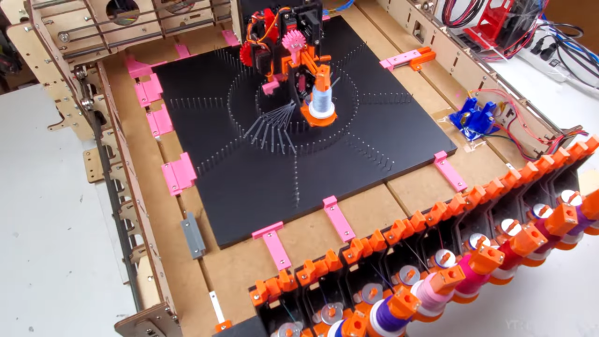
According to [knezuld11], the robot creates its art through mathematical algorithms via a Python program that translates them into nail positions and string paths. The modified CNC router frame, constructed of laser-cut plywood, has two interchangeable tool heads. The first places the nails, which are held in a small hopper. After being picked up by a servo-controlled magnetic arm and held vertically, a gear-driven ram pushes each nail into a board at just the right coordinates. After changing to a different tool, the robot is able to pick up one of nine different thread dispensers. A laser sensor verifies the thread nozzle position, and the thread starts its long journey around the nails. It’s a little mesmerizing to watch, and the art looks great, with a vibe that brings us right back to the 70s. Groovy, man.

This reminds us a little of a recent [Barton Dring] project that makes art from overlapping strings. That one was pretty cool for what it accomplished with just one thread color, while this one really brings color to the party. Take your pick, place your nails, and get stringing.

Continue reading “CNC Router Frame Repurposed For Colorful String Art Bot”

Remoticon Video: Learn How To Hack A Car With Amith Reddy

There was a time not too long ago when hacking a car more often than not involved literal hacking. Sheet metal was cut, engine cylinders were bored, and crankshafts were machined to increase piston travel. It was all in the pursuit of milking the last ounce performance out of every drop of gasoline, along with a little personal expression in the form of paint and chrome.

While it’s still possible — and encouraged — to hack cars thus, the inclusion of engine control units and other systems to our rides has created an entirely different universe of car hacking options, which Amith Reddy distilled into his very popular workshop at the 2020 Remoticon. The secret sauce behind all the hacks you can accomplish in today’s drive-by-wire cars is the Controller Area Network (CAN), the network used to connect the array of sensors, actuators, and controllers that lie under the metal and plastic of modern cars.

Continue reading “Remoticon Video: Learn How To Hack A Car With Amith Reddy”

This Automated Wire Prep Machine Cuts And Strips The Wire

We’ve seen a fair number of automated wire cutting builds before, and with good reason: cutting lots of wires by hand is repetitive and carries the risk of injury. What’s common to all these automated wire cutters is a comment asking, “Yeah, but can you make it strip too?” As it turns out, yes you can.

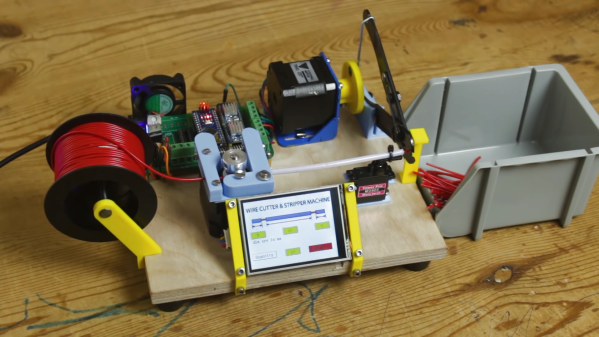
The key to making this automated wire cutter and stripper is [Mr Innovative]’s choice of tooling, and accepting a simple compromise. (Video, embedded below.) Using just about the simplest wire strippers around — the kind with a diamond-shaped opening that adjusts to different wire gauges by how far the jaws are closed — makes it so that the tool can both cut and strip, and adapt to different wire sizes. The wire is fed from a spool to a custom attachment sitting atop a stepper motor, which looks very much like an extruder from a 3D-printer. The wire is fed through a stiff plastic tube into the jaws of the cutter. Choosing between cutting and stripping is a matter of aiming the wire for different areas on the cutter’s jaws, which is done with a hobby servo that bends the guide tube. The throw of the cutter is controlled by a stepper motor — partial closure nicks the insulation, while a full stroke cuts the wire off. The video below shows the build and the finished product in action.

Yes, the insulation bits at the end still need to be pinched off, but it’s a lot better than doing the whole job yourself. [Mr Innovative] has a knack for automating tedious manual tasks like this. Check out his label dispenser, a motor rotor maker, and thread bobbin winder.

Continue reading “This Automated Wire Prep Machine Cuts And Strips The Wire”

Vacuum Tube Logic Hack Chat

Join us on Wednesday, December 9th at noon Pacific for the Vacuum Tube Logic Hack Chat with David Lovett!

For most of us, circuits based on vacuum tubes are remnants of a technological history that is rapidly fading from our collective memory. To be sure, there are still applications for thermionic emission, especially in power electronics and specialized switching applications. But by and large, progress has left vacuum tubes in a cloud of silicon dust, leaving mainly audiophiles and antique radio enthusiasts to figure out the hows and whys of plates and grids and filaments.

But vacuum tubes aren’t just for the analog world. Some folks like making tubes do tricks they haven’t had to do in a long, long time, at least since the birth of the computer age. Vacuum tube digital electronics seems like a contradiction in terms, but David Lovett, aka Usagi Electric on YouTube, has fallen for it in a big way. His channel is dedicated to working through the analog building blocks of digital logic circuits using tubes almost exclusively. He has come up with unique circuits that don’t require the high bias voltages typically needed, making the circuits easy to work with using equipment likely to be found in any solid-state experimenter’s lab.

David will drop by the Hack Chat to share his enthusiasm for vacuum tube logic and his tips for exploring the sometimes strange world of flying electrons. Join us as we discuss how to set up your own vacuum tube experiments, learn what thermionic emission can teach us about solid-state electronics, and maybe even get a glimpse of what lies ahead in his lab.

join-hack-chatOur Hack Chats are live community events in the Hackaday.io Hack Chat group messaging. This week we’ll be sitting down on Wednesday, December 9 at 12:00 PM Pacific time. If time zones have you tied up, we have a handy time zone converter.

Click that speech bubble to the right, and you’ll be taken directly to the Hack Chat group on Hackaday.io. You don’t have to wait until Wednesday; join whenever you want and you can see what the community is talking about.

Continue reading “Vacuum Tube Logic Hack Chat”

Hackaday Links Column Banner

Hackaday Links: December 6, 2020

By now you’ve no doubt heard of the sudden but not unexpected demise of the iconic Arecibo radio telescope in Puerto Rico. We have been covering the agonizing end of Arecibo from almost the moment the first cable broke in August to a eulogy, and most recently its final catastrophic collapse this week. That last article contained amazing video of the final collapse, including up-close and personal drone shots of the cable breaking. For a more in-depth analysis of the collapse, it’s hard to beat Scott Manley’s frame-by-frame analysis, which really goes into detail about what happened. Seeing the paint spalling off the cables as they stretch and distort under loads far greater than they were designed for is both terrifying and fascinating.

Exciting news from Australia as the sample return capsule from JAXA’s Hayabusa2 asteroid explorer returned safely to Earth Saturday. We covered Hayabusa2 in our roundup of extraterrestrial excavations a while back, describing how it used both a tantalum bullet and a shaped-charge penetrator to blast regolith from the surface of asteroid 162173 Ryugu. Samples of the debris were hoovered up and hermetically sealed for the long ride back to Earth, which culminated in the fiery re-entry and safe landing in the midst of the Australian outback. Planetary scientists are no doubt eager to get a look inside the capsule and analyze the precious milligrams of space dust. In the meantime, Hayabusa2, with 66 kilograms of propellant remaining, is off on an extended mission to visit more asteroids for the next eleven years or so.

The 2020 Remoticon has been wrapped up for most of a month now, but one thing we noticed was how much everyone seemed to like the Friday evening Bring-a-Hack event that was hosted on Remo. To kind of keep that meetup momentum going and to help everyone slide into the holiday season with a little more cheer, we’re putting together a “Holiday with Hackaday & Tindie” meetup on Tuesday, December 15 at noon Pacific time. The details haven’t been shared yet, but our guess is that this will certainly be a “bring-a-hack friendly” event. We’ll share more details when we get them this week, but for now, hop over to the Remo event page and reserve your spot.

On the Buzzword Bingo scorecard, “Artificial Intelligence” is a square that can almost be checked off by default these days, as companies rush to stretch the definition of the term to fit almost every product in the neverending search for market share. But even those products that actually have machine learning built into them are only as good as the data sets used to train them. That can be a problem for voice-recognition systems; while there are massive databases of utterances in just about every language, the likes of Amazon and Google aren’t too willing to share what they’ve leveraged from their smart speaker using customer base. What’s the little person to do? Perhaps the People’s Speech database will help. Part of the MLCommons project, it has 86,000 hours of speech data, mostly derived from audiobooks, a clever source indeed since the speech and the text can be easily aligned. The database also pulls audio and the corresponding text from Wikipedia and other random sources around the web. It’s a small dataset, to be sure, but it’s a start.

And finally, divers in the Baltic Sea have dredged up a bit of treasure: a Nazi Enigma machine. Divers in Gelting Bay near the border of Germany and Denmark found what appeared to be an old typewriter caught in one of the abandoned fishing nets they were searching for. When they realized what it was — even crusted in 80-years-worth of corrosion and muck some keys still look like they’re brand new — they called in archaeologists to take over recovery. Gelting Bay was the scene of a mass scuttling of U-boats in the final days of World War II, so this Engima may have been pitched overboard before by a Nazi commander before pulling the plug on his boat. It’ll take years to restore, but it’ll be quite a museum piece when it’s done.

Exhaust Fan-Equipped Reflow Oven Cools PCBs Quickly

With reflow soldering, sometimes close is good enough. At the end of the day, the home gamer really just needs a hot plate or an old toaster oven and a calibrated Mark I eyeball to get decent results. This exhaust fan-equipped reflow oven is an attempt to take control of what’s perhaps the more challenging part of the reflow thermal cycle — the cool down.

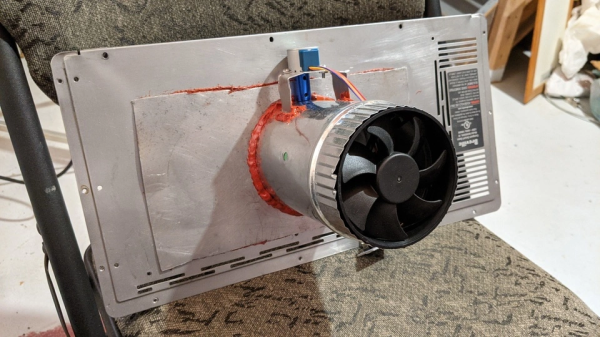
No fan of the seat-of-the-pants school of reflow soldering, [Nabil Tewolde] started with a cast-off toaster oven for what was hoped to be a more precise reflow oven. The requisite temperature sensors and solid-state relays were added, along with a Raspberry Pi Zero W and a small LCD display. Adding the cooling assist started by cutting a gaping hole cut in the rear wall of the oven, which was then filled with a short stretch of HVAC duct and a stepper-controlled damper. The far end of the duct was fitted with a PC cooling fan; while it seems sketchy to use a plastic fan to eject hot air from the oven, [Nabil] says the exhaust isn’t really that hot by the time it gets to the fan. At the end of the reflow phase of the thermal profile, the damper opens and the fan kicks on, rapidly cooling the oven’s interior.

Unfortunately, [Nabil] still needs to crack open the oven door to get decent airflow; seems like another damper to admit fresh air would help with that. That would complicate things a bit, but it still wouldn’t be as over-the-top as some reflow builds we’ve seen. Then again, that calibrated eyeball thing can work pretty well too, even without a toaster oven.

Continue reading “Exhaust Fan-Equipped Reflow Oven Cools PCBs Quickly”

Fridge Compressor Turned Into Capable Little Four-Stroke Engine

Never underestimate the power of a well-stocked junk bin. Along with a TIG welder and mechanical ingenuity bordering on genius-level, all of which come to bear on this fridge compressor to four-stroke engine build.

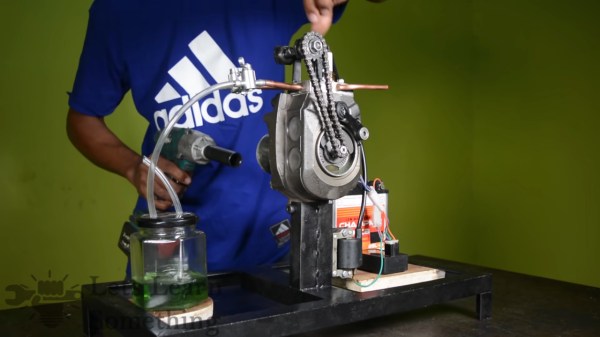
The video posted by [Let’s Learn Something] is long, but watching it at double speed doesn’t take away much from the enjoyment. By using a piston-type compressor, a lot of the precision machining is already taken care of here. Adding the intake and exhaust valves, camshaft, timing chain, carburetor, and ignition system are still pretty challenging tasks, though. We loved the home-made timing chain sprockets, made with nothing more than a drill and an angle grinder. In a truly inspired moment, flat-head screws are turned into valves, rocker arms are fabricated from bits of scrap, and a bolt becomes a camshaft with built-up TIG filler. Ignition and carburetion are cobbled together from more bits of scrap, resulting in an engine that fired up the first time — and promptly melted the epoxy holding the exhaust header to the cylinder head.

Now, compressor-to-engine conversions aren’t exactly new territory. We’ve seen both fridge compressors and automotive AC compressors turned into engines before. But most of what we’ve seen has been simple two-stroke engines. We’re really impressed with the skill needed to bring off a four-stroke engine like this, and we feel like we picked up quite a few junk-box tips from this one.

Continue reading “Fridge Compressor Turned Into Capable Little Four-Stroke Engine”