IoT For Agriculture Hack Chat With Akiba

Join us Wednesday at 5:00 PM Pacific time for the IoT and Agriculture Hack Chat with Akiba!

Note the different time than our usual Hack Chat slot! Akiba willi be joining us from Japan.

No matter what your feelings are about the current state of the world, you can’t escape the fact that 7.7 billion humans need to be fed every day. That means a lot of crops to grow and harvest and a lot of animals to take care of and bring to market. And like anything else, technology can make that job easier and more productive.


join-hack-chatTo test concepts at the interface between technology and agriculture, Akiba has developed HackerFarm, a combination of homestead, hackerspace, and small farm in Japan. It’s a place where hackers with agriculture-related projects can come to test ideas and collaborate with other people trying to solve the problems of a hungry world by experimenting on an approachable scale with open-source technology.

Our Hack Chats are live community events in the Hackaday.io Hack Chat group messaging. This week we’ll be sitting down on Wednesday, May 15 at 5:00 PM Pacific time. If time zones have got you down, we have a handy time zone converter.

Click that speech bubble to the right, and you’ll be taken directly to the Hack Chat group on Hackaday.io. You don’t have to wait until Wednesday; join whenever you want and you can see what the community is talking about.

Automate The Freight: Shipping Containers Sorted By Robot Stevedores

Towering behemoths are prowling the docks of Auckland, New Zealand, in a neverending shuffle of shipping containers, stacking and unstacking them like so many out-sized LEGO bricks. And they’re doing it all without human guidance.
It’s hard to overstate the impact containerized cargo has had on the modern world. The ability to load and unload ships laden with containers of standardized sizes rapidly with cranes, and then being able to plunk those boxes down onto a truck chassis or railcar carrier for land transportation has been a boon to the world’s economy, and it’s one of the main reasons we can order electronic doo-dads from China and have them show up at our doors essentially for free. At least eventually.
As with anything, solving one problem often creates other problems, and containerization is no different. The advantages of being able to load and unload one container rather than separately handling the dozen or more pallets that can fit inside it are obvious. But what then does one do with a dozen enormous containers? Or hundreds of them?
That’s where these giant self-driving cranes come in, and as we’ll see in this installment of “Automate the Freight”, these autonomous stevedores are helping ports milk as much value as possible out of containerization.

Continue reading “Automate The Freight: Shipping Containers Sorted By Robot Stevedores”

Prototyping PCBs With Electrical Discharge Machining

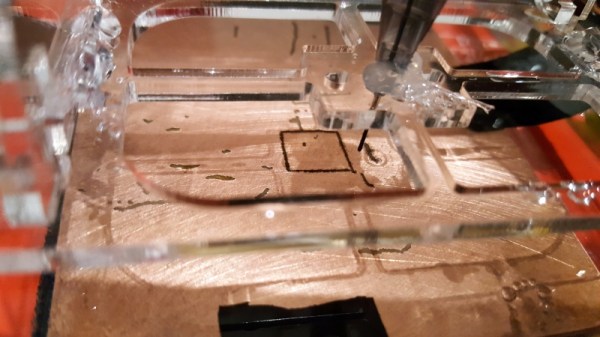
Here at Hackaday, we thought we’d seen every method of making PCBs: CNC machining, masking and etching with a variety of chemicals, laser engraving, or even the crude but effective method of scratching away the copper with a utility knife. Whatever works is fine with us, really, but there still does seem to be room for improvement in the DIY PCB field. To whit, we present rapid PCB prototyping with electrical discharge machining.

Using an electric arc to selectively ablate the copper cladding on a PCB seems like a great idea. At least that’s how it seemed to [Jake Wachlin] when he realized that the old trick of cutting a sheet of aluminum foil using a nine-volt battery and a pencil lead is really just a form of EDM, and that the layer of copper on a PCB is not a million miles different from foil. A few experiments with a bench power supply and a mechanical pencil lead showed that it’s relatively easy to blast the copper from a blank board, so [Jake] took the next logical step and rigged up an old 3D-printer to move the tool. The video below shows the setup and some early tests; it’s not perfect by a long shot, but it has a lot of promise. If he can control the arc better, this homebrew EDM looks like it could very rapidly produce prototype boards.

[Jake] posted this project in its current state in the hopes of stimulating a discussion and further experimentation. That’s commendable, and we’d really love to see this one move along rapidly. You might start your brainstorming by looking at this somewhat sketchy mains-powered EDM, or look into the whole field in a little more detail.

Continue reading “Prototyping PCBs With Electrical Discharge Machining”

Hacking The Ionosphere, For Science

Imagine what it must have been like for the first human to witness an aurora. It took a while for our species to migrate from its equatorial birthplace to latitudes where auroras are common, so it was a fairly recent event geologically speaking. Still, that first time seeing the shimmers and ribbons playing across a sky yet to be marred by light pollution must have been terrifying and thrilling, and like other displays of nature’s power, it probably fueled stories of gods and demons. The myths and legends born from ignorance of what an aurora actually represents seem quaint to most of us, but it was as good a model as our ancestors needed to explain the world around them.

Our understanding of auroras needs to be a lot deeper, though, because we now know that they are not only a beautiful atmospheric phenomenon but also a critical component in the colossal electromagnetic system formed by our planet and our star. Understanding how it works is key to everything from long-distance communication to keeping satellites in orbit to long-term weather predictions.

But how exactly does one study an aurora? Something that’s so out of reach and so evanescent seems like it would be hard to study. While it’s not exactly easy science to do, it is possible to directly study auroras, and it involves some interesting technology that actually changes them, somehow making the nocturnal light show even more beautiful.

Continue reading “Hacking The Ionosphere, For Science”

Old Nixie Display Rides Again As 3D-Printer Filament Meter

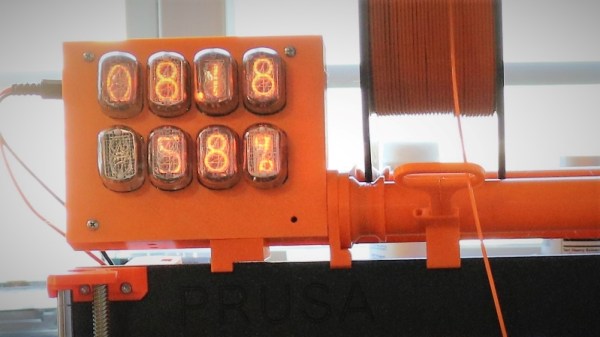
We’re not sure about the name of this Nixie tube filament meter that [Scott M. Baker] built. He calls it a “filadometer”, perhaps a portmanteau of “filament” and “odometer”, in which case it makes sense. It may not flow trippingly from the tongue and we can’t come up with anything better, but whatever moniker you use it’s actually a pretty cool build.

The filadometer started life as something completely different and utterly typical for Nixie tube projects – a temperature and humidity gauge. [Scott] decided to recycle the eight-tube display to keep track of his Prusa, and in doing so he reveals a pretty remarkable degree of forethought in his design process. The original Nixie display has all the usual trappings – the driver chips, the shift registers, and the high voltage power supply. What stands out is the modularity of his design: the tube sockets and drivers live on a backplane PCB, with a Raspberry Pi and a separate HV supply board plugging into it. The original display had a Model B Pi, so there was plenty of room for a new Zero W. A new printed case and a little programming to capture the filament use from Octoprint is all it took to put this nifty little build back in action. The video below shows the details.

We’re always excited to see new videos from [Scott] because we learn so much from looking over his virtual shoulder. If you haven’t checked out his stuff, take a look at his homage to the 8″ floppy or his dual-port memory hack for retro gaming.

Continue reading “Old Nixie Display Rides Again As 3D-Printer Filament Meter”

Robot Arms Nudge The Hands Of Time In The Strangest Clock

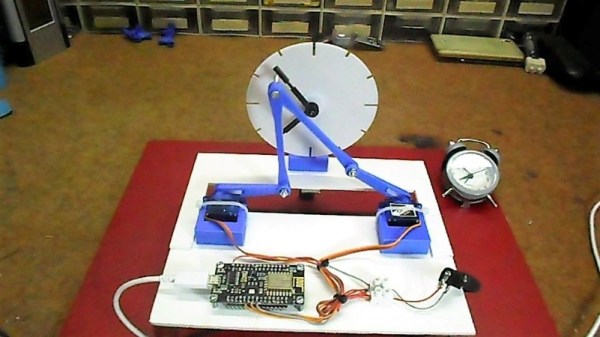
We see a lot of clocks here at Hackaday. Digital clocks, retro clocks, lots of Nixie clocks, binary clocks, and clocks that appear to be designed specifically to be unreadable. But this dual-servo kinematic clock is something we haven’t seen yet, and it’s certainly worth a mention.

[mircemk]’s idea is simple and hearkens back to grammar school days when [Teacher] put a large cardboard clock dial on the blackboard and went through the “big hand, little hand” drill. In this case, the static cardboard clock has been replaced by a 3D-printed dial and hands, while a pair of servos linked together by two arms takes the place of the teacher. The video below shows it in action; the joint in the linkage between the two servos has a screw sticking out that can be maneuvered across the clock face to reposition the hands. It’s a little jittery, though; [mircemk] might want to tune the servo loops up a bit or tighten the linkage joints to make things a little smoother.

Even with the shakes, we find it wonderfully weird and hard to stop watching. It reminds us a bit of this luminous plotting clock from a while back – same linkage, different display.

Continue reading “Robot Arms Nudge The Hands Of Time In The Strangest Clock”

LED Matrix And A Phototransistor Make A Reverse Camera

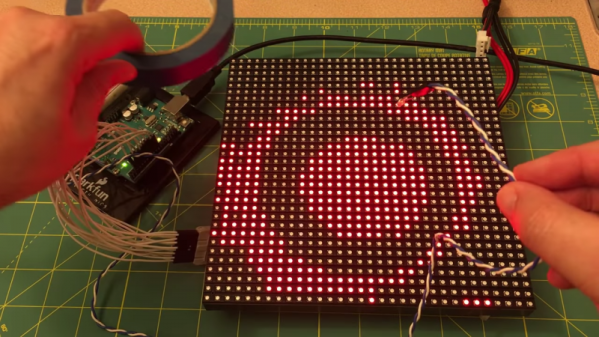
A digital camera has an array of sensors that captures light reflected or transmitted onto it. This build is something closer to a reverse camera – a single sensor that makes images on a matrix of LEDs. And we think it’s pretty neat.

We have to admit to being a little confused by [marciot]’s LED matrix scanner when we first stumbled upon it. From the video below we thought that the LEDs in the matrix were being used both to detect incident light and as a display. We’ve seen LEDs used as photodiodes before, so such a contraption could work, but that’s not what’s going on here. A phototransistor is wired to an Arduino Uno and positioned above a 32×32 RGB LED matrix. A scanning routine rasters over the LEDs in the matrix while the sensor watches, and then the program turns on the LEDs that the sensor saw during the scan. Positioned far above the matrix, a large disc of light results, making it look like the phototransistor is beaming light down onto the matrix. The effect is reinforced by placing something between the sensor and the matrix, which casts a virtual shadow. Used close to the LEDs the sensor acts more like a light pen.

It’s a cool effect and it looks like a fun project to throw together. Refresh time could perhaps be a bit snappier, though; maybe an ESP32 could help with that.

Continue reading “LED Matrix And A Phototransistor Make A Reverse Camera”