Radar In Space: The Gemini Rendezvous Radar

In families with three kids, the middle child always seems to get the short end of the stick. The first child gets all the attention for reaching every milestone first, and the third child will forever be the baby of the family, and the middle child gets lost in-between. Something similar happened with the U.S. manned space program in the 60s. The Mercury program got massive attention when America finally got their efforts safely off the ground, and Apollo naturally seized all the attention by making good on President Kennedy’s promise to land a man on the moon.

In between Mercury and Apollo was NASA’s middle child, Project Gemini. Underappreciated at the time and even still today, Gemini was the necessary link between learning to get into orbit and figuring out how to fly to the Moon. Gemini was the program that taught NASA how to work in space, and where vital questions would be answered before the big dance of Apollo.

Chief among these questions were tackling the problems surrounding rendezvous between spacecraft. There were those who thought that flying two spacecraft whizzing around the Earth at 18,000 miles per hour wouldn’t work, and Gemini sought to prove them wrong. To achieve this, Gemini needed something no other spacecraft before had been equipped with: a space radar.

Continue reading “Radar In Space: The Gemini Rendezvous Radar”

Juggling Machine Listens To The Bounce To Keep Ball In The Air

It’s a seemingly simple task: bounce a ping-pong ball on a wooden paddle. So simple that almost anyone can pick up a ball and a paddle and make a reasonable job of it. Now, close your eyes and try to do it just by the sound the ball makes when it hits the paddle. That’s a little tougher, but this stepper-driven platform juggler manages it with aplomb.

That’s not to say that the path to the finished product in the video below was a smooth one for [tkuhn]. He went through multiple iterations over the last two years, including a version that surrounded the juggling platform with a fence of phototransistors to track where the ball was at any time. That drove four stepper motors through a cross-linkage that popped the platform up at just the right moment to keep the ball moving, and at just the right angle to nudge it back toward the center of the platform. The current version of the platform does away with the optical sensors in favor of four small microphones. The mics pick up the sharp, well-defined sound of the ball hitting the platform, process the signal through an analog circuit, and use that signal to trigger a flip-flop if the signal exceeds a setpoint. An Arduino then measures the time delay between arriving signals, calculates the ball’s position on the platform, and drives the steppers through a PID loop to issue the corrective bounce.

The video below is entrancing, but we found ourselves wishing for a side view of the action too. It’s an impressive build nonetheless, one that reminds us of the many maze-runner and Stewart platform robots we’ve seen.

Continue reading “Juggling Machine Listens To The Bounce To Keep Ball In The Air”

Custom LCD Module Is Unexpectedly Cheap And Easy

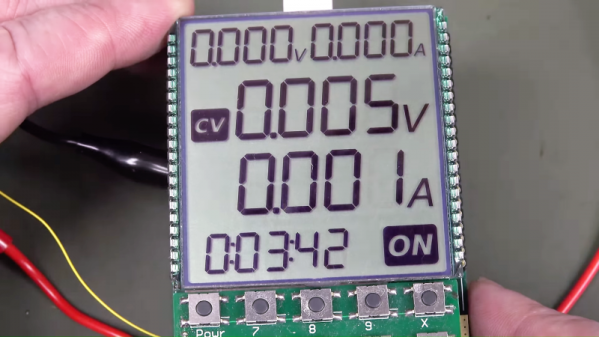
Looking to take your project to the next level in terms of functionality and appearance? A custom LCD display might be the thing that gets you there, at least compared to the dot-matrix or seven-segment displays that anyone and their uncle can buy from the usual sources for pennies. But how does one create such a thing, and what are the costs involved? As is so often the case these days, it’s simpler and cheaper than you think, and [Dave Jones] has a great primer on designing and specifying custom LCDs.

The video below is part of an ongoing series; a previous video covered the design process, turning the design into a spec, and choosing a manufacturer; another discussed the manufacturer’s design document approval and developing a test plan for the module. This one shows the testing plan in action on the insanely cheap modules – [Dave] was able to have a small run of five modules made up for only $138, which included $33 shipping. The display is for a custom power supply and has over 200 segments, including four numeric sections, a clock display, a bar graph, and custom icons for volts, amps, millijoules, and watt-hours. It’s a big piece of glass and the quality is remarkable for the price. It’s not perfect – [Dave] noted a group of segments on the same common lines that were a bit dimmer than the rest, but was able to work around it by tweaking the supply voltage a bit.

We’re amazed at how low the barrier to entry into custom electronics has become, and even if you don’t need a custom LCD, at these prices it’s tempting to order one just because you can. Of course, you can also build your own LCD display completely from scratch too.

Continue reading “Custom LCD Module Is Unexpectedly Cheap And Easy”

A Dramatic Demo Of AC Versus DC Switching

Switches seem to be the simplest of electrical components – just two pieces of metal that can be positioned to either touch each other or not. As such it would seem that it shouldn’t matter whether a switch is used for AC or DC. While that’s an easy and understandable assumption, it can also be a dangerous one, as this demo of AC and DC switching dramatically reveals.

Using a very simple test setup, consisting of an electric heater for a load, a variac to control the voltage, and a homemade switch, [John Ward] walks us through the details of what happens when those contacts get together. With low-voltage AC, the switch contacts exhibit very little arcing, and even with the voltage cranked up all the way, little more than a brief spark can be seen on either make or break. Then [John] built a simple DC supply with a big rectifier and a couple of capacitors to smooth things out and went through the same tests. Even at a low DC voltage, the arc across the switch contacts was dramatic, particularly upon break. With the voltage cranked up to the full 240-volts of the UK mains, [John]’s switch was essentially a miniature arc welder, with predictable results as the plastic holding the contacts melted. Don your welding helmet and check out the video below.

As dramatic as the demo is, it doesn’t mean we won’t ever be seeing DC in the home. It just means that a little extra engineering is needed to make sure that all the components are up to snuff.

Continue reading “A Dramatic Demo Of AC Versus DC Switching”

Fail Of The Week: How Not To Make A 3D Scanner

Sometimes the best you can say about a project is, “Nice start.” That’s the case for this as-yet awful DIY 3D scanner, which can serve both as a launching point for further development and a lesson in what not to do.

Don’t get us wrong, we have plenty of respect for [bitluni] and for the fact that he posts his failures as well as his successes, like composite video and AM radio signals from an ESP32. He used an ESP8266 in this project, which actually uses two different sensors: an ultrasonic transducer, and a small time-of-flight laser chip. Each was mounted to a two-axis scanner built from hobby servos and 3D-printed parts. The pitch and yaw axes move the sensors through a hemisphere gathering data, but unfortunately, the Wemos D1 Mini lacks the RAM to render the complete point cloud from the raw points. That’s farmed out to a WebGL page. Initial results with the ultrasonic sensor were not great, and the TOF sensor left everything to be desired too. But [bitluni] stuck with it, and got a few results that at least make it look like he’s heading in the right direction.

We expect he’ll get this sorted out and come back with some better results, but in the meantime, we applaud his willingness to post this so that we can all benefit from his pain. He might want to check out the results from this polished and pricey LIDAR scanner for inspiration.

Continue reading “Fail Of The Week: How Not To Make A 3D Scanner”

Be A Fire Bender With The Power Of Magnets

More often than you think, scientific progress starts with a simple statement: “Huh, that’s funny…” That’s the sign that someone has noticed something peculiar, and that’s the raw fuel of science because it often takes the scientist down interesting rabbit holes that sometimes lead to insights into the way the world works.

[Ben Krasnow] ended up falling down one of those rabbit holes recently with his experiments with magnets and flames. It started with his look at the Zeeman effect, which is the observation that magnetic fields can influence the spectral lines of light emitted by certain sources. In a previous video, [Ben] showed that light from a sodium lamp could be dimmed by a powerful electromagnet. Some of his viewers took exception to his setup, which used an oxy-acetylene flame doped with sodium passing through the poles of the magnet; they thought the effect observed was a simple magnetohydrodynamic effect, and not the Zeeman effect he was supposed to be testing. That led to the experiments in the video below, which started with a candle flame being strongly deflected by the magnet. [Ben] methodically worked through the problem, eliminating variables by going so far as to blow soap bubbles of various gasses within the magnet’s poles to rule out the diamagnetism of oxygen as a cause of the phenomenon. He finally showed that even hot air by itself is deflected, using a simple light bulb and a FLIR camera. It’s good stuff, and well worth a watch.

Spoiler alert: [Ben] is still scratching his head about what’s going on, and we’re looking forward to his conclusions. This isn’t his first rabbit hole expedition, of course; his experiments with creating plasma with high-pressure water were fascinating, as were his DIY superconducting ceramics. Continue reading “Be A Fire Bender With The Power Of Magnets”

The Return Of RadioShack?

We’ve been following the ups and downs of Radio Shack for a while now, and it looks like another chapter is about to be penned in the storied retailer’s biography – and not Chapter 11 bankruptcy this time.

According to the ARRL website and major media reports, up to 50 of the 147 US locations of HobbyTown, the brick-and-mortar retailer of RC and other hobby supplies, will soon host a “RadioShack Express” outlet. Each outlet will be up to 500 square feet of retail space devoted to electronic components that would be of use to HobbyTown’s core customer base, as well as other merchandise and services.

HobbyTown locations in Mooresville, North Carolina, and Ontario, Ohio, will be among the first stores to get the RadioShack Express treatment. Current employees of the franchisees will staff the store-within-a-store, which will be stocked with RadioShack merchandise purchased by the store. Stores with Express outlets will have special RadioShack branding inside and out to attract customers. There’s talk of the deal being extended chain-wide if the pilot program goes well.

Back from the Ashes?

This is obviously great news for the beleaguered electronics retailer that was once a neighborhood fixture. True, its parts selection was often less than complete, more so in recent years than in the chain’s heyday in the mid-1970s and early 1980s. And it’s true that prices were often astronomical compared to buying online. But on a Sunday afternoon, The Shack was a lifesaver for that last minute part needed to finish a project, and the premium was well worth the convenience. Watching the decline of the chain and seeing stores disappear one by one was a slow, sad process, so that makes this seems like an unqualified positive development.

But is it? On the face of it, there’s a lot of synergy between the HobbyTown offerings and what could be stocked in a RadioShack Express. I’ve never actually visited a HobbyTown myself — I plan to fix that now that I know I’ve got an outlet nearby, even if it doesn’t appear to be on the list of 50 early Express locations — so I can only go by what I see listed online for merchandise. But a store that sells every conceivable part for RC cars and planes, drones, model rockets, and STEM-related toys and kits seems a likely place to find customers for RadioShack’s offerings.

It won’t be clear until someone sees one of these Express kiosks first hand and reports back, but it seems like we might see something like the old “cabinet o’ components” that was found in the back of the most recent incarnation of RadioShack retail stores, along with a few shelves full of things like solder, wire, and tools. There may also be some items in the Arduino-Pi space, which would be really exciting, although that might run afoul of existing HobbyTown offerings. Still, one-stop shopping of everything from servos to MOSFETs would be a huge win for electronics hobbyists.

Not the Cell Phones Again!

But there may be cause for concern. Reports are that RadioShack Express locations will also offer services such as cell phone repairs. Dipping a toe into the cell phone market seemed to be the beginning of the end for RadioShack the first time through, and by the time it was clear to everyone that the chain was on death’s door, it was hard to go into a RadioShack store without being bombarded by cell phone sales pitches. To be brutally frank, I don’t take the early inclusion of cell phone repairs as an encouraging sign of the long-term viability of the RadioShack Express concept. Do we really need another place that fixes cell phones? The areas that HobbyTown stores tend to locate are rife with places that fix phones already, so I just don’t see the point. And it just smacks of the bad old days of RadioShack.

Still, I’m cautiously optimistic that this is a positive development for RadioShack, and I think it’s a win for electronics hobbyists overall. I’ll be keeping my eye on my local HobbyTown for the return of that iconic RadioShack logo, and looking forward to the day that I can pay a buck for a resistor again. Until then, if any readers happen to be near one of the combined locations when they open next week, we’d love a boots-on-the-ground report. Post your observations in the comments below, and pix or it didn’t happen.

[via r/amateurradio]