3D Printed Desk Harnesses The Power Of Fusion 360 And McMaster-Carr

Black pipe furniture is all the rage now, and for good reason — it has a nice industrial aesthetic, it’s sturdy, and the threaded fittings make it a snap to put together. But if you’ve priced out the fittings lately, you know that it’s far from cheap, so being able to 3D-print your own black pipe fittings can make desks and tables a lot more affordable.

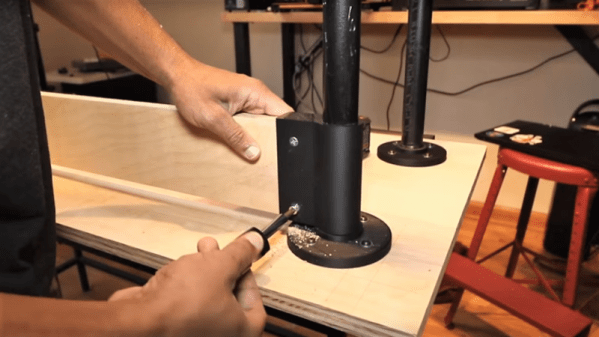
Cheapness comes at a price, of course, and [Vladimir Mariano] takes pains to point out that his desk is a light-duty piece that would likely not stand up to heavy use. But since the flange fittings used to connect the plywood top to the legs and as feet would cost about $64 all by themselves from the local home center, printing them made sense. Together with custom pieces to mount stretchers between the legs, the 3D-printed parts made for a decently sturdy base.

But the end product isn’t the main point of the video below. Thanks to the ability to browse the McMaster-Carr catalog from within Fusion 360, [Mariano] was able to seamlessly import the CAD model of a suitable iron flange and quickly modify it to his needs. The power of this feature is hard to overstate; you can literally browse through a catalog of engineered parts and print usable replicas instantly. Sure, it’s not made of metal, but it’s a huge boon to designers to be able to see how the final product would look, especially in the prototyping phase of a project.

Not familiar with McMaster-Carr? It’s an engineer’s online playground, and we covered the ins and outs of doing business with McMaster a while back.

Continue reading “3D Printed Desk Harnesses The Power Of Fusion 360 And McMaster-Carr”

Quick And Dirty Driver Tips For Surplus VFDs

Sometimes it seems like eBay is the world’s junk bin, and we mean that in the best possible way. The variety of parts available for a pittance boggles the mind sometimes, especially when the parts were once ordered in massive quantities but have since gone obsolete. The urge to order parts like these in bulk can be overwhelming, and sooner or later, you’ll find yourself with a fistful of old stuff but no idea how to put it to use.

Case in point: the box of Russian surplus seven-segment vacuum fluorescent displays (VFDs) that [w_k_fay] had to figure out how to use. The result is a tutorial on quick and dirty VFD drivers that looks pretty handy. [w_k_fay] takes pains to point out that these are practical tips for putting surplus VFDs to work, as opposed to engineered solutions. He starts with tips on characterizing your surplus tubes in case you don’t have a pinout. A 1.5 V battery will suffice for the hot cathode, while a 9 V battery will turn on the segments. The VFDs can be treated much like a common cathode LED display, and a simple circuit driving the tube with a 4026 decade counter can be seen below. He also covers the challenges of driving VFDs from microcontrollers, and promises a full build of a frequency counter wherein the mysteries of multiplexing will be addressed.

Sounds like it’s time to stock up on those surplus VFDs and put them to work. For inspiration, take a look at this minimalist VFD clock, or perhaps mix VFDs with Nixies to satisfy your urge for all things glowy.

Continue reading “Quick And Dirty Driver Tips For Surplus VFDs”

Trio Of Tips For A Cetus Printer

Thanks to the holiday gifting cycle, many homes are newly adorned with 3D printers. Some noobs are clearly in the “plug and play” camp, looking for a user experience no more complicated than installing a new 2D printer. But most of us quickly learn that adding a dimension increases the level of difficulty substantially, and tinkering ensues.

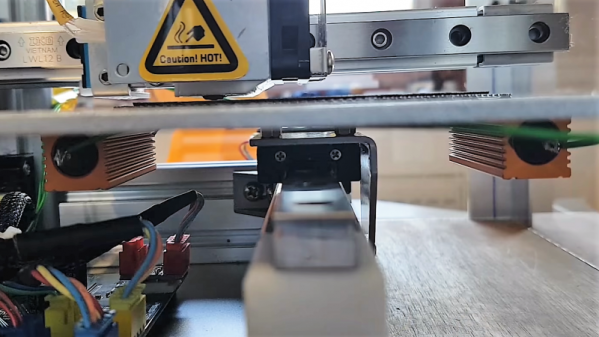
One such tinkerer, [Marco Reps], has been taking his new Cetus 3D printer to new places, and his latest video offers a trio of tips to enhance the user experience of this bare-bones but capable printer. First tip: adding a heated bed. While the company offers a heated aluminum bed for ABS and PETG printing at a very reasonable price, [Marco] rolled his own. He bolted some power resistors to the aluminum platen, built a simple controller, and used the oversized stock power supply to run everything.

To contain the heat, tip two is an enclosure for the printer. Nothing revolutionary here — [Marco] just built a quick cover from aluminum profiles and acrylic.

But the clear case allows for tip number three, the gem of this video: synchronized time-lapse photography. Unhappy with the jerky time-lapse sequences that are standard fare, he wrote a Python program that uses OpenCV to compare webcam frames and save those that are similar to the last saved frame. This results in super smooth time-lapse sequences that make it look like the print is being extruded as a unit. Pretty neat stuff.

Did you find a 3D printer under your Festivus Pole, and now you’re wondering what’s next? Check out [Tom Nardi]’s guide for 3D newbies for more tips.

Continue reading “Trio Of Tips For A Cetus Printer”

This USB Drive Will Self-Destruct After Ruining Your Computer

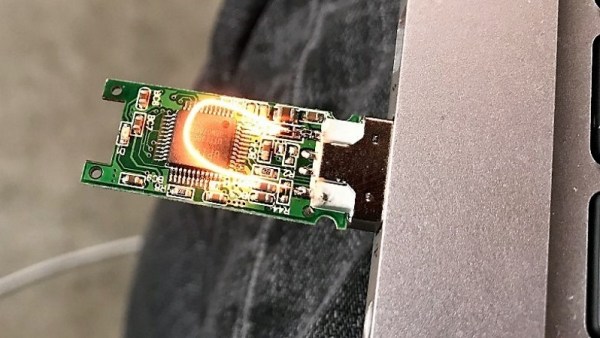
Who would have thought that you could light up pyrotechnics on USB power? This USB keystroke injector that blows up after it’s used proves the concept.

Fully aware that this is one of those “just because you can doesn’t mean you should” projects, [MG] takes pains to point out that his danger dongle is just for dramatic effect, like a prop for a movie or the stage. In fact, he purposely withholds details on the pyrotechnics and concentrates on the keystroke injection aspect, potentially nasty enough by itself, as well as the dongle’s universal payload launching features. We’re a little bummed, because the confetti explosion (spoiler!) was pretty neat.

The device is just an ATtiny85 and a few passives stuffed into an old USB drive shell, along with a MOSFET to trigger the payload. If you eschew the explosives, the payload could be anything that will fit in the case. [MG] suggests that if you want to prank someone, an obnoxious siren might be a better way to teach your mark a lesson about plugging in strange USB drives.

While this isn’t the most dangerous thing you can do with a USB port, it could be right up there with that rash of USB killer dongles from a year or so ago. All of these devices are fun “what ifs”, but using them on anything but your own computers is not cool and possibly dangerous. Watching the smoke pour out of a USB socket definitely drives home the point that you shouldn’t plug in that thumbdrive that you found in the bathroom at work, though.

Continue reading “This USB Drive Will Self-Destruct After Ruining Your Computer”

Wrecked Civic Rides Again As Cozy Camp Trailer

It may not be the typical fare that we like to feature, but you can’t say this one isn’t a hack. It’s a camp trailer fashioned from the back half of a wrecked Honda Civic, and it’s a pretty unique project.

We don’t know about other parts of the world, but a common “rural American engineering” project is to turn the bed and rear axle of an old pickup truck into a trailer. [monickingbird]’s hacked Civic is similar to these builds, but with much more refinement. Taking advantage of the intact and already appointed passenger compartment of a 1997 Civic that had a really bad day, [monickingbird] started by lopping off as much of the front end as possible. Front fenders, the engine, transmission, and the remains of the front suspension and axle all fell victim to grinder, drill, and air chisel. Once everything in front of the firewall was amputated, the problem of making the trailer safely towable was tackled. Unlike the aforementioned pickup trailers, the Civic lacks a separate frame, so [monickingbird] had to devise a way to persuade the original unibody frame members to accept his custom trailer tongue assembly. Once roadworthy, the aesthetics were tackled — replacing the original interior with a sleeping area, installing electrics and sound, and a nice paint job. Other drivers may think the towing vehicle is being seriously tailgated, but it seems like a comfy and classy way to camp.

Now that the trailer is on the road, what to do with all those spare Civic parts? Sure, there’s eBay, but how about a nice PC case featuring a dashboard gauge cluster?

Miss Beatrice Shilling Saves The Spitfire

On a bright spring morning in 1940, the Royal Air Force pilot was in the fight of his life. Strapped into his brand new Supermarine Spitfire, he was locked in mortal combat with a Luftwaffe pilot over the English Channel in the opening days of the Battle of Britain. The Spitfire was behind the Messerschmitt and almost within range to unleash a deadly barrage of rounds from the four eight Browning machine guns in the leading edges of the elliptical wings. With the German plane just below the centerline of the gunsight’s crosshairs, the British pilot pushed the Spit’s lollipop stick forward to dive slightly and rake his rounds across the Bf-109. He felt the tug of the harness on his shoulders keeping him in his seat as the nimble fighter pulled a negative-g dive, and he lined up the fatal shot.

But the powerful V-12 Merlin engine sputtered, black smoke trailing along the fuselage as the engine cut out. Without power, the young pilot watched in horror as the three-bladed propeller wound to a stop. With the cold Channel waters looming in his windscreen, there was no time to restart the engine. The pilot bailed out in the nick of time, watching his beautiful plane cartwheel into the water as he floated down to join it, wondering what had just happened.

Continue reading “Miss Beatrice Shilling Saves The Spitfire”

Cable Cutting Machine Makes Fast Work Of A Tedious Job

We’ve all been there: faced with a tedious job that could be knocked out manually with a modest investment of time, we choose instead to overcomplicate the task and build something to do it for us. Such was the impetus behind this automated wire cutter, but in this case the ends justify the means.

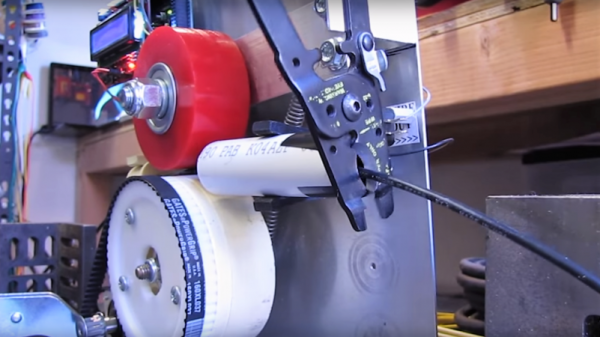
That [Edward Carlson] managed to stretch a twenty-minute session with wire cutters and a tape measure into four days of building and tweaking this machine is pretty impressive. The build process was jump-started by modifying an off-the-shelf wire measuring machine, of the kind one finds in the electrical aisle of The Big Orange Store. Stripped of the original mechanical totalizer and with a stepper added to drive the friction wheels, the machine can now measure cable by counting steps. A high-torque servo drives a stout pair of cable shears through a nifty linkage, or the machine can just measure the length of cable without cutting. [Edward]’s solution in search of a problem ends up bringing extra value, so maybe the time spent was worth it after all.

If the overall design looks familiar, you may be thinking of a similar of another cable-cutting bot we featured a while back. That one used a filament extruder and was for lighter gauge wires than this machine. Continue reading “Cable Cutting Machine Makes Fast Work Of A Tedious Job”