Lamp Analysis Tells Sad Truth Behind The Marketing Hype

Here in the northern hemisphere, winter has wrapped us in her monochromatic prison. A solid deck of gray clouds means you need a clock to tell the difference between night and day, and by about the first week of February, it gets to feeling like you’ll never see a blue sky again. It’s depressing, to be honest, and the lack of sunlight can even lead to a mood disorder known as SAD, or seasonal affective disorder.

SAD therapy is deceptively simple — bright full-spectrum light, and lots of it, to simulate the sun and stimulate the lizard brain within us. Not surprisingly, such lights are available commercially, but when [Justin Lam] bought one to help with his Vancouver blues, he decided to analyze the lamp’s output to determine whether the $70 he spent paid for therapy or marketing.

The initial teardown was not encouraging, with what appeared to be a standard CFL “curly fry” light with a proprietary base in a fancy plastic enclosure. With access to a spectrometer, [Justin] confirmed that not only does the SAD light have exactly the same spectrum as a regular CFL, the diffuser touted to provide “full UV protection” does so simply by attenuating the entire spectrum evenly so that the UV exposure falls below the standards. In short, he found that the lamp was $70 worth of marketing wrapped around a $1.50 CFL. Caveat emptor.

Hats off to [Justin] for revealing the truth behind the hype, and here’s hoping he finds a way to ameliorate his current SAD situation. Perhaps one of these DIY lamps will be effective without the gouging.

Robotic Table Saw Automates Finger Joints

We’ve all seen finger joints or box joints, those interlocking puzzle pieces that make laser-cut plywood enclosures such a fixture for DIY projects. But laser cutters make finger joints look much easier to fabricate than they are with traditional woodworking tools, which often lead to disappointing results.

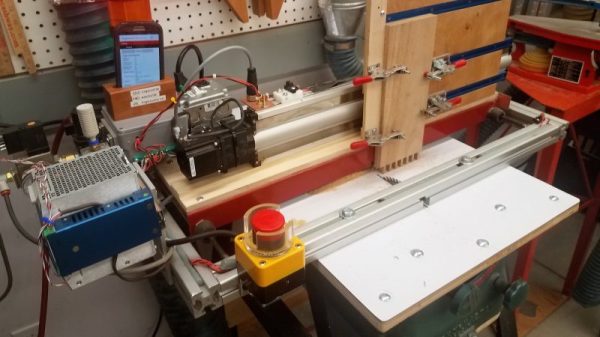
But this finger joint cutting robot is no traditional woodworking tool, and [timschefter] put a lot of work into building the rig. We have to admit that when we first saw the video below, the thought of having a table saw in our shop that could be turned on with a button on a phone gave us pause. But on closer analysis, it looks like safety was a major concern with this build. With a prominent e-stop and an interlock switch, the small table saw that forms the foundation of the robot should be safe enough. On the table top is a sled with a linear slide that moves the workpiece perpendicular to the blade, and the sled moves back and forth over the blade with pneumatic cylinders. The joint is set up with a custom app which calculates the pin width and spacing, which can be evenly distributed across the panel, or, for a bit of geeky fun, controlled to make a joint that encodes a message in Morse.

A lot of work went into this, and while it’s not the first robotic finger joint cutter we’ve seen, it’s pretty impressive. Now if it could only automate dovetails.

Continue reading “Robotic Table Saw Automates Finger Joints”

Debouncing The Old-Fashioned Way

If you were given the task of designing a computer at a time when computers weren’t really even a thing, how would you start? How would you take a collection of vacuum tubes, passive components, and a precious few germanium diodes and engineer something to sell to customers looking for an “electronic brain”?

Where there’s a paycheck, there’s a way, and computer archeologist [Ken Shirriff] laid his hands on some old IBM hardware that tells us a lot about how engineers thought in the earliest days of the computer industry. The gear is a pluggable module from IBM, one of hundreds that once went into their Model 705 computer from the mid-1950s. The particular module [Ken] has is a 5-channel contact debouncer, or in Big Blue’s mid-century parlance, a “Contact-Operated Trigger.” It was used to debounce five of the many, many mechanical contacts in the machine, both buttons and relays, and used eight dual triode tubes to do it. Other modules with the exact same footprint formed the flip-flops, inverters, buffers and clocks needed to build a computer.

[Ken]’s analysis of the debouncer is a fascinating look at what was possible with the technology of the day, and the fact that it led to a standardized framework for generic modules that were actually hot-swappable with what essentially was a zero insertion force plug was quite a feat of engineering. And as a bonus, [Ken] and friends actually got the module up in running in the video after the break.

Jonesing for more retro-computer pluggable goodness? Check out this reproduction IBM flip-flop module from the 1940s.

Continue reading “Debouncing The Old-Fashioned Way”

Behind The Scenes At A Pair Of Cell Sites

Those who fancy themselves as infrastructure nerds find cell sites fascinating. They’re outposts of infrastructure wedged into almost any place that can provide enough elevation to cover whatever gap might exist in a carrier’s coverage map. But they’re usually locked behind imposing doors and fences with signs warning of serious penalty for unauthorized access, and so we usually have to settle for admiring them from afar.

Some folks, like [Mike Fisher] aka [MrMobile], have connections, though, and get to take an up close and personal tour of a couple of cell sites. And while the video below is far from detailed enough to truly satisfy most of the Hackaday crowd, it’s enough to whet the appetite and show off a little of what goes into building out a modern cell site. [Mike] somehow got AT&T to take him up to a cell site mounted in the belfry and steeple of the 178-year old Unitarian Church in Duxbury, Massachusetts. He got to poke around everything from the equipment shack with its fiber backhaul gear and backup power supplies to the fiberglass radome shaped to look like the original steeple that now houses the antennas.

Next he drove up to Mount Washington in New Hampshire, the highest point in the northeast US and home to a lot of wireless infrastructure. Known for having some of the worst weather in the world and with a recent low of -36°F (-38°C) to prove it, Mount Washington is brutal on infrastructure, to which the tattered condition of the microwave backhaul radomes attests.

We appreciate the effort that went into this video, but again, [Mike] leaves us wanting more details. Luckily, we’ve got an article that does just that.

Continue reading “Behind The Scenes At A Pair Of Cell Sites”

A Stepper Motor For Two Dimensions

We’ve all heard linear motors, like those propelling Maglev trains, described as “unrolled” versions of regular electric motors. The analogy is apt and helps to understand how a linear motor works, but it begs the question: what if we could unroll the stator in two dimensions instead of just one?

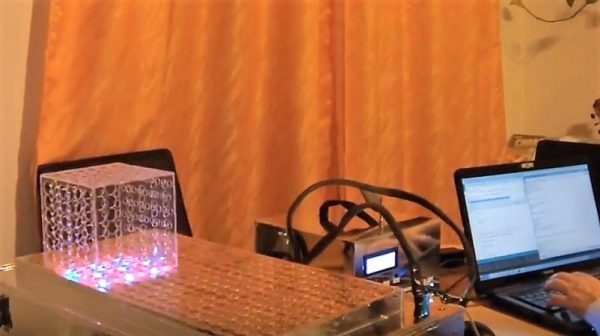
That’s the idea behind [BetaChecker’s] two-axis stepper motor, which looks like it has a lot of potential for some interesting applications. Build details are sparse, but from what we can gather from the videos and the Hackaday.io post, [BetaChecker] has created a platen of 288 hand-wound copper coils, each of which can be selectively controlled through a large number of L293 H-bridge chips and an Arduino Mega. A variety of sleds, each with neodymium magnets in the base, can be applied to the platen, and depending on how the coils are energized, the sled can move in either dimension. For vertical applications, it looks like some coils are used to hold the sled to the platen while others are used to propel it. There are RGB LEDs inside the bore of each coil, although their function beyond zazzle is unclear.

We’d love more details to gauge where this is going, but with better resolution, something like this could make a great 3D-printer bed. If one-dimensional movement is enough for you, though, check out this linear stepper motor that works on a similar principle.

Continue reading “A Stepper Motor For Two Dimensions”

First Light: The Story Of The Laser

Lasers are such a fundamental piece of technology today that we hardly notice them. So cheap that they can be given away as toys and so versatile that they make everything from DVD players to corneal surgery a reality, lasers are one of the building blocks of the modern world. Yet lasers were once the exclusive province of physicists, laboring over expansive and expensive experimental setups that seemed more the stuff of science fiction than workhouse tool of communications and so many other fields. The laser has been wildly successful, and the story of its development is an intriguing tale of observation, perseverance, and the importance of keeping good notes.

Continue reading “First Light: The Story Of The Laser”

Scrap A Hard Drive, Build A Rotary Encoder

There’s something to be said for the feel of controls. Whether it’s the satisfying snap of a high-quality switch or the buttery touch of the pots on an expensive amplifier, the tactile experience of the controls you interact with says a lot about a device.

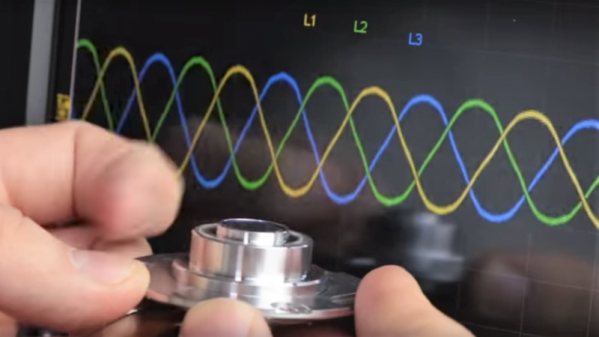
[GreatScott!] knows this, and rather than put up with the bump and grind of a cheap rotary encoder, he decided to find an alternative. He ended up exploring hard drive motors as encoders, and while the results aren’t exactly high resolution, he may be onto something. Starting with a teardown of some old HDDs — save those magnets! — [Scott!] found that the motors fell into either the four-lead or three-lead categories. Knowing that HDD motors are brushless DC motors, he reasoned that the four-lead motors had their three windings in Wye configuration with the neutral point brought out to an external connection. A little oscilloscope work showed the expected three-phase output when the motor hub was turned, with the leading and lagging phases changing as the direction of rotation was switched. Hooked to an Arduino, the motor made a workable encoder, later improved by sending each phase through a comparator and using digital inputs rather than using the Nano’s ADCs.

It looks like [GreatScott!]’s current setup only responds to a full rotation of the makeshift encoder, but we’d bet resolution could be improved. Perhaps this previous post on turning BLDC motors into encoders will help.

Continue reading “Scrap A Hard Drive, Build A Rotary Encoder”