Reed Organ MIDI Conversion Tickles All 88 Keys

What did you do in high school? Chances are it wasn’t anywhere near as cool as turning a reed organ into a MIDI device. And even if you managed to pull something like that off, did you do it by mechanically controlling all 88 keys? Didn’t think so.

A reed organ is a keyboard instrument that channels moving air over sets of tuned brass reeds to produce notes. Most are fairly complex affairs with multiple keyboards and extra controls, but the one that [Willem Hillier] scored for free looks almost the same as a piano. Even with the free instrument [Willem] is about $500 into this project. Almost half of the budget went to the solenoids and driver MOSFETs — there’s a solenoid for each key, after all. And each one required minor surgery to reduce the clicking and clacking sounds that don’t exactly contribute to the musical experience. [Willem] designed custom driver boards for the MOSFETs with 16 channels per board, and added in a couple of power supplies to feed all those hungry solenoids and the three Arduinos needed to run the show. The video below shows the organ being stress-tested with the peppy “Flight of the Bumblebee”; there’s nothing wrong with a little showing off.

[Willem]’s build adds yet another instrument to the MIDI fold. We’ve covered plenty before, from accordions to harmonicas and even a really annoying siren.

Continue reading “Reed Organ MIDI Conversion Tickles All 88 Keys”

Doppler Module Teardown Reveals The Weird World Of Microwave Electronics

Oscillators with components that aren’t electrically connected to anything? PCB traces that function as passive components based solely on their shape? Slots and holes in the board with specific functions? Welcome to the weird and wonderful world of microwave electronics, brought to you through this teardown and analysis of a Doppler microwave transceiver module.

We’ve always been fascinated by the way conventional electronic rules break down as frequency increases. The Doppler module that [Kerry Wong] chose to pop open, a Microsemi X-band transceiver that goes for about $10 on eBay right now, has vanishingly few components inside. One transistor for the local oscillator, one for the mixer, and about three other passives are the whole BOM. That the LO is tuned by a barium titanate slug that acts as a dielectric resonator is just fascinating, as is the fact that PB traces can form a complete filter network just by virtue of their size and shape. Antennas that are coupled to the transceiver through an air gap via slots in the board are a neat trick too.

[Kerry] analyzes all this in the video below and shows how the module can be used as a sensor. If you need a little more detail on putting these modules to work, we’ve got some basic circuits you can check out.

Continue reading “Doppler Module Teardown Reveals The Weird World Of Microwave Electronics”

A Ham Radio Go-Box Packed With Functionality

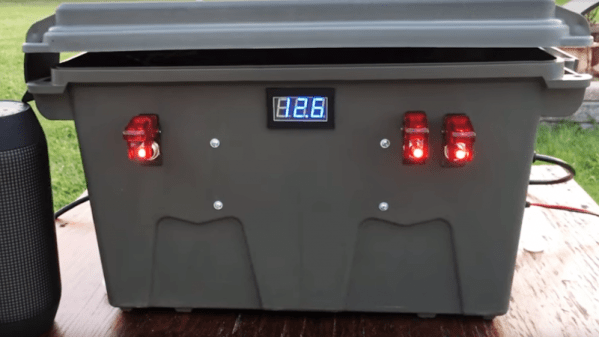
“When all else fails, there’s ham radio.” With Hurricane Harvey just wrapping up, and Irma queued up to clobber Florida this weekend, hams are gearing up to pitch in with disaster communications for areas that won’t have any communications infrastructure left. And the perfect thing for the ham on the go is this ham shack in a box.

Go-boxes, as they are known, have been a staple of amateur radio field operations for as long as there have been hams. The go-box that [Fuzz (KC3JGB)] came up with is absolutely packed with goodies that would make it a perfect EmComm platform. The video tour below is all we have to go on, but we can see a tri-band transceiver, an RTL-SDR dongle and a Raspberry Pi with a TFT screen for tracking satellites. The Pi and SDR might also be part of a NOAA satellite receiver like the one [Fuzz] describes in a separate video; such a setup would be very valuable in natural disaster responses. Everything is powered by a 12-volt battery which can be charged from a small solar panel.

[Fuzz] is ready for action, and while we genuinely hope he and other hams won’t be needed in Florida, it doesn’t seem likely at this point. You can read more about the public service face of ham radio, or about an even more capable go-box.

Continue reading “A Ham Radio Go-Box Packed With Functionality”

Your Work Won’t Move With A Magnetic Drill Press Vise

Setting up your workpiece is often the hardest part of any machining operation. The goal is to secure the workpiece so it can’t move during machining in such a way that nothing gets in the way of the tooling. Magnetic chucks are a great choice for securely and flexibly holding down workpieces, as this simple shop-built electromagnetic vise shows.

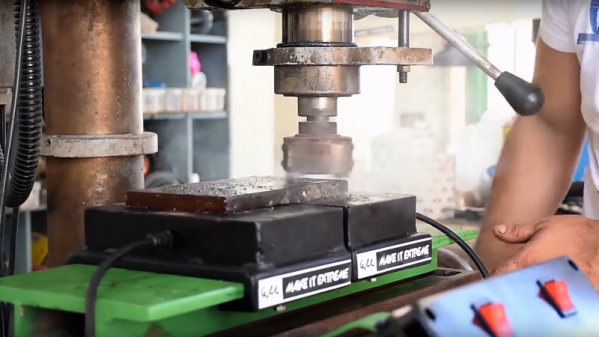
It looks like [Make It Extreme] learned a thing or two about converting microwave oven transformers to electromagnets when they built a material handling crane for the shop. Their magnetic vise, designed for a drill press but probably a great choice for securing work to a milling machine, grinder, or even a CNC router, has a simple but sturdy steel frame. Two separate platforms slide on the bed of the vise, each containing two decapitated MOTs. Wired to mains power separately for selective control and potted in epoxy, the magnets really seem to do the job. The video below shows a very thick piece of steel plate cantilevered out over one magnet while having a hole cut; that’s a lot of down force, but the workpiece doesn’t move.

Like the idea of a shop-made vise but would rather go the old-fashioned way? Check out [Make It Extreme]’s laminated bench vise, which also makes an appearance in this video.

Continue reading “Your Work Won’t Move With A Magnetic Drill Press Vise”

This Electric Longboard Collapses For Air Travel

How do you manage to get an electric off-road longboard past TSA and onto an international flight? Simple — make it a collapsible longboard that fits into a carry-on bag.

The mechanical and electrical feats accomplished by [transistor-man] may not be the most impressive parts of this hack. We’re pretty impressed by the build, starting as it did with the big knobby tires and front truck from an unused mountain board and the hub motor from a hoverboard, turning this into a trike. The incredible shrinking chassis comes courtesy of a couple of stout drawer slides and cam locks to keep it locked in place; collapsed, the board fits in a carry on bag. Expanded, it runs like a dream, as the video below shows.

But we think the really interesting part of this hack is the social engineering [transistor-man] did to ensure that the authorities wouldn’t ground his creation for electrical reasons. It seems current rules limit how big a battery can be and how many of them can be brought on a flight, so there was a lot of battery finagling before his creation could fly.

Electric longboards look like a real kick, whether they be all-aluminum or all-plastic, or even all-LEGO. This one, which went from concept to complete a week and a half before the flight, really raises the bar.

Continue reading “This Electric Longboard Collapses For Air Travel”

Knowing What’s Below: Buried Utility Location

We humans have put an awful lot of effort into our infrastructure for the last few centuries, and even more effort into burying most of it. And with good reason — not only are above ground cables and pipes unsightly, they’re also vulnerable to damage from exposure to the elements. Some utilities, like natural gas and sanitary sewer lines, are also dangerous, or at least perceived to be so, and so end up buried. Out of sight, out of mind.

But humans love to dig, too, and it seems like no sooner is a paving project completed than some joker with a jackhammer is out there wrecking the pristine roadway. Before the construction starts, though, cryptic markings will appear on the pavement courtesy of your local buried utility locating service, who apply their rainbow markings to the ground so that nothing bad happens to the often fragile infrastructure below our feet.

Continue reading “Knowing What’s Below: Buried Utility Location”

Ask Hackaday: How Small Is Your Shop?

Electronics, metalwork, carpentry, sewing — however you express your inner hacker, you’ve got to have a place to work. Most of us start out small, assembling projects on the kitchen table, or sharing space on a computer desk. But eventually, if we’re lucky, we all move on to some kind of dedicated space. My first “shop” was a corner of the basement my Dad used for his carpentry projects. He built me what seemed at the time like a huge bench but was probably only about five feet long. Small was fine with me, though, and on that bench I plotted and planned and drew schematics and had my first real lesson in why you don’t reach for a soldering iron without looking first. My thumb still bears that scar as a reminder.

Many of us outgrow that first tiny space eventually, as projects (and accumulated junk) outpace the available space. Some of us go on to build workspaces to die for; personally, I feel wholly inadequate whenever I see Frank Howarth’s immense wood shop, with its high ceilings, huge windows for natural light, and what amounts to a loading dock. Whenever I see it I think The work I could do in there!

Or could I? Is bigger necessarily better when it comes to workspaces? Would more space make me a better craftsman?

Continue reading “Ask Hackaday: How Small Is Your Shop?”