Cutting Paper And Corners In Animation

Cutting every corner can lead to some shoddy projects, but [Terry Gilliam] shows us that cutting the right corners yields unforgettable animations when mixed with the right amount of quirky imagination. The signature animation style of Monty Python’s Flying Circus is a mixture of [Terry]’s artistic craft and doing it with as little work as possible. You can watch after the break.

For [Terry], cutout animation is the quickest and easiest way he knows to convey an idea, a joke, or a story. With his vocal repertoire, even the sound effects can be produced in a basement studio. Sometimes, he makes the artwork himself and sometimes he relies on found-media in magazines or print. Both of these resources have vast digital counterparts for the betterment or detriment of animators.

Cutout animations have limitations such as jerky movement and the signature paper-on-a-background look, but that didn’t stop South Park. Textures and gradients can be used, unlike traditional animation which leverages a simplified color palette so you can pick your poison.

If your story or idea is held back because it can’t be expressed, maybe it needs a cutout animation kick in the right direction, and it couldn’t hurt to illustrate your 2018 Hackaday Prize submissions. At the opposite end of the tech spectrum, we have an animation made with 3D printed objects.

Continue reading “Cutting Paper And Corners In Animation”

Super-Blue CNC Part Fixturing

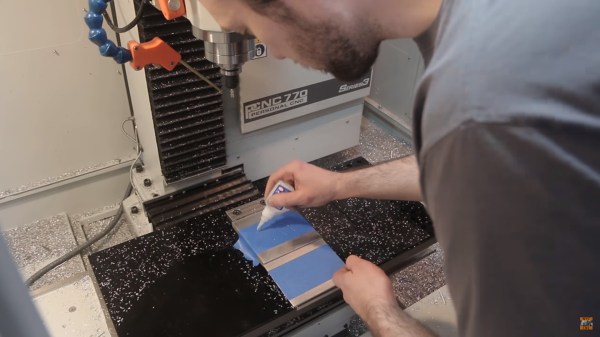
Simple clamps are great if you need to keep the pressure on two parallel surfaces, but if you have an irregular plane, or you need to cut through it, clamps are not the correct tool. The folks at [NYC CNC] feature a video with a clever hack borrowing from other disciplines. Painters tape is applied to the top of a level mounting surface in the machine and then burnished. The same is done to the bottom of the workpiece. Superglue is drizzled between the tape layers and pressed together so now the stock is held firmly below the toolhead.

Some parts are machined in the video, which can be seen below, and the adhesion holds without any trouble. One of the examples they cut would be difficult to hold without damage or stopping the machine. The accepted wisdom is that superglue holds well to a slightly porous surface like tape, but it doesn’t like do as well with smooth surfaces like metal. Removing residue-free tape at the end of a cut is also cleaner and faster than glue any day.

If you have yet to cut your teeth, you can watch our very own Elliot Williams getting introduced to CNC machines or a portable machine even a child can use.

Continue reading “Super-Blue CNC Part Fixturing”

Car Revival According To Tesla

Frankencars are built from the parts of several cars to make one usable vehicle. [Jim Belosic] has crossed the (finish) line with his Teslonda. In the most basic sense, it is the body of a Honda Accord on top of the drive train of a Tesla Model S. The 1981 Honda was the make and model of his first car, but it wasn’t getting driven. Rather than sell it, he decided to give it a new life with electricity, just like Victor Frankenstein.

In accord with Frankenstein’s monster, this car has unbelievable strength. [Jim] estimates the horsepower increases by a factor of ten over the gas engine. The California-emissions original generates between forty and fifty horsepower while his best guess places the horsepower over five-hundred. At this point, the Honda body is just holding on for dear life. Once all the safety items, like seatbelts, are installed, the driver and passengers will be holding on for the same reason.

This kind of build excites us because it takes something old, and something modern, and marries the two to make something in a class of its own. And we hate to see usable parts sitting idle.

Without a body, this electric car scoots around with its driver all day, and this Honda doesn’t even need the driver inside.

Continue reading “Car Revival According To Tesla”

“Attempt” At Wristwatch Is A Solid Success

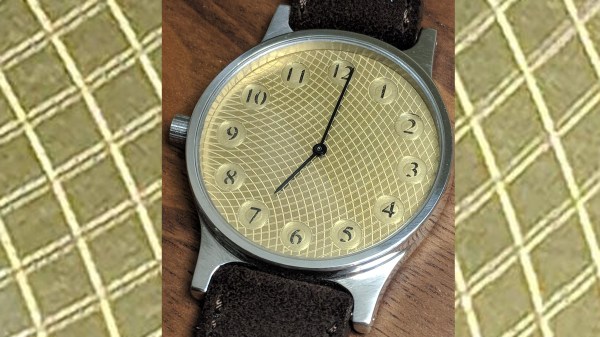
Sometimes silence is the best compliment to a DIY project, and that doesn’t just apply to homemade lockjaw toffee. When a watch is so well-made that it looks like one from a jewelry store, it is easy to keep quiet. [ColinMerkel] took many pictures of his fourth wristwatch attempt but “attempt” is his word because we call this a success. This time around he didn’t forget the crown for adjusting the time so all the pieces were in place.

His second “attempt” at wristwatch making was featured here and it had a classical elegance. Here, the proverbial game has been stepped up. Instead of using stock steel, the body is constructed of 303 stainless steel. The watch dial will definitely draw compliments if its DIY nature is revealed, which is equally mathematical and charming. Pictures of this process were enough to convey the build without words which is always a bonus if you only want a quick look or English isn’t your first choice for language.

Not only is [Colin] an upstanding horologist, he has a reputation with aftermarket door security and a looping guitar pedal.

What To Do With Your Brand New Ultrasonic Transducer

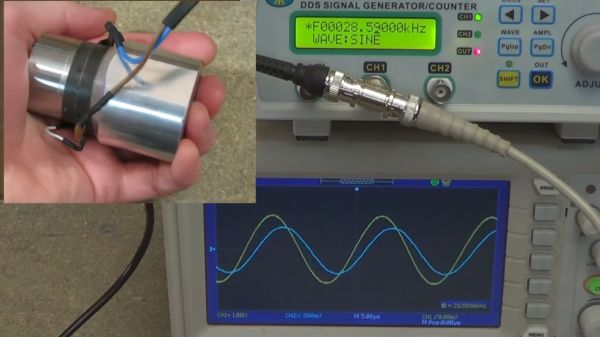
We wager you haven’t you heard the latest from ultrasonics. Sorry. [Lindsay Wilson] is a Hackaday reader who wants to share his knowledge of transducer tuning to make tools. The bare unit he uses to demonstrate might attach to the bottom of an ultrasonic cleaner tank, which have a different construction than the ones used for distance sensing. The first demonstration shows the technique for finding a transducer’s resonant frequency and this technique is used throughout the video. On the YouTube page, his demonstrations are indexed by title and time for convenience.

For us, the most exciting part is when a tuned transducer is squeezed by hand. As the pressure increases, the current drops and goes out of phase in proportion to the grip. We see a transducer used as a pressure sensor. He later shows how temperature can affect the current level and phase.

Sizing horns is a science, but it has some basic rules which are well covered. The basic premise is to make it half of a wavelength long and be mindful of any tools which will go in the end. Nodes and antinodes are explained and their effects demonstrated with feedback on the oscilloscope.

We have a recent feature for an ultrasonic knife which didn’t cut the mustard, but your homemade ultrasonic tools should be submitted to our tip line.

Continue reading “What To Do With Your Brand New Ultrasonic Transducer”

Learn Programming From Ants

Humans and insects think on a different scale, but entomologists study the behavior of these little organisms, so they’re not a complete mystery. There isn’t much intelligence in a single ant or a cubic millimeter of gray matter, but when they all start acting together, you get something greater than the sum of the parts. It is easy to fall into the trap of putting all the intelligence or programming into a single box since that’s how we function. Comparatively, itty-bitty brains, like microcontrollers and single-board computers are inexpensive and plentiful. Enter swarm mentality, and new tasks become possible.

[Kevin Hartnett] talks about a paper researching the simple rules which govern army ants who use their bodies as bridges when confronted with a gap in their path. Anyone with a ruler and a map can decide the shortest route between two places, but army ants perform this optimization from the ground, real-time, and with only a few neurons at their disposal. Two simple rules control bridge building behavior, and that might leave some space in the memory banks of some swarm robots.

A simpler example of swarm mentality could be robots which drive forward anytime they sense infrared waves from above. In this way, anyone watching the swarm could observe when an infrared light was present and where it was directed. You could do the same with inexpensive solar-powered toy cars, but we can already see visible light.

We’re not saying ants should be recruited to control robots, but we’re not objecting to the humane treatment of cyborg bugs either. We’ve been looking into swarm robots for a long time.

Thanks for the tip, [JRD].

Continue reading “Learn Programming From Ants”

Speaking The Same Language As A Wireless Thermometer

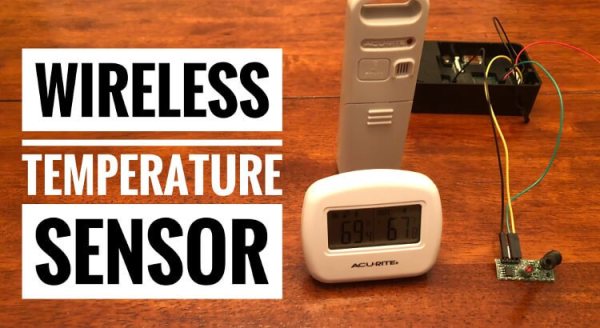
Temperature is a delicate thing. Our bodies have acclimated to a tight comfort band, so it is no wonder that we want to measure and control it accurately. Plus, heating and cooling are expensive. Measuring a single point in a dwelling may not be enough, especially if there are multiple controlled environments like a terrarium, pet enclosure, food storage, or just the garage in case the car needs to warm up. [Tim Leland] wanted to monitor commercially available sensors in several rooms of his house to track and send alerts.

The sensors of choice in this project are weather resistant and linked in his project page. Instead of connecting them to a black box, they are linked to a Raspberry Pi so your elaborate home automation schemes can commence. [Tim] learned how to speak the thermometer’s language from [Ray] who posted about it a few years ago.

The system worked well, but range from the receiver was only 10 feet. Thanks to some suggestions from his comments section, [Tim] switched the original 433MHz receiver for a superheterodyne version. Now the sensors can be a hundred feet from the hub. The upgraded receiver is also linked on his page.

We’ve delved into thermocouple reading recently, and we’ve featured [Tim Leland] and his 433MHz radios before.