Controlling A Broken Super Nintendo With MIDI

A Super Nintendo that has trouble showing sprites doesn’t make for a very good game system. As it turns out, Super Mario World is a lot less fun when the titular hero is invisible. So it’s no surprise that [jwotto] ended up tossing this partially functional SNES into the parts bin a few years back.

But he recently came up with a project that may actually benefit from its unusual graphical issues; turning the glitched console into a circuit bent video synthesizer. The system was already displaying corrupted visuals, so [jwotto] figured he’d just help things along by poking around inside and identifying pins that created interesting visual effects when shorted out.

Installing the new electronics into the SNES.

Once he mapped out the pins, he wired them all up to a transistor switching board that he’d come up with for a previous project. That would let an Arduino short out the pins on command while still keeping the microcontroller relatively isolated from the SNES. Then it was just a matter of writing some code that would fire off the transistors based on MIDI input.

The end result is a SNES that creates visual glitches along with the music, which [jwotto] can hook up to a projector when he does live shows. A particularly neat feature is that each game responds in its own way, so he can swap out the cartridge to show completely different visuals without having to change any of the MIDI sequencing.

A project like this serves as a nice introduction to both circuit bending and MIDI hacking for anyone looking to get their digital feet wet, and should pair nicely with the MIDI Game Boy Advance.

Continue reading “Controlling A Broken Super Nintendo With MIDI”

Falcon 9 Lamp Is Touching Down In The Living Room

Many of us have been inspired by the videos of the Falcon 9 booster, tall as an office building, riding a pillar of flame down to a pinpoint landing at Kennedy Space Center or on one of SpaceX’s floating landing pads in the ocean. It’s not often that we get to see science fiction fantasy become reality on such a short timescale, and while they might not be sold on the practicality of reusable rockets, even the most skeptical of observers have to admit it’s an incredible feat of engineering.

Though it can’t quite compare to the real thing, this 1:60 scale Falcon 9 lamp by [Sir Michael II] promises to bring a little of that excitement home every time you flick on the light. Combining a scratch built model of the reusable booster with some RGB LEDs, the hovering tableau recreates the tense final seconds before the towering rocket comes to a rest on its deployable landing legs. We imagine those last moments must seem like an eternity for the SpaceX engineers watching from home as well.

The LED “exhaust” without the fluff.

[Michael] walks readers through assembling the Falcon 9 model, which cleverly uses a 2 inch white PVC pipe as the fuselage. After all, why waste the time and material printing a long white cylinder when you can just buy one at the hardware store for a few bucks?

Dressed up with 3D printed details from Thingiverse user [twuelfing] and splashed with a bit of paint, it makes for a very convincing model. While the diameter of the pipe isn’t quite right for the claimed 1:60 scale, unless Elon Musk is coming over your place to hang out, we don’t think anyone will notice.

The rocket is attached to the pad with a piece of threaded steel rod, around which [Michael] has wrapped one meter of RGB LEDs controlled by an Arduino Uno. With some polyester fiber filler as a diffuser and a bit of code to get the LEDs flickering, he’s able to produce a realistic “flame” that looks to be coming from the Falcon 9’s center engine. While we admit it may not make a very good lamp in the traditional sense, it certainly gets extra points for style.

We’ve actually seen a similar trick used before to light up the engines of a LEGO Saturn V and Apollo Lunar Module. It’s amazing how realistic the effect can be, and we’d love to see it used more often. We’d also like to see more model rockets that actually levitate over their pads, but one step at a time.

Radon Monitor Recreates Steam Gauge With E-Ink

While the full steampunk aesthetic might be a bit much for most people, those antique gauges do have a certain charm about them. Unfortunately, implementing them on a modern project can be somewhat tricky. Even if you’ve got a stock of old gauges laying around, you’ve still got to modify the scale markings and figure out how to drive them with digital electronics. While we’ve seen plenty of people do it over the years, there’s no debating it’s a lot harder than just wiring up an I2C display.

But maybe it doesn’t have to be. With his Rad-O-Matic, [Hans Jørgen Grimstad] created a pretty convincing “analog” gauge using a small e-ink panel. Of course it won’t fool anyone who gives it a close look, but at a glance, you could certainly be forgiven for thinking it was some kind of vintage indicator. Especially with the cracked and stained Fresnel lens he put in front of it.

For this project [Hans] used a LilyGo T5, which combines an ESP32 with a 2.13 inch electronic paper display. These are presumably meant to be development boards for digital signage applications, but they occasionally show up in hacker projects since they’re so easy to work with. The board pulls data from a RD200M radon sensor over a simple UART connection, and the current reading is indicated by a “needle” that moves across a horizontal scale on the display.

On its own, it wouldn’t look very vintage. In fact, quite the opposite. But [Hans] really helped sell the look on this project by designing and 3D printing a chunky enclosure and then weathering it to make it look like it’s been kicking around since the Cold War.

If you don’t feel like faking it, we’ve seen some very impressive projects based on authentic vintage gauges. As long as you don’t mind tearing up hardware that’s likely older than you are, putting in the extra effort necessary for a convincing modification can really pay off.

[Thanks to Tarjei for the tip.]

This Ruggedized Raspberry Pi Was Built To Be Copied

Over the last couple of years, we’ve seen a wave of impressive rugged mobile computing devices based on the ubiquitous Raspberry Pi. Sometimes they involve repurposing an existing heavy duty enclosure, and in others the Pi takes up residence in a 3D printed case which may or may not be as strong as it appears. In either event, they usually don’t lend themselves to duplication because of the time and expense involved in tracking down or printing all the parts required.

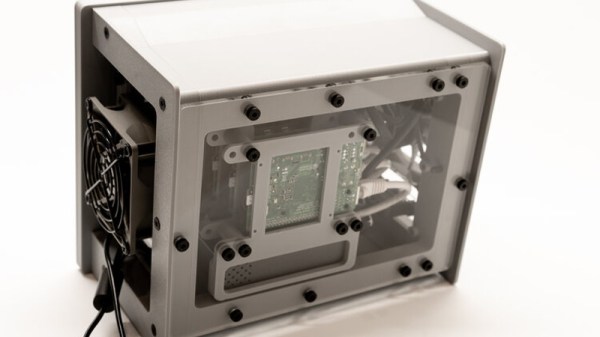
But the Raspberry Pi Quick Kit by [Jay Doscher] may change that. It represents what must surely be the simplest and fastest route to a building a rugged mobile ARM computer for your hacking adventures. Beyond the Pelican 1150 case that serves as the outer enclosure, you only need three printed parts and a handful of fasteners to complete the build. Of course you’ll need a Raspberry Pi and the official touch screen as well, but that’s sort of a given.

Electronics mounted to the 3D printed frame.

All of the electronics mount onto the three piece 3D printed frame, which is then press-fit into the opening of the Pelican case. Since you don’t need to pop any holes through the case itself, the assembled unit remains water and air tight. While [Jay] has recently shown off a very impressive 3D printed Pi enclosure, there’s really no beating a legitimate heavy duty storage case if you’re trying to protect the hardware.

When you want to use the Pi, just open the case and plug your power and accessories into the panel mount connectors under the display. There’s no integrated battery or keyboard on this build, but considering how small it is, that shouldn’t really come as a surprise.

[Jay] is targeting the Pi 4 for the Quick Kit, so that means WiFi and Bluetooth will come standard without the need for any external hardware. It looks like there might just be enough room to include an RTL-SDR receiver inside the case as well, but you’ll need to do a little redesigning of the 3D printed parts. If you do modify this design to pack in a few new tricks, we’d love to hear about it.

The Quick Kit is a greatly simplified version of the Raspberry Pi Recovery Kit that [Jay] unleashed on an unsuspecting world late last year. We’ve seen numerous variations on that original design sprout up since then, so we’re very interested to see what the response will be like to this much cheaper and easier to build version.

Finalists Announced For The 2020 Hackaday Prize

In light of everything going on in 2020, the 7th annual Hackaday Prize is devoted to nurturing ideas that could literally help change the world. In a first, we partnered with several nonprofits to help identify some of today’s most difficult problems, ranging from conservation and disaster relief to the need for advanced assistive technology. With over $200,000 up for grabs, including microgrants to help teams work full-time on their projects, this year’s competition was designed to help bring critical solutions to fruition which otherwise might never see the light of day.

But it hasn’t been easy. The global pandemic has made it far more difficult to collaborate on projects in the way we’re all used to, parts have become harder to source, and many makers found themselves so engaged with grassroots efforts to combat COVID-19 that they found little time for anything else. But despite all of this uncertainty, we received hundreds of incredible entries from all over the globe.

It’s never easy to select who will move on to the next round of the competition. But with the help of our nonprofit partners, the panel of expert judges was able to whittle the list of entries down to the 34 finalists that produced some of the most impressive and impactful ideas the Hackaday Prize has ever seen. Let’s take a look at just a few of the projects that will be vying for the top prizes in November.

Continue reading “Finalists Announced For The 2020 Hackaday Prize”

Floating Spaceports For Future Rockets

While early prototypes for SpaceX’s Starship have been exploding fairly regularly at the company’s Texas test facility, the overall program has been moving forward at a terrific pace. The towering spacecraft, which CEO Elon Musk believes will be the key to building a sustainable human colony on Mars, has gone from CGI rendering to flight hardware in just a few short years. That’s fast even by conventional rocket terms, but then, there’s little about Starship that anyone would dare call conventional.

An early Starship prototype being assembled.

Nearly every component of the deep space vehicle is either a technological leap forward or a deviation from the norm. Its revolutionary full-flow staged combustion engines, the first of their kind to ever fly, are so complex that the rest of the aerospace industry gave up trying to build them decades ago. To support rapid reusability, Starship’s sleek fuselage abandons finicky carbon fiber for much hardier (and heavier) stainless steel; a material that hasn’t been used to build a rocket since the dawn of the Space Age.

Then there’s the sheer size of it: when Starship is mounted atop its matching Super Heavy booster, it will be taller and heavier than both the iconic Saturn V and NASA’s upcoming Space Launch System. At liftoff the booster’s 31 Raptor engines will produce an incredible 16,000,000 pounds of thrust, unleashing a fearsome pressure wave on the ground that would literally be fatal for anyone who got too close.

Which leads to an interesting question: where could you safely launch (and land) such a massive rocket? Even under ideal circumstances you would need to keep people several kilometers away from the pad, but what if the worst should happen? It’s one thing if a single-engine prototype goes up in flames, but should a fully fueled Starship stack explode on the pad, the resulting fireball would have the equivalent energy of several kilotons of TNT.

Thanks to the stream of consciousness that Elon often unloads on Twitter, we might have our answer. While responding to a comment about past efforts to launch orbital rockets from the ocean, he casually mentioned that Starship would likely operate from floating spaceports once it started flying regularly:

While history cautions us against looking too deeply into Elon’s social media comments, the potential advantages to launching Starship from the ocean are a bit too much to dismiss out of hand. Especially since it’s a proven technology: the Zenit rocket he references made more than 30 successful orbital launches from its unique floating pad.

Continue reading “Floating Spaceports For Future Rockets”

World Radio Lets Your Fingers Do The Walking

Listening to radio from distant countries used to take a shortwave rig, but thanks to the Internet we can now pull in streams from all over the globe from the comfort of our own desktop. With a few clicks you can switch between your local news station and the latest in pop trends from Casablanca. But as convenient as online streaming might be, some folks still yearn for the traditional radio experience.

For those people, the Raspberry Pi World Radio by [Abraham Martinez Gracia] might be the solution. Built into the body of a 1960s Invicta radio, this Internet radio uses a very unique interface. Rather than just picking from a list of channels, you use the knobs on the front to pan and zoom around a map of the world. Streaming channels are represented by bubbles located within their country of origin, so you’ll actually have to “travel” there to listen in. The video after the break gives a brief demonstration of how it works in practice.

We’ll admit it might become a bit tedious eventually, but from a visual standpoint, it’s absolutely fantastic. [Abraham] even gave the map an appropriately vintage look to better match the overall aesthetic. Normally we’d say using a Raspberry Pi 4 to drive a streaming radio player would be a bit overkill, but considering the GUI component used here, it’s probably the right choice.

Of course we’ve seen Internet radios built into vintage enclosures before, and we’ve even seen one that used a globe to select the station, but combining both of those concepts into one cohesive project is really quite an accomplishment.

Continue reading “World Radio Lets Your Fingers Do The Walking”