You’ll Flip For This Toggle Switch Handheld Game

Teacher says that every time a toggle switch clunks, a hacker gets their wings. Or something like that. All we know is that there are few things the hardware tinkerer likes more than the satisfying action of a nice flip. Which by extension means this handheld game built by [Roman Revzin] and controlled by nothing more than three toggle switches will likely be a big hit at the hackerspace.
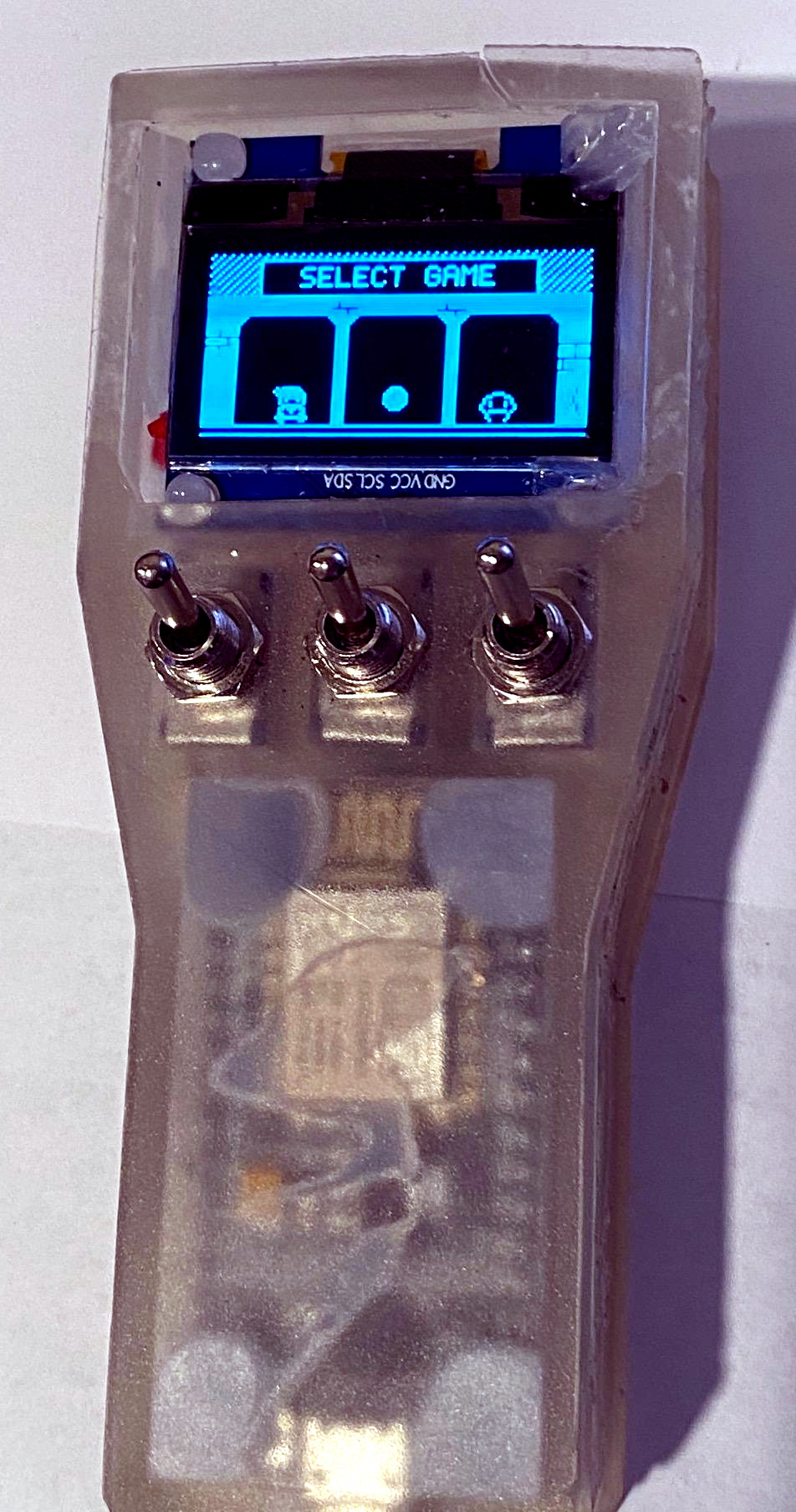
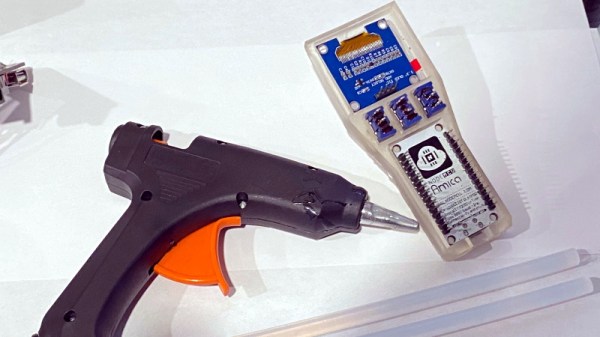
The parts list for this game, which [Roman] calls the ToggleBoss, is about as short as it gets. There’s a NodeMCU ESP8266 development board, a common SH1106 OLED display, and a trio of suitably clunky toggle switches. Add a bit of wire, toss it all into a 3D printed enclosure, and you’re halfway to thumb flicking nirvana.

Naturally, you might be wondering about the sort of games that can be played with three latching digital inputs; after all, it’s not exactly the most conventional controller layout. But there is where ToggleBoss really shines. Instead of trying to shoehorn traditional games into an exceptionally unconventional system, [Roman] has come up with several games which really embrace the limited input offered to the user.

In a platforming game not unlike the classic Mario Bros, the positions of the physical switches are mapped to virtual walls that are raised and lowered to control a character’s movement through the level. Another game shows the player three dots which correspond to the intended switch states, which they have to match as quickly and as accurately as possible. [Roman] has released the source code to his current lineup of games, which hopefully will inspire others to try their hand at creating software for this fascinating little system.

With the availability of cheap OLED displays and powerful microcontrollers, we’ve started to see more of these bespoke gaming systems. While some will undoubtedly prefer a pocket full of Nintendo’s classics, we think there’s something special about a game system that you can truly call your own.


Teardown: Cobra XRS 9740 Radar Detector

Drivers with a lead foot more often than not have Waze open on their phone so they can see if other drivers have spotted cops up ahead. But avoiding a speeding ticket used to involve a lot more hardware than software. Back before the smartphone revolution, that same driver would have had a radar detector on their dashboard. That’s not to say the gadgets are completely unused today, but between their relatively high cost (one of the top rated models on Amazon as of this writing costs over $300) and the inevitable false positives from so many vehicles on the road having their own radar and LIDAR systems, they’ve certainly become a less common sight over the years

The subject of today’s teardown is a perfect example of “Peak Radar Detector”. Manufactured back in 2007, the Cobra XRS 9740 would have been a fairly mid-range entry offering the sort of features that would have been desirable at the time. Over a decade ago, having an alphanumeric display, voice alerts, and a digital compass were all things worth shouting about on the box the thing was sold in. Though looking like some kind of Cardassian warship was apparently just an added bonus.

As the name implies these devices are primarily for detecting radar activity, but by this point they’d also been expanded to pick up infrared lasers and the strobe beacons on emergency vehicles. But false positives were always a problem, so the device allows the user to select which signals it should be on the lookout for. If you were getting some kind of interference that convinced the detector it was being bombarded with IR lasers, you could just turn that function off without having to pull the plug entirely.

But it’s important to remember that this device was built back when people were still unironically carrying around flip phones. Detecting laser and multi-band radars might sound like something pulled from the spec sheet of a stealth fighter jet, but this is still a piece of consumer electronics from more than a decade in the past. So let’s crack it open and take a look at what goes on inside a radar detector that’s only a few years away from being old enough to get its own driver’s license.

Continue reading “Teardown: Cobra XRS 9740 Radar Detector”

Hearing Plants Giggle Is Just As Creepy As You Think

While best known for Charlie and the Chocolate Factory, Roald Dahl wrote quite a few similarly oddball stories in his time. One of them, The Sound Machine, is about a device that allowed the user to hear the anguished screams of trees as they were cut down. Sounds kind of weird to us, but [Roni Bandini] liked the idea so much he decided to build his own version.

Now to be fair, the device doesn’t only scream in pain. In fact, most of the time it should be emitting laughs and happy noises. Using a moisture sensor driven into the soil of a plant’s pot, the device uses these audio cues to tell you the relative health of your leafy friend. So assuming you’ve got any sort of green thumb at all, things should be fine.

But once the soil gets too dry and the device determines the plant is in “pain”, things take a turn for the worse. We suppose it doesn’t technically scream out so much as grunt like a zombie, but it’s still not a noise we’d want to hear while walking through the house at night. Luckily, it seems you need to hit the button on the front of the 3D printed enclosure to get it to play the appropriate sound track from its DFPlayer module.

Personally we’d rather build something that makes sure the plants are being taken care of automatically than a gadget that cries out in anguish to remind us that we don’t know what we’re doing. But hey, everyone gets inspired in their own way.

Continue reading “Hearing Plants Giggle Is Just As Creepy As You Think”

A Smart Controller For Your DIY UV Cure Box

Resin 3D printers are finally cheap enough that peons like us can finally buy them without skipping too many meals, and what means we’re starting to see more and more of them in the hands of hackers. But to get good results you’ll also want a machine to cure the prints with UV light; an added expense compared to more traditional FDM printers. Of course you could always build one yourself to try and save some money.

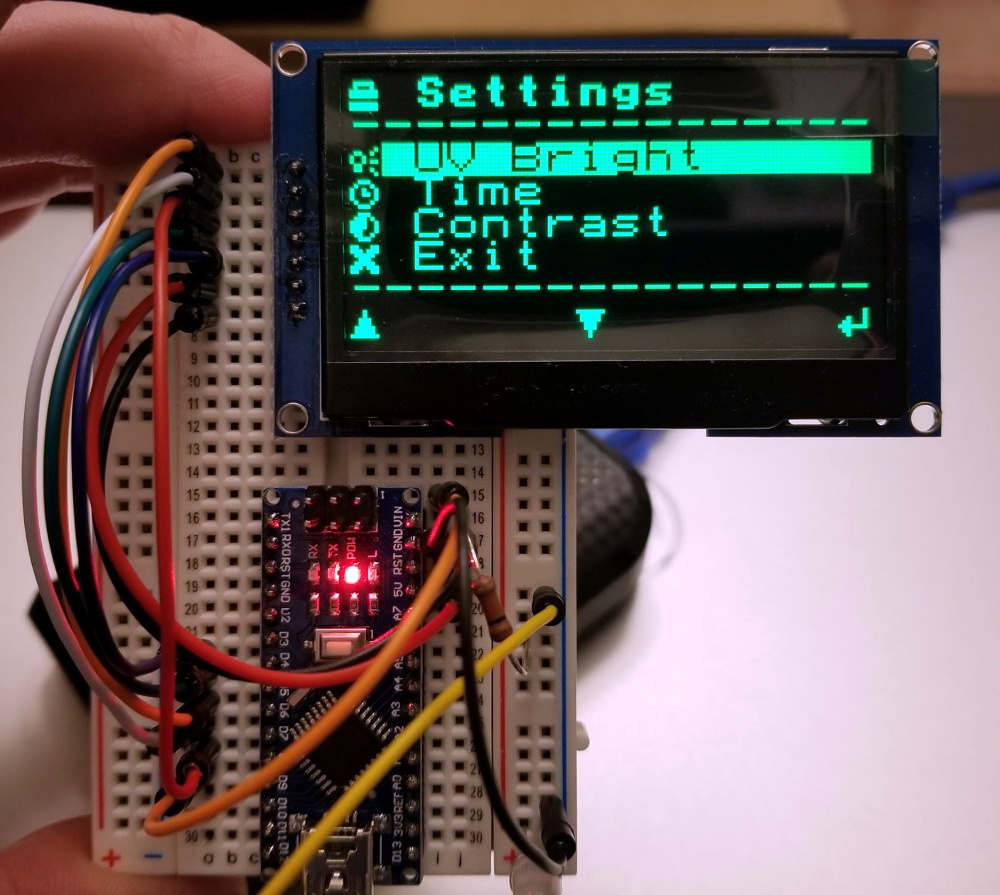
An earlier prototype build of the interface.

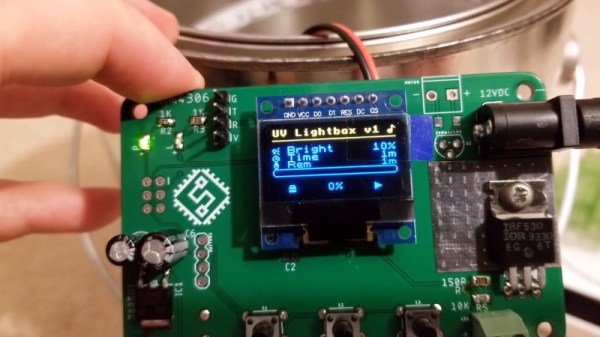
To that end, [sjm4306] is working on a very impressive controller for all your homebrew UV curing needs. The device is designed to work with cheap UV strip lights that can easily be sourced online, and all you need to bring to the table is a suitable enclosure to install them in. Here he’s using a metal paint can with a lid to keep from burning his eyes out, but we imagine the good readers of Hackaday could come up with something slightly more substantial while still taking the necessary precautions to not cook the only set of eyes you’ll ever have.

Of course, the enclosure isn’t what this project is really about. The focus here is on a general purpose controller, and it looks like [sjm4306] has really gone the extra mile with this one. Using a common OLED display module, the controller provides a very concise and professional graphical user interface for setting parameters such as light intensity and cure time. While the part is cooking, there’s even a nice little progress bar which makes it easy to see how much time is left even if you’re across the room.

At this point we’ve seen a number of hacked together UV cure boxes, but many of them skip the controller and just run the lights full time. That’s fine for a quick and dirty build, but we think a controller like this one could help turn a simple hack into a proper tool.

Continue reading “A Smart Controller For Your DIY UV Cure Box”

Custom Reddit Keyboard Only Needs One Hand

Sometimes you might want to browse your favorite social media site while eating a sandwich, or throwing darts, or fending off an attacker with a sword. You know, normal things that might occupy only one of your hands. If you’ve ever found yourself in such a situation, then this custom Reddit keyboard could be for you.

Built by [jangxx], this little board is about as simple as it gets. Even if you aren’t looking for a way to browse /r/cooking while practicing your single-handed egg cracking technique, the same principles could be used to quickly throw together a macro keyboard for whatever your particular needs might be.

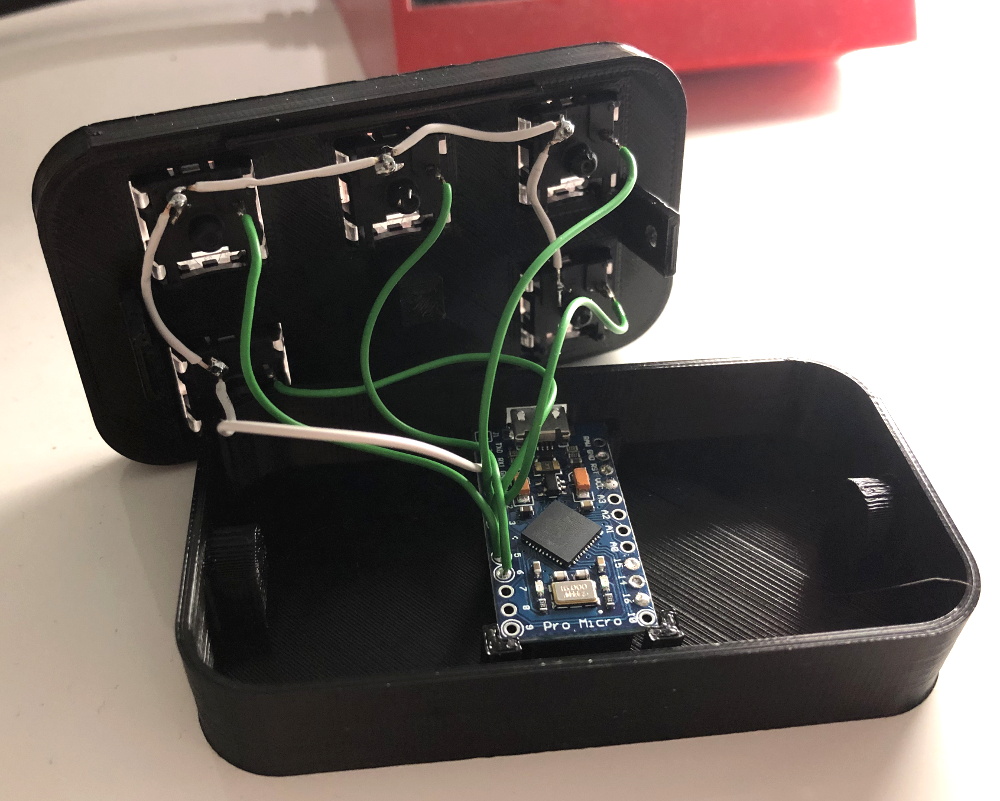
Inside the 3D printed enclosure is nothing more exotic than an Arduino Pro Micro and five Cherry MX Red switches. The switches have been wired directly to the GPIO pins on the Arduino, and a simple Sketch takes care of the rest. [jangxx] has written the code in such a way that you can easily define the mapping of USB HID keys to physical switches right at the top of the file, making it easy to reuse for your own purposes.

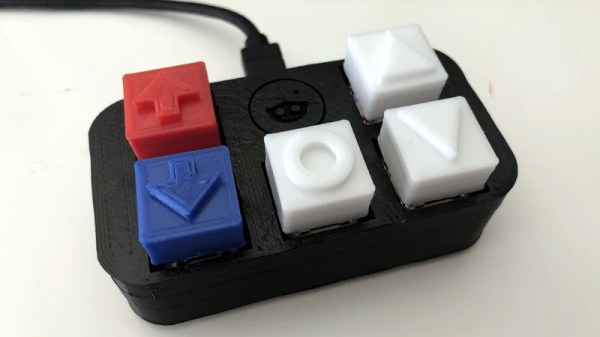
As simple as this project is, we really like the trouble that [jangxx] went through on the 3D printed key caps. The white up and down arrows allow you to navigate through the posts, and the center key selects the one you want to view. Since it’s for Reddit, naturally the red and blue buttons for rapid voting. When you want to go back to the list of posts, just hit the center button again.

Back in 2011 we saw a dedicated Reddit voting peripheral, but we think the addition of simple navigation keys makes this project a bit more compelling. Incidentally, if you can think of any other reason you might want a one-handed keyboard for browsing Reddit…we definitely don’t want to hear about it.

Northrop Grumman Tests Space Tow Truck

In the early days, satellites didn’t stick around for very long. After it was launched by the Soviet Union in 1957, it only took about three months for Sputnik 1 to renter the atmosphere and burn up. But the constant drive to push ever further into space meant that soon satellites would remain in orbit for years at a time. Not that they always functioned for that long; America’s Explorer 1 remained in orbit for more than twelve years, but its batteries died after just four months.

Of course back then, nobody was too worried about that sort of thing. When you can count the number of spacecraft in Earth orbit on one hand, what does it matter if one of them stays up there for more than a decade? The chances of a collision were so low as to essentially be impossible, and if the satellite was dead and wasn’t interfering with communication to its functional peers, all the better.

The likelihood of a collision steadily increased over the years as more and more spacecraft were launched, but the cavalier approach to space stewardship continued more or less unchanged into the modern era. In fact, it might have endured a few more decades if companies like SpaceX weren’t planning on mega-constellations comprised of thousands of individual satellites. Concerned over jamming up valuable near-Earth orbits with so much “space junk”, modern satellites are increasingly being designed with automatic disposal systems that help make sure they are safely deorbited even in the event of a system failure.

That’s good news for the future, but it doesn’t help us with the current situation. Thousands of satellites are in orbit above the planet, and they’ll need to be dealt with in the coming years. The good news is that many of them are at a low enough altitude that they’ll burn up on their own eventually, and methods are being developed to speed up the process should it be necessary to hasten their demise.

Unfortunately, the situation is slightly more complex with communications satellites in geosynchronous orbits. At an altitude of 35,786 kilometers (22,236 miles), deorbiting these spacecraft simply isn’t practical. It’s actually far easier to maneuver them farther out into space where they’ll never return. But what if the satellite fails or runs out of propellant before the decision to retire it can be made?

That’s precisely the sort of scenario the Mission Extension Vehicle (MEV) was developed for, and after a historic real-world test in February, it looks like this “Space Tow Truck” might be exactly what we need to make sure invaluable geosynchronous orbits are protected in the coming decades.

Continue reading “Northrop Grumman Tests Space Tow Truck”

A DIY Stun Gun You Probably Shouldn’t Build

In these troubled times, when a trip to the grocery store could turn into a brawl over toilet paper, you might be inclined to build yourself a low-cost electroshock weapon. Or at least, that’s what [Alex Zidros] did. We don’t necessarily recommend you follow in his footsteps, and we’re certainly not advocating testing it on a loved one. We just bring you this information, you have to decide what you do with it.

This is what peer pressure looks like.

So what does it take to build an improvised stun gun? Not a whole lot, it turns out. As you might have guessed, the star of the show is a high voltage transformer which supposedly puts out 400 kV. Just looking at it (and the price) we’re going to go out on a limb and say the performance specs are way overrated, but in this case that might actually be a good thing.

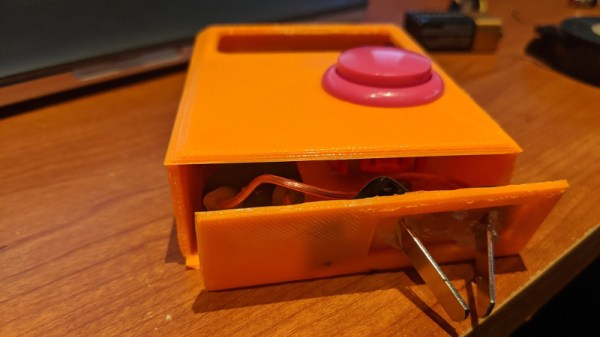
Beyond the transformer, there’s a simple 9 V battery holder and electrodes made from the prongs of a hacked up travel adapter. To deliver the lightning, [Alex] is using a pink arcade button. Just because you might be fighting for your life doesn’t mean you can’t have a little fun, right? Everything is packed into a simple 3D printed enclosure, but you could easily replace that with any suitably sized box. Something made out of wood might be a good idea, considering.

If you’d like to see another person shocked by a cobbled together high-voltage weapon, and potentially even learn something in the process, check out the “tutorial” video [Mehdi Sadaghdar] did back in 2014. We did mention you definitely shouldn’t do this at home, right?